Debt Leverage to Dissolve Native Land Holdings (1)
“Jefferson pursued expansion more aggressively than Washington or Adams had. Trading posts, for instance, switched from a way to preserve peace to a way to leverage Native land. The government, Jefferson wrote, should “be glad to see the good and influential individuals among them run in debt”—because then Native leaders would be more willing to sell.”
Agrarian Republic as Expansion Doctrine (1)
“Turning these ideas into policy kept Washington and his cabinet busy, especially his new secretary of state. Jefferson was a paradoxical politician, a practical visionary. He saw the world in timelines and tools, and he was constantly refining his use of both. Still, his goal remained the same. Jefferson wanted to expand. He wanted even more land, even if it was far in the future. This land, he believed, would support independent farmers and American ideals—an agrarian republic, an agrarian empire.”
“After departing from near St. Louis on May 14, 1804, the Corps traveled some eight thousand miles to find “the most direct and practicable water communication across this continent, for the purposes of commerce.” Those were Thomas Jefferson’s words, and the Corps was his idea. When Lewis and Clark returned, more than two years later, they did not have a Northwest Passage. But they did have an incredible tale featuring themselves as courageous explorers, skilled survivalists, underrated scientists, and peaceful ambassadors.”
“This book attempts a more accurate account of their expedition by emphasizing two ideas. The first is that, in the nineteenth century, life was shaped by land. Native people wanted it to farm and fish and trap and hunt. American people wanted it for the same reasons. Elites like Jefferson added more angles and desires—partisan quarrels, international intrigues, and legal concepts like preemption and the “right of soil.” It’s easy to think of land as the obstacle Lewis and Clark had to overcome, the mountains and rapids and rain. But land was also their motivation, along with everyone else’s. Their story was man versus nature, but it was also man versus man.”
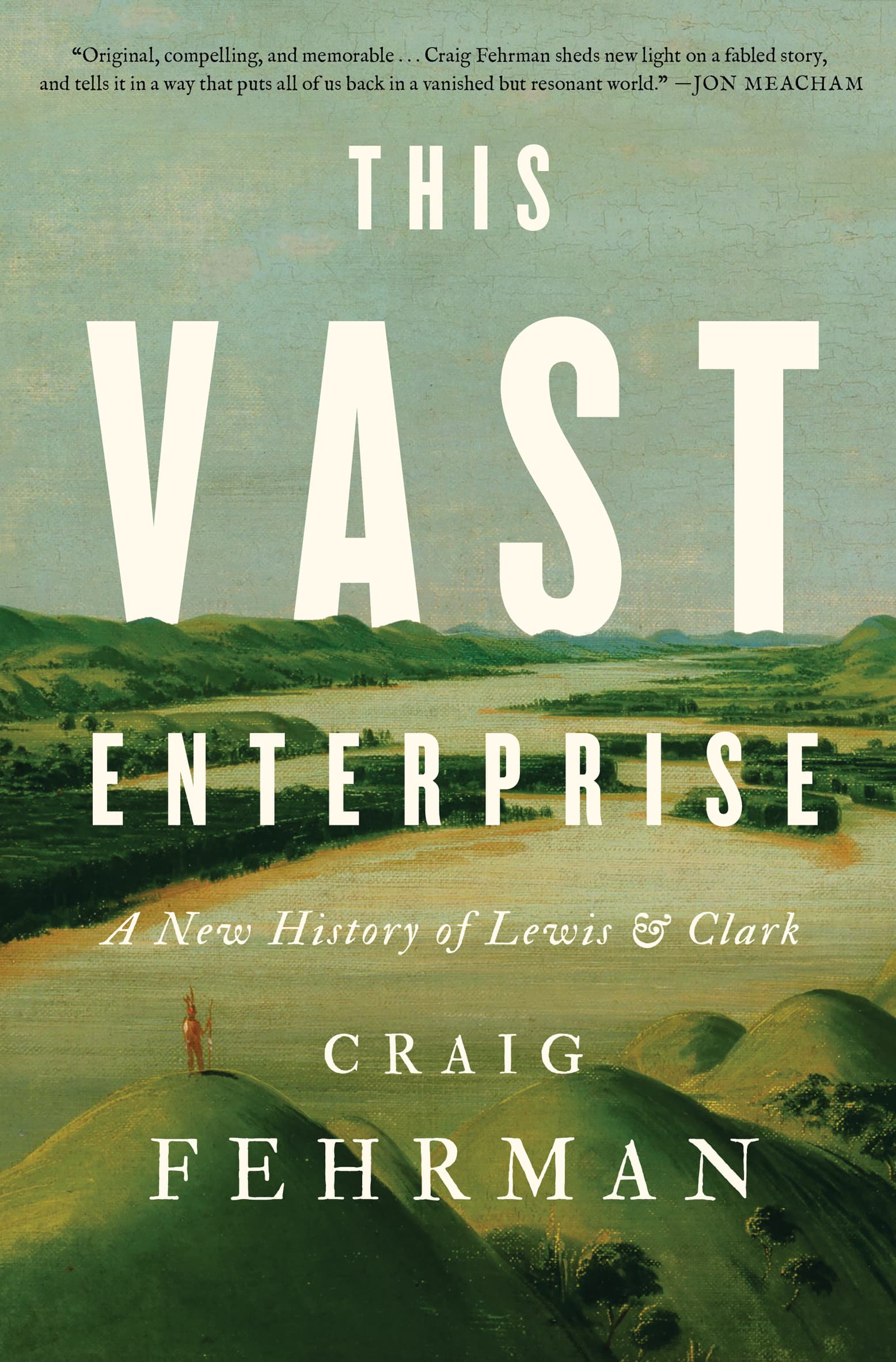
“The success of Lewis and Clark depended on more than Lewis and Clark. The captains knew this. Before they left, Clark told Jefferson he would “cheerfully, and with great pleasure, join my friend Captain Lewis in this vast enterprise.” Clark was right—it was a vast enterprise, a phrase he used more than once, a sprawling and federally funded military operation that required a broad cast of people.”
“Chapter 1: Meriwether Lewis”
“On the island, it took only seven shots to stun the locals, as Lewis efficiently obliterated a target fifty-five yards away. After he finished, one of the men asked to hold the weapon. Lewis obliged, but as the man lifted the rifle to inspect it, he accidentally fired an eighth shot.
The bullet hit a woman forty yards away, and she crumpled instantly. Her hat obscured her face, but even from a distance Lewis could see blood spurting out. His first thought was that she was dead.
People started screaming, but Lewis acted quickly, sprinting toward her, removing the hat, and noting that she was unconscious. Before he could do more, the woman revived. To everyone’s relief, especially Lewis’s, she seemed fine. The air rifle had only nicked her, which meant Lewis’s expedition had begun not with a grisly death but a near one.
It was a reminder that even the easy, preliminary parts of this journey would not be easy. Lewis lingered on the island to study the woman and, perhaps, to quiet his mind. Then he returned to his boats and headed west.”
“Lewis was smart, and he loved to learn. But he lacked a parental anchor. He lacked support. Even by the standards of his era, he grew up quickly, and he grew up alone. “What language can express the anxiety I feel to be with you,” he wrote to Lucy, in a letter composed when he was fourteen. The gifted student could not find the words, and he shoved the feeling away: “As it is now a thing impossible, I shall quit the subject and say nothing more.””
“The flush of new love wore off, only to reveal something deeper. The army gave him structure. It gave him purpose, what he called “the glorious cause of liberty and my country.” To Lewis, liberty and country were more than ideas. They were ideals, and he felt them as intensely as he felt everything else.”
“Lewis extended his tour, then extended it again. He rose to ensign and switched to the regular army. He celebrated Christmas in a small hut with a quart of rum. His attachment to the army did not make rational sense. (Lewis hired an overseer at Locust Hill, paying the man more to do his old job than he made at his new one.) But it made emotional sense. Military life, he explained to Lucy, satisfied his “governing passion for rambling.” It also gave him a place that felt like home.”
“Lewis’s intelligence and drive led Jefferson to expand his duties, especially regarding Congress. The Capitol sat a mile and a half from the White House, connected by a mostly empty Pennsylvania Avenue that alternated between dusty and marshy, depending on the rain. Lewis carried messages back and forth, noting the partridges that resided along the avenue. (Legislators loved to hunt them.) He tracked congressional debates and met privately with key figures. His demeanor, remembered a charmed senator, was “easy and unaffected.””
“That changed with a surprising job offer. In the election of 1800—an ugly and polarizing affair, with Jefferson and the Democratic-Republicans facing off against John Adams and the Federalists—Jefferson won the presidency. Before his inauguration, he wrote to Lewis and asked him to be his private secretary.
Jefferson admired Lewis’s “knowledge of the western country, of the army and of all its interests.” Mostly, though, he needed someone he could trust. America remained angry and divided. When a Federalist senator learned that a sympathetic Supreme Court justice was sick, he responded with partisan calculation: “God grant him a life as long as Jefferson.” Outrage and ideological fracture cropped up everywhere. Politics was almost certainly the cause of the argument that led to Lewis’s court-martial.”
“The key thing, from the president’s perspective, was that Lewis had been arguing the Democratic-Republican side. Jefferson promised that, as secretary, Lewis would “know and be known to characters of influence.” The pay wasn’t much, but he could save on expenses by living at the White House. As Jefferson put it, “you would be one of my family.””
“The fur trade seemed simple enough. Traders wanted furs they could sell for a profit, including beaver and buffalo. Native people wanted manufactured goods, including metal tools and metal weapons. But complications lurked around every riverbend. A Native nation might want to block its rivals from getting gunpowder and bullets. A European nation might want to encroach on another’s network. America needed to know more. It needed information.”
“Lewis was just as concerned, but he refused to rush. Perhaps he couldn’t. Faced with limited space and an unlimited range of potential disasters, Lewis sought the comforts of reason, of micromanagement. To store gunpowder, he designed watertight cases out of lead that, once empty, could be melted into additional shot. He tracked down thirty-two canisters of portable soup, a salty and gelatinous concentrate that could be reconstituted into emergency rations.”
“He adapted. He improvised. He persevered.”
“These incidents weighed on Lewis. He tended to personalize his problems and doubt his decisions. He was comfortable around senators. He seemed less so with his men.”
“When Lewis asked a corporal to buy bread, there was a mix-up, and the corporal returned with no food. Lewis snapped, giving the soldier a “sharp reprimand” for his “negligence and inattention.” He sent him back for the bread.
The corporal was gone for one hour, then two. It began to rain, heavy and cold, and it did not let up. Before he went to sleep, Lewis had to wring the water out of his clothes.
The captain kept thinking about his response to the corporal. Had he been too harsh? Would he be able to lead effectively in the months ahead? In his journal, Lewis wrote that he was beginning “to fear that [the soldier] was piqued”—that he “had deserted.”
The next morning, the corporal returned with the bread. The rain stopped, and the party resumed.”
“Rodney checked in on the captain and his growing fleet, and they ate slices of sticky watermelon on the barge. Lewis showed him the air rifle, which went better and worse than the first demonstration—better because no one got shot and worse because the rifle kept leaking pressure, even after the captain pumped it until his arm ached. Later, in his own journal, Rodney recorded his assessment: “Captain Lewis is a stout young man, but not so robust as to look able to fully accomplish the object of his mission. Nor does he seem to set out in the manner that promises a fulfillment of it.””
“And yet, after Wheeling, things got better. The river level rose. The men listened. The barge began averaging twenty miles a day instead of ten. Lewis experimented with the sails until a sprit cracked. Once more, he adapted, letting out less sail, wrapping his tools in the oiled linen to stop the rust, and commanding Seaman to dive in after the plump squirrels, which were delicious when fried.”
“Everything in the Ohio River Valley seemed to be growing—the vines as thick as a man’s thigh, the corn twelve feet tall—but nothing was growing as fast as its population. When locals met a new neighbor, they asked: “From what part of the world did you come?””
“In 1787, Congress passed the Northwest Ordinance, which created a system for converting that side into tidy farms and future states. The ordinance said Native land would “never be taken from them without their consent.” But that was the theory of America’s political elites. The practice of America’s settlers was that, almost immediately, thousands of them began pouring into Shawnee territory, squatting where they wanted and daring the Natives or, for that matter, their own government to do something about it.”
“The government launched two major offensives, which led to two major defeats. The first was suffered by Josiah Harmar in 1790. The second was suffered by Arthur St. Clair in 1791, with St. Clair’s being by some measures the worst defeat in American military history.
The Americans pivoted to diplomacy, trying to buy the confederacy’s land. But no matter how badly they wanted that land, and no matter what they offered, they found it was not for sale. The Shawnee said no, and that was that.”
“It was a cycle of violence, a brutalizing back-and-forth. In 1794, a third general, Anthony Wayne, launched a third offensive and defeated the confederacy at the Battle of Fallen Timbers. The next year, both sides signed a treaty at Fort Greenville. The Americans offered annual payments for the territory that would become much of Ohio, a swap that proved disastrous for the Shawnee.
Even that treaty wasn’t enough for the settlers. As Natives were also learning in Georgia and New York, American treaties did not hold. George Washington was learning the same thing. In private, the president complained that “scarcely anything short of a Chinese wall, or a line of troops, will restrain land jobbers and the encroachment of the settlers upon the Indian territory.””
“After several pages, Lewis paused to laugh at himself: “So much for the great outlines of this scheme.” Then he wrote the hardest sentence, the one asking Clark if he would join him as co-captain: “If therefore there is anything under those circumstances, in this enterprise, which would induce you to participate with me in its fatigues, its dangers, and its honors, believe me there is no man on earth with whom I should feel equal pleasure in sharing them as with yourself.””
“They started collaborating right away, exchanging letters while Lewis waited on his boatbuilders (“incorrigible drunkards”) and as he slalomed through the sandbars of the Ohio. Their most pressing concern was recruitment. Lewis explained what he wanted: “stout, healthy, unmarried men, accustomed to the woods and capable of bearing bodily fatigue in a pretty considerable degree.” He explained what Clark could offer—not just money but land, with Jefferson promising each man a plot equal to the ones received by veterans of the Revolutionary War.”
“In America, the present overwhelmed the past. While a few states had begun the slow process of abolishing slavery, Virginia and its planters viewed it as economically essential. The Clarks lived a comfortable life—they wore satin to local balls, poured tea out of a silver pot—but they wanted more.
Slavery was how they got it. John Clark saw his slaves as property, not people. He fought a lawsuit for decades to retain possession of two enslaved people. (One of his attorneys was a young Thomas Jefferson.) While John was a warm father to his ten children, he was fine with ripping Black families apart when it improved his finances. Whatever it took to keep climbing, to keep his property productive, he would do. The Clarks beat their slaves—certainly with a cowhide whip, but also perhaps with a bundle of switches cured by the fire or with any household object so long as it was blunt and heavy and at hand.”
“At some point, York fell in love. This was a dangerous thing, as every enslaved person understood—one more intimacy an owner could ruin. (When a Black preacher performed weddings in Kentucky, his vows said “until death or distance do you part.”) In York’s case, the danger was doubled because he fell for a woman who was enslaved by a different family, which left them exposed to the whims of two owners. But there was beauty in that danger: In a system designed to destroy their freedom, York and his wife made their own choice.”
“Clark whipped a woman named Easter because she “cut a few capers.” “I gave her a very gentle whipping,” he wrote—gentle because Easter was around eight months pregnant at the time. Clark placed ads to recapture runaway slaves, including one that described Juba, another of York’s siblings: “He has a scar in one of his eyebrows and, when confused, stutters a little.” Such stutters were common among American slaves, a symptom of their psychological torture. Clark threatened to sell his slaves down south, to send them to a place known for cruel owners and demanding crops. At least once, Clark did try to sell such a slave—Scipio, another of York’s siblings. According to one contemporary, on the way to New Orleans, Scipio killed himself.”
“That was only Clark’s view. In truth, York had found another way to make a choice of his own. He could have been a bad body servant, accepting a few beatings and an eventual demotion to a lifetime of clearing Kentucky scrub. Instead, he decided to become a superb body servant, attentive and obedient. York succeeded because of his intelligence—because of his willingness to shrink himself in Clark’s eyes, to play a part—and that part lifted him from scratchy homespun to elegant suits, from a dirt-floor cabin to the Jefferson White House. In a brutal and restrictive system, York excelled, though always with an understanding that his choices came with real limits and psychological costs.”
“Two days later, they entered the Mississippi and began to ascend. On this river, the right bank belonged to the United States. The left bank belonged to France, notionally, at least, though Spanish officials were still the ones in charge. York saw more farmers and traders and camps of Shawnee, displaced by decades of war. All of them depended on this mighty and muddy river, with a current so powerful it could carry the barge faster by itself than the combination of current and sail had on the Ohio.”
“Chapter 3: Thomas Jefferson”
“To understand Lewis and Clark, you need to understand how Jefferson did this, which turned out to be surprisingly messy. You need to understand *why* he did it, which turned out to be messier still. Jefferson, like every president, woke up each morning and faced an endless list of problems and pressures: pirates in North Africa, Native nations to the west, Napoleon Bonaparte everywhere, and reflexive partisanship at home. “When the Federalists commend me,” wrote Samuel Mitchill, a Democratic-Republican, “I feel uneasy and inquire whether I have been doing wrong.””
“Years later, the purchase and the expedition seemed like two steps in an orderly plan. But that wasn’t true. Jefferson started working on the expedition first. In fact, he started working on it decades before, a long process that culminated in a few frantic weeks at the start of 1803. The Louisiana Purchase was a flash of good luck; the expedition was a lifelong obsession. They both mattered, but the expedition (and the fight to fund it) provided the better glimpse of an elusive president—of his ambitions, his contradictions, and his ability to wield power.”
“America’s first president, of course, was George Washington, and once he took office, in 1789, he created all sorts of precedents. A crucial one was the federal stance toward Natives. Washington and his secretary of war, Henry Knox, worried about America’s global reputation and its greedy settlers. “It is a melancholy reflection,” Knox wrote, “that our modes of population have been more destructive to the Indian natives than the conduct of the conquerors of Mexico and Peru.””
“To slow this destruction, and to consolidate his authority, Washington decided to treat Natives as independent entities—“as foreign nations,” in Knox’s phrase. This approach followed the law of nations, a loose set of imperial concepts from European intellectuals like Emer de Vattel. It also ensured that the federal government would handle all wars and treaties and, thanks to Article I, Section 8 of the Constitution, all commerce. Knox and Washington still wanted land, after all, but they wanted to secure it through economic means—by buying parcels, pushing agriculture, and building goodwill via government-funded trading posts, where Natives could find manufactured goods at subsidized prices.”
“Jefferson went first. He remained tall and thin, though his red hair was going gray. In a quiet voice, he restated the government’s position, under the law of nations, to honor Native autonomy. Americans needed to remember, he argued, “that the Indians had the full, undivided, and independent sovereignty, as long as they chose to keep it; and that this might be forever.”
Jefferson had always excelled at declaring independence. But this time there was a catch. The law of nations did not grant Natives full equality. Instead, it conveyed shades of sovereignty through a knotty but essential concept, what Jefferson called “our right of preemption.””