Wang Xing
Strategic Concepts & Mechanics
Primary Evidence
"The protagonist of this book—Wang Xing—is precisely a great learning example. Born in 1979, Wang Xing started his entrepreneurial journey early. In 2004, he began a venture with classmates and launched the social network Xiaonei in 2005. In 2007, he founded Fanfou, one of the earliest Twitter-like platforms in China. In 2010, he founded Meituan. Both Xiaonei and Fanfou had regrets in Wang Xing’s entrepreneurial journey, not reaching a perfect conclusion. However, Meituan carved a bloody path out of over 5,000 group-buying websites and has become one of the most watched startups to date. By July 2014, Meituan’s monthly transaction volume exceeded 3.9 billion yuan."
"His biggest dilemma was: I’ve seen the big trend, but which niche market within this trend should I target?"
"You should create a website for a segment of people. Websites made for everyone usually seem irrelevant to everyone."
"Fourth, leading by example is not the best way to shape company values, it is the only standard."
"Even the best product needs promotion. Perfect products, killer apps, things everyone loves. But in fact, it’s unnecessary. First make features that satisfy the core needs of users, the rest can be quickly iterated and improved through user use. More users make the app more usable."
"Don’t innovate blindly; learn from others when necessary. Undoubtedly, they imitated Facebook, and while saving costs, they achieved a first-rate UI experience at the time."
"Third, the duties a CEO cannot delegate include: designing the overall vision and all strategies of the company, ensuring they are communicated to all stakeholders, not only management but all employees, and beyond those internally, including shareholders, consumers, merchants, and partners; recruiting and retaining the best people; ensuring the company always has enough funding."
"Wang Xing and others realized that resolving disagreements among partners is a key basis for establishing a company’s governance structure, where everyone “bets and accepts loss.” Ultimately, the CEO decides who decides on matters, which is the game rule that everyone acknowledges."
"Wang Huiwen later understood why Wang Xing wanted him to start the business. On one hand, Wang Huiwen was also an entrepreneurial enthusiast; on the other hand, during lab courses, they often partnered, with Wang Xing coming up with ideas and Wang Huiwen executing them. “Wang Xing’s father is an entrepreneur, and being an entrepreneur doesn’t require hands-on involvement in everything. I am the son of a farmer, and my background left a mark on me that I must work diligently.”"
"Wang Xing did not participate in programming, and neither Wang Huiwen nor Lai Binqiang complained. They understood that this was something the team had to do. No matter what, someone must not get entangled in daily technical work. If everyone was focused only on technology, they would have no opportunity to pay attention to the outside world, become disconnected from it, and create products that only met hypothetical needs, missing possible major trends of the times."
"In fact, for a young entrepreneur, the choice of partners is usually limited to classmates or colleagues because these are the people he can frequently interact with, allowing for a better understanding of each other. It’s hard to build deep trust with other relationships. When the team is small, trust based on personal relationships is crucial because starting a business is difficult, starting from nothing, facing numerous setbacks. Only with mutual trust can they support each other and overcome challenges."
"Second, respecting the spirit of contracts and the established rules of the game among all is fundamental, without which entrepreneurship cannot be discussed."
"When Wang Xing and his peers were still studying at Tsinghua, a startup team became famous, but it didn’t go well later. Someone wrote an article analyzing why they didn’t succeed, one reason being that the founders had identical shares. People realized that within a startup team, there must be a major shareholder and someone who can make decisions."
"The reason for the failure was that they hadn’t determined how long each person could endure the uncertainty of starting a business. Could they handle not making money for a year? Two years? How about ten years? Some could endure long periods, while others couldn’t."
"They understood the pulse of the times. Starting a business in line with the trends of the times is comfortable and can lead to achieving twice the result with half the effort; if it runs contrary to the trends, the startup struggles and achieves half the result with twice the effort."
"You must start a business with people you trust; only trust can keep the team steadfast during low periods. In Wang Xing’s later entrepreneurial experiences, this was particularly validated."
"Don’t idealize capital too much. It’s better to approach capital earlier, lower your stance, and make some compromises."
"After Lai Binqiang arrived, he took charge of the front-end code, while Wang Huiwen handled the back-end code. Wang Xing was freed to observe the external world, understanding global product and market changes."
"How can one have foresight? You won’t develop foresight by not observing the outside world every day and just working hard."
"While fascinated by games, Wang Huiwen felt that the games were not good enough and wanted to learn programming to create games himself. Wang Xing told him that he had considered becoming a programmer in high school, but now he had changed his mind and wanted to start a business. Regarding entrepreneurship, Wang Xing had thought about it quite early. Instead of being a computer enthusiast, he might be better described as an entrepreneurship enthusiast. Wang Xing later said: “I don’t consider entrepreneurship itself to be a particularly remarkable thing; it’s just the lifestyle I chose. I never thought about what it would be like if I didn’t start a business. Entrepreneurship feels like being struck by lightning; I have to do it.”"
"His intelligence more so derives from a set of effective thinking patterns gained through long-term training. This long-term refers to his childhood, student days, and even post-entrepreneurship."
"Since July 2013, in order to write this book, I often stayed at Meituan’s office in Beichen Taiyue Building around 9 PM, interviewing almost all the senior executives of Meituan. They often just finished meetings then, and sometimes we talked until one or two in the morning before going home. I remember once chatting with Meituan’s Vice President of Sales Yang Jun, discussing from Xiaonei to Fanfou to Meituan, where he had been, and we talked for more than five hours. We are neighbors, and when we returned to the community together, it was already 2:40 AM. Yang Jun, known as a “hard worker,” texted me at 9 AM the next day: Haha, I’m already at the office having a meeting."
"In March 2011, Meituan was still vying for third place in the group-buying industry. A Meituan employee asked me, “Do you think there’s a chance with Wang Xing?” I replied, “I have confidence in Wang Xing, as he has made almost all the mistakes an entrepreneur can make. First, he has foresight; second, he will no longer be short of money; third, his team is still there.”"
"If Meituan can win this competition, it will be an O2O giant; if not, it will have to settle as a small feudal lord in the Spring and Autumn Warring States period."
"First, past long-term experience isn’t the most important; rapid learning ability is a key factor in determining a person’s current situation and future prospects."
"From Xiaonei to Meituan, Wang Xing’s early entrepreneurial partners are still there, and they are now key figures at Meituan. Although some left midway (to start their own businesses or work elsewhere), they eventually reunited at Meituan. Meituan is a story of great reunion; the original entrepreneurs gathered due to ignorance, parted ways due to differing interests, and finally reunited at Meituan. On March 1, 2014, I asked Wang Xing, “What is the reason for your reunion at Meituan?” Wang Xing said four words: contract spirit!"
"“When everyone is entering this industry, we need to perform better. If we cannot do better, we are in a very dangerous situation. It is no exaggeration to say that Meituan is always only six months away from bankruptcy. This is not alarmism or implying that Meituan is unreliable, and there is no need to worry about it. Instead, we should embrace it. If you are at another company that believes it can rest easy, then it is not far from its demise. It’s not that Meituan is unreliable, but that the industry, this era, and the world change incredibly fast. Companies without a sense of crisis that do not tread cautiously are extremely dangerous, even more so than those that are small yet remain highly vigilant.”"
"This book tells the entrepreneurial story of Wang Xing from 2004 to 2014, inevitably involving stories from his younger years. If I were to summarize the entrepreneurial experiences of Wang Xing over the past ten years, it would be as follows:"
"After eating the fifth bread, your stomach is full. However, without the first four pieces of bread, eating the fifth one alone wouldn’t satisfy you. Those scientists, inventors, and entrepreneurs who left records in history all went through a treacherous road of failures before succeeding. These failures led them to success. Take Wang Xing, for instance— Before Xiaonei, nearly ten projects failed because the direction was wrong. Xiaonei, the team was good, the direction was correct, but there was a lack of funds. Fanfou, no lack of funds, the team was fine, the product was decent, the timing was right, but there was a lack of political understanding. Hainei, no lack of funds, the direction was correct, the team was fine, the politics were in order, but the product was poor. Meituan, no lack of funds, the direction was correct, the team was fine, and the product was good. Thus, Meituan succeeded."
"Meituan, which secured first place in the small group-buying market, has leaped into a vast new arena: O2O, Online To Offline. This connects consumers and merchants through the internet and mobile internet, cutting out high-loss and inefficient segments of traditional offline industries. The earliest representative of O2O enterprises would be Ctrip. Due to the development of smartphones and mobile internet in recent years, along with the improvement of mobile positioning and payment technologies, O2O has entered an era of explosive growth."
"“In 2014, we face unprecedented and exceptionally formidable internet competitors. I believe this is an honor because such opportunities are rare.”"
"More typically, every venture he undertakes leads the wave of imitation in China’s internet scene. Renren, akin to Facebook, led the campus SNS wave; Fanfou, similar to Twitter, led the microblogging trend; Meituan, similar to Groupon, pioneered the group buying wave. His grasp of American internet trends is very accurate, and when transplanted to the Chinese internet, the products he made were outstanding. There is a lot of replication of foreign websites in the Chinese internet, many people only jump in when they see someone doing it successfully. Discovering an opportunity first once may be luck, but Wang Xing being the first every time is quite intriguing."
"They recruited employees and formed teams in various cities, sought offline life service (catering, KTV, movies, etc.) merchant collaborations, offering discounted prices to internet users, who then paid online and consumed offline. Group buying was the hottest entrepreneurial field over the past three years, with up to 5000 group buying sites at its peak. By 2014, most group buying sites had closed, with the remainder either struggling or acquired or invested in by Baidu and Tencent. Only Meituan continued to thrive, dominating the field. In 2013, Meituan’s transaction volume was 16 billion yuan, occupying over 50% of the market share."
"If BAT (Baidu, Alibaba, Tencent) directly entered group buying and went to war with Meituan, this is Meituan’s strong suit and they are not afraid. The fear is competitors entering from outside group buying. Crises always lurk where unseen, and you can’t predict where the competitor will strike from. Wang Xing and Meituan can only work harder and move faster."
"During the wait for Fanfou’s return, to keep the team from dispersing, Wang Xing and his team considered starting another project, which led to Meituan. On March 4, 2010, Meituan went live. This Groupon-like website introduced the concept of group buying to China. This team that had launched Xiaonei and Fanfou turned to build a substantial company."
"“Similarly, we must thank all colleagues present and not present, as well as those who have been with Meituan and are no longer with us. Some of their departures are regrettable; I believe that many of them may have made a wrong choice, but we still respect their decisions. As long as they are still connecting people and merchants, using the internet to change the world and make life better, we respect them. But we believe that we, remaining together, will defeat all competitors, including our former colleagues, and become number one on the path we choose.”"
"Although Xiaonei did not continue to develop independently under Wang Xing, it allowed Wang Xing and his team to earn their first pot of gold."
"From 2007, Wang Xing successively founded Fanfou and Hainei. Fanfou was a website similar to Twitter, one of China’s earliest microblogging sites. Hainei was an SNS site aimed at office workers. During Fanfou’s plateau, Wang Xing focused his efforts on this site."
"Three years later, this entrepreneur, 35 years old with 10 years of entrepreneurial experience, exuded a stronger presence, ambitious and seemingly holding the world in his chest. There is an old saying, money gives courage. Similarly, in entrepreneurship, each successful decision builds the entrepreneur’s confidence. Presence comes from past validation and a grasp of the future."
"“I hope to see this book soon. In the first two or three years of entrepreneurship, it’s all about repeatedly trying directions, often digging in one direction for half a year without finding gold, then quickly switching to another direction. I really hope to see what failures Wang Xing encountered in his ten years of entrepreneurship, to learn from them and avoid detours.”"
"The non-delegable duties of a CEO are: designing the overall vision and all strategies of the company, ensuring they are communicated to all stakeholders, not just the management, including all employees, not just internal people, but also shareholders, consumers, merchants, and partners; attracting and retaining the best talent; ensuring the company always has sufficient funds."
"Past long-term experience is not the most important; the ability to learn quickly is crucial in determining a person’s current development status and future prospects."
"The group-buying competition in recent years can be divided into three stages. The first stage relied on capital expansion; whoever had more money and could quickly build an offline team could gain more market share. The second stage relied on merchant expansion; whoever could secure more quality merchants and offer consumers more choices could gain more market share. The third stage emphasized product innovation and technological capabilities. Serious homogenization among merchants on group-buying websites meant that if a product’s user experience was better, and the backend verification, refunds, and checkout process was faster, more consumers and merchants would gravitate towards that website."
"In the second half of 2011, the winter did indeed arrive. Group-buying websites fattened by capital quickly revealed their false prosperity, beginning large-scale layoffs and merchant payment defaults. At this time, Meituan launched a winter offensive, with ground promotion staff working overtime to visit merchants and secure deals, thus pushing Meituan to industry leadership through a series of strategic moves."
"In July 2011, after completing the $50 million Series B financing led by Alibaba, the initial $10 million financing still lay in the account. Wang Xing even disclosed bank accounts in a press conference to prove that their financing was real. At that time, Meituan also predicted an impending capital market winter for group buying."
"In 2012, after two years of exploration, Wang Xing proposed the “three highs and three lows” theory of group buying, with a more independent understanding of group buying that even diverged from Groupon, the initial mentor of Meituan. Groupon is a high-margin, high-cost company, whereas Meituan is positioned to provide high-quality, low-cost services to consumers; for this, they achieve high efficiency and low cost; high technology and low margin."
"Wang Xing’s first breakout entrepreneurship project was Xiaonei, a social networking service (SNS) website for college students, similar to Facebook. Before creating Xiaonei, Wang Xing and his team had explored and abandoned nearly ten projects, one every two months on average. Xiaonei was founded in 2005, but due to Wang Xing’s lack of experience and inadequate financing, the funding chain broke. In this situation, Xiaonei was sold to Chen Yizhou’s Oak Pacific Interactive in 2006, becoming the foundation for what would later become Renren."
"At the end of 2009, as Wang Xing prepared to launch Meituan, he presented the “Four Verticals and Three Horizontals” theory within the company: 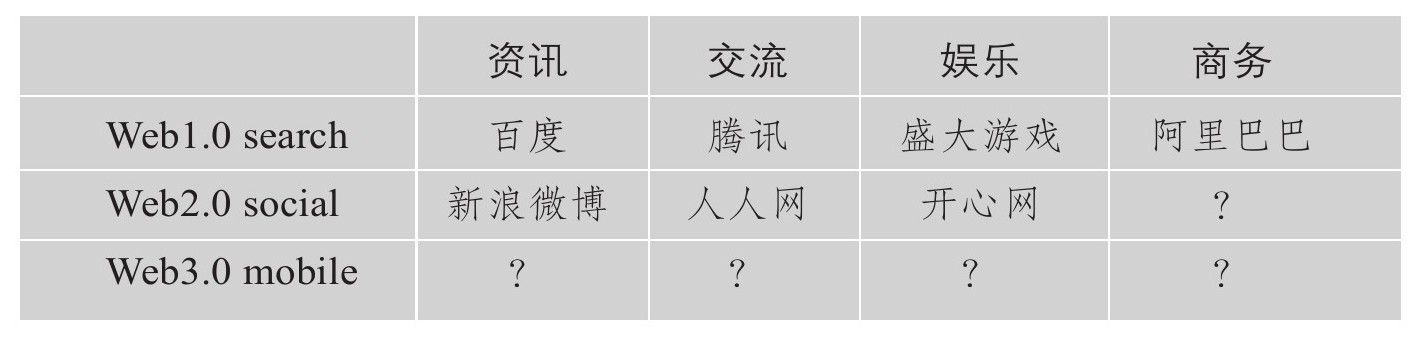 Based on the “four vertical and three horizontal” theory, he continued to elaborate on the group-buying profit model: the Internet marketing model. The first phase is portal websites, with the profit model being display advertisements, targeting large enterprises capable of placing expensive ads. The second phase is search engines, serving small and medium-sized enterprises. With just tens of thousands of yuan, you can buy keywords and advertise, significantly lowering the threshold and increasing precision. The third phase is group buying, promoting to consumers more precisely through transactions, serving local small businesses. This forms a pyramid, with group-buying service businesses at the base, portal service businesses at the top, and search engine service businesses in the middle. The group-buying profit model reduces merchants’ advertising expenditure, giving some profit back to consumers, while group-buying websites also share in the profits."
"Conversely, how a team is can also reflect the quality of its CEO. To judge the level of a CEO, observe the caliber of the people around him. If a CEO surrounds himself with mediocre talents, his level will not rise. Only by gathering exceptional talents around himself can a CEO elevate his level."
"In the three years following Meituan’s inception, Wang Xing underwent a massive transformation—from a geek, a product manager, to an outstanding CEO and entrepreneur. I attempt to find the reasons for Wang Xing’s transformation in this book."
"I have always believed that Wang Xing is one of China’s best entrepreneurs, and there are many aspects of him that entrepreneurs can learn from. In July 2013, I persuaded Wang Xing and his team to accept my comprehensive interview to write a book about Wang Xing and Meituan. Initially, they were concerned that I might write a glorifying personal hero tribute that could mislead entrepreneurs. Fortunately, through years of interaction, they trusted my character and abilities, and finally agreed."
"From Xiaonei, Fanfou to Meituan, Wang Xing’s early entrepreneurial partners remain and are now the backbone of Meituan. On the night of March 1, 2014, Wang Xing and I chatted for four hours in a cafe in Wangjing. I asked Wang Xing, “What is the reason behind your reuniting at Meituan?” Wang Xing replied with four words: Spirit of Contract!"
"Tencent’s co-founder and CTO, Zhang Zhidong, believed that Wang Xing’s understanding of group buying surpassed that of Tencent and Groupon. “In doing group buying, Wang Xing must be better than Jack Ma and Pony Ma. In this competition, the core team’s understanding is decisive. Good execution, cost, pace, order, all well-executed. When everyone was burning money, Meituan pursued the most economical, efficient, and sustainable way.”"
"What impressed me most about Wang Xing is his learning ability. In several articles, I mentioned that in today’s entrepreneurship, accumulated experience is not the most crucial aspect, and it may even hinder the discovery of new opportunities. The most essential quality an entrepreneur should possess is the ability to learn quickly. Wang Xing is a person with a strong ability to learn. He consistently approaches the world with an open mind, and a curious perspective, exploring the essence and patterns of how the world operates."
"Over the years, I have interacted with numerous entrepreneurs, some just starting from scratch, and others busily pursuing rapid growth. They have faced various problems, such as an online education entrepreneur who said, “It took us two years of exploration to finally understand what we really wanted to do.”"
"Their confusion is not individual but shared. All entrepreneurs face these issues. Besides the examples mentioned above, there are many other problems, such as how to instill a good corporate culture, or what makes an excellent CEO."