Jonathan
Strategic Concepts & Mechanics
Primary Evidence
"Bill took great care in preparing for one-on-one meetings. Remember, he believed the most important thing a manager does is to help people be more effective and to grow and develop, and the 1:1 is the best opportunity to accomplish that. Once he became a full-time coach, he varied his approach to suit the person he was coaching. But as a CEO he developed a standard format, which is what he always taught others. He always started with the “small talk,” but in Bill’s case, the talk wasn’t really that small. Oftentimes, small talk in a work environment is cursory: a quick “how are the kids?” or chatter about the morning commute before moving on to the business stuff. Conversations with Bill were more meaningful and layered; you sometimes got the feeling that the conversation about life was more the point of the meeting than the business topics. In fact, while his interest in people’s lives was quite sincere, it had a powerful benefit: a 2010 study concludes that having these sort of “substantive” conversations, as opposed to truly small talk, makes people happier.12 From the (not so) small talk, Bill moved to performance: What are you working on? How is it going? How could he help? Then, we would always get to peer relationships, which Bill thought were more important than relationships with your manager and other higher-ups. One day, Jonathan spent part of his 1:1 with Bill talking about how he wasn’t getting any feedback from the founders on his work. What do they want? he wondered. Bill’s response was that Jonathan should not worry about top-down feedback; rather, he should pay attention to input from his peers. What do your teammates think of you? That’s what’s important! They proceeded to talk about Jonathan’s peers, how they generally appreciated the work he was doing, and what he could do better. From peer relationships, Bill would move on to teams. He always wanted to know, were we setting a clear direction for them, and constantly…"
"work more on coaching people and pairing them up on things. Don’t just be a dictator assigning tasks, pair people up! So from that point forward, for projects such as preparing material for public events like earnings calls, producing team off-sites, working on compensation and promotion ladders, and developing internal tools, Jonathan stopped dictating and started pairing people up. The results: better decisions, stronger team."
"“You get these quirky guys or women who are going to be great differentiators for you. It is your job to manage that person in a way that doesn’t disrupt the company. They have to be able to work with other people. If they can’t, you need to let them go. They need to work in an environment where they collaborate with other people.” So how do you do this? Over the years, through lots of trial and error and with a lot of advice from Bill, we learned this particular art. Support them as they continue to perform, and minimize time spent fighting them. Instead, invest that energy in trying as hard as possible to coach them past their aberrant behavior. As long as you can do this successfully, the rewards can be tremendous: more genius, less aberrant. “He has everything that he needs,” Bill once wrote Jonathan about one of his problematic team members. “Now that you fully supported him, you should try to get him to behave as a leader. He has"
"Jonathan often came to have lunch at Keigetsu with Apple founder Steve Jobs. When the number of customers rapidly declined in 2008 and the general lunch service was temporarily suspended, the store had opened exclusively for the two of them at Steve’s request (Photo 1-1). 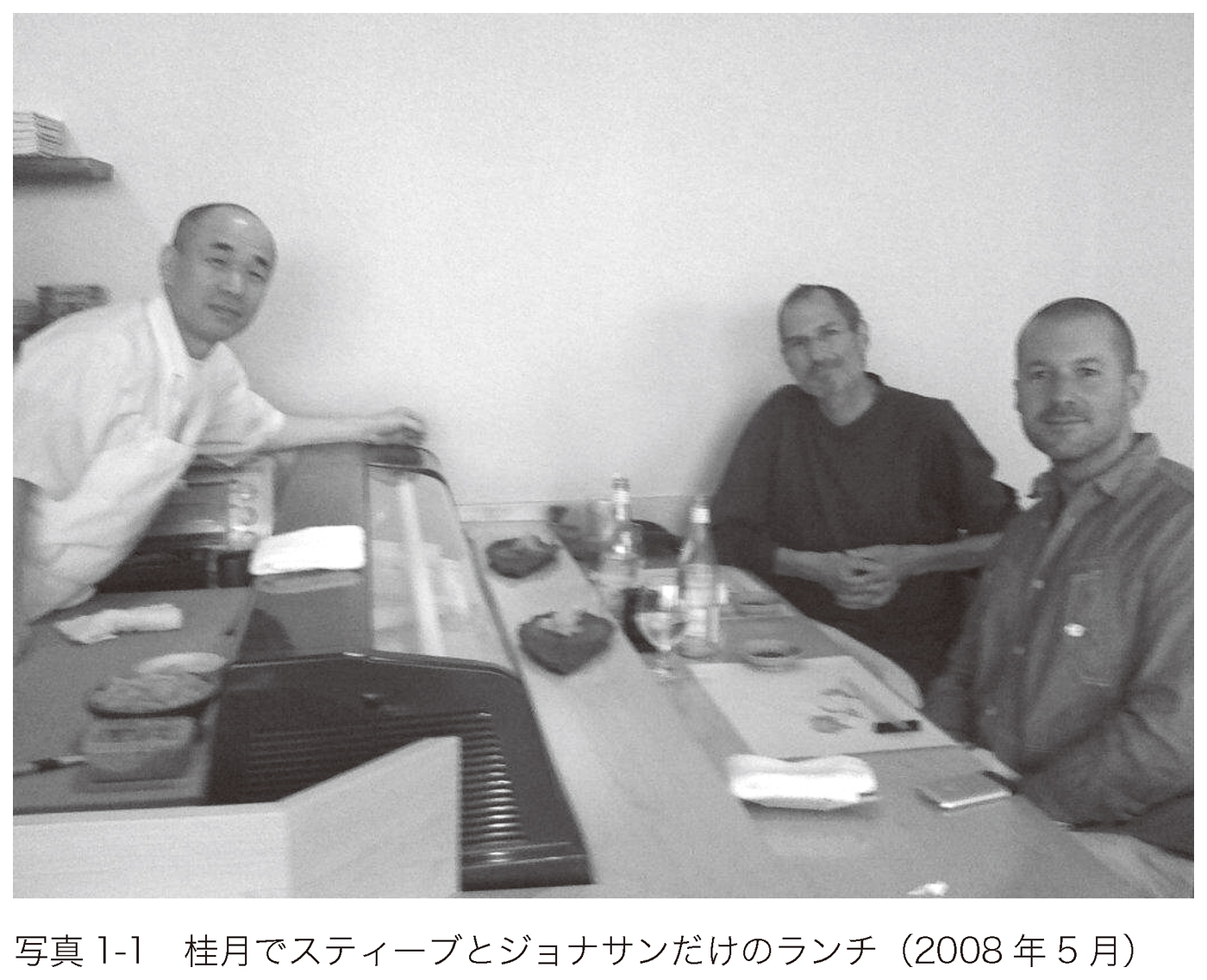 Given these circumstances, Jonathan probably visited Keigetsu with Steve the most, outside of his family."
"But when I actually face Jonathan, I still can’t bring myself to bring up the topic. What was Jonathan thinking when he made the reservation, and who was the “guest”? The truth remains a mystery."
"The secretary also emphasized further, “Jonathan says he would like the seat he always sat in with Mr. Jobs, can you arrange that?”"
"When Steve ordered “five toro,” Jonathan would follow up by saying, “I’ll have three.” Jonathan consistently came across as reserved. He was a good person who was always polite to us."
"Although Jonathan was certainly a regular customer, it was always Steve’s role to make reservations, and it was the first time Jonathan contacted us himself. (What could be going on?) This action just before closing seemed suspicious."
"On the 6th at 11:30, Jonathan did not show up at the shop. Just before, a short email from his secretary said, “Unfortunately, we have to cancel the reservation,” and we replied, “We are filled with sadness upon hearing of Steve’s passing. Our condolences.” That afternoon, amidst a store bustling with regular customers, I silently continued to make sushi while looking at the two empty seats. The same was true on the final day, the 7th. After saying tearful goodbyes, we closed the store a little earlier than usual that day."
"One more thing that still bothers me is Jonathan’s reservation, which was made for the day after Steve’s death. What was that all about? (Maybe Jonathan believed in Steve’s recovery.) (Perhaps Steve was temporarily feeling better.) (Was it simply that he intended to come with guests unrelated to Steve?)"
"Lunch Time Exclusive to Steve and Jonathan The year 2008, when the Lehman Shock occurred, was a turning point for Tsukigetsu. The impact of the Internet bubble burst in 2001 had not been felt much, but this year, from early spring, the number of customers visibly dwindled. I seriously worried, thinking, “At this rate, the store might not survive.” The decrease in the number of customers was particularly significant during lunch hours. Once I again calculated the revenues and expenditures, I found that keeping the store closed could save on labor and utility costs, thereby minimizing losses. Thus, reluctantly, we decided to temporarily suspend lunch operations. However, our decision led to unexpected events. Immediately after, such a story came to us. “Could you open the store once a week for lunch?” The client was Steve. This is how the private lunch started. Every Wednesday, Steve began to come with Jonathan, the Senior Vice President. In the silent store with no other customers, I was able to see an unexpected side of Steve."
"At Tsukigetsu, they once prepared manju as a dessert for Kaiseki cuisine, and even served it to Steve, who always ate sushi. In the beginning, he often complained, saying things like “the skin is a bit hard” or “the filling is not quite there”, which prompted us to make continuous improvements. One day, while sitting at the counter, Steve said, “It’s gradually getting better, but it’s still not up to Aono’s standard.” Then, suddenly, as if a good idea had struck him, he said, “I’ll cover all the costs, so why not send a chef out for training?” Jonathan, the senior vice president who was with him, also chimed in, saying, “That’s a great idea!” and they both got excited. When I retorted, “It can’t be that simple,” Steve was insistent, saying, “No, it’ll be fine.” From our perspective, managing the store, we had to avoid at all costs a situation where we would lose a valuable resource. Although the chef in question showed a certain eagerness to go, this “plan” was ultimately not carried out."