Jonathan's Ego-Driven Exit
Bill learned to push harder when talented people let bruised egos override what's best for the team — he kept meeting with Jonathan until he found his way back to Google.
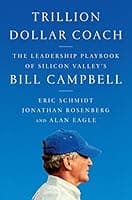
Eric Schmidt, Jonathan Rosenberg, Alan Eagle
56 highlights · 16 themes · 4 cited people/companies
Bill Campbell, legendary Silicon Valley executive coach who shaped the leaders of Google, Apple, and Intuit — the "Trillion Dollar Coach" whose behind-the-scenes guidance helped build some of the most valuable companies in history.
Bill learned to push harder when talented people let bruised egos override what's best for the team — he kept meeting with Jonathan until he found his way back to Google.
Even Bill acknowledged that brilliance doesn't justify eighteen hours a day of management damage control — when coaching can't fix the behavior, the person must go.
“FIVE WORDS ON A WHITEBOARD Our one-on-one meetings with Bill were always held at his nondescript office off California Avenue, Palo Alto’s quieter commercial district a mile or so south of the glitzier University Avenue. This felt like a waste of time at first—why couldn’t he come to Google?—but we quickly realized it was the right location. After all, when you go see your therapist, you go see your therapist. When…”
“START WITH TRIP REPORTS For more than a decade, Eric held his weekly staff meetings on Mondays at 1 p.m. In many ways, these meetings were pretty much like any other staff meeting you might have been to. There was an agenda, check-ins with everyone around the table, people surreptitiously checking email and texts . . . all the usual stuff. Eric did one thing different from the norm, though: when everyone had come in…”
“Things come up, tensions arise, and they don’t naturally go away. People do their best to avoid talking about these situations, because they’re awkward. Which makes it worse. When that happens, people refer to the “elephant in the room”: the big problem that overshadows everything but that no one acknowledges. As former Avon CEO Andrea Jung says, “With Bill there was never an elephant in the room.” Or, more accurate…”
“BE THE EVANGELIST FOR COURAGE BELIEVE IN PEOPLE MORE THAN THEY BELIEVE IN THEMSELVES, AND PUSH THEM TO BE MORE COURAGEOUS.”
“ONLY COACH THE COACHABLE On a January day in 2002, Jonathan drove over to the Google office in Mountain View, where he thought he was going to pick up a formal job offer to become head of the growing Google product team. He thought the job was a lock, but once he arrived, he was escorted to a plain conference room where a gruff, older guy greeted him. It was the first time Jonathan met Bill. He couldn’t quite rememb…”
“Bill took great care in preparing for one-on-one meetings. Remember, he believed the most important thing a manager does is to help people be more effective and to grow and develop, and the 1:1 is the best opportunity to accomplish that. Once he became a full-time coach, he varied his approach to suit the person he was coaching. But as a CEO he developed a standard format, which is what he always taught others. He a…”
“Bill highly valued peer relationships. An important, often overlooked, aspect of team building is developing relationships within the team. This can happen organically, but it is important enough that it should not be left to chance. So Bill looked for any opportunity to pair people up. Take a couple of people who don’t usually work together, assign them a task, project, or decision, and let them work on it on their…”
“So as a coach of teams, what would Bill do? His first instinct was always to work the team, not the problem. In other words, he focused on the team’s dynamics, not on trying to solve the team’s particular challenges. That was their job. His job was team building, assessing people’s talents, and finding the doers. He ran toward the biggest problems, the stinkers that fester and cause tension. He focused on winning bu…”
“Sheryl finally copped to the truth: so far, she didn’t do anything. “I learned an incredibly important lesson,” she says. “It’s not what you used to do, it’s not what you think, it’s what you do every day.” This is perhaps the most important characteristic Bill looked for in his players: people who show up, work hard, and have an impact every day. Doers.”
“LEAD BASED ON FIRST PRINCIPLES DEFINE THE “FIRST PRINCIPLES” FOR THE SITUATION, THE IMMUTABLE TRUTHS THAT ARE THE FOUNDATION FOR THE COMPANY OR PRODUCT, AND HELP GUIDE THE DECISION FROM THOSE PRINCIPLES.”
““Ben, you cannot let him keep his job, but you absolutely can let him keep his respect.”22 HEADS HELD HIGH IF YOU HAVE TO LET PEOPLE GO, BE GENEROUS, TREAT THEM WELL, AND CELEBRATE THEIR ACCOMPLISHMENTS.”
“DON’T STICK IT IN THEIR EAR And when he was finished asking questions and listening, and busting your butt, he usually would not tell you what to do. He believed that managers should not walk in with an idea and “stick it in their ear.” Don’t tell people what to do, tell them stories about why they are doing it. “I used to describe success and prescribe to everyone how we were going to do it,” says Dan Rosensweig. “…”
Edited by Nikkei Business Publications
Shares Eric Schmidt, Google, and Microsoft.
John Doerr
Shares Bill, Jonathan Rosenberg, and Google.
John Malone
Shares Bill, Google, and Microsoft.
Barry Diller
Shares Google, Microsoft, and Al Gore.
Jimmy Soni
Shares Google, Microsoft, and Palo Alto.
Peter Thiel, Blake Masters
Shares Google and Microsoft.
“When his team was confronted with a challenging decision, Eric liked to use a management technique he called the “rule of two.” He would get the two people most closely involved in the decision to gather more information and work together on the best solution, and usually they would come back a week or two later having decided together on the best course of action. The team almost always agreed with their recommendation, because it was usually quite obvious that it was the best idea. The rule of two not only generates the best solution in most cases, it also promotes collegiality. It empowers the two people who are working on the issue to figure out ways to solve the problem, a fundamental principle of successful mediation.13 And it forms a habit of working together to resolve conflict that pays off with better camaraderie and decision making for years afterward.*14 This time around, it wasn’t happening. The two executives were dug in. When Eric asked Bill for advice, he replied, “You say, all right, either you two break that tie, or I will.” Eric took Bill’s advice, giving the two managers another week to come to an agreement. They failed, so Eric stepped in and made the decision.”
“The way to get the best idea, he believed, was to get all of the opinions and ideas out in the open, on the table for the group to discuss. Air the problem honestly, and make sure people have the opportunity to provide their authentic opinions, especially if they are dissenting. If the problem or decision at hand is more functional in nature (for example, primarily a marketing or finance decision), then the discussion should be led by the person with that functional expertise. When it is a broader decision cutting across multiple functional areas, then the team leader owns the discussion. Regardless, it should involve everyone’s point of view. To get those ideas on the table, Bill would often sit down with individuals before the meeting to find out what they were thinking. This enabled Bill to understand the different perspectives, but more important, it gave members of his team the chance to come into the room prepared to talk about their point of view. Discussing it with Bill helped gather their thoughts and ideas before the broader discussion. Maybe they would all be aligned by the time they got there, maybe not, but they had already thought through, and talked through, their own perspective and were ready to present it.”
“When we were working on this book and Eric talked about his meetings with Bill, Jonathan had to intervene. That was not how Bill started 1:1s, Jonathan reminded Eric. While Bill did have his top-five list of things to discuss, he didn’t write them on the whiteboard for all to see. Rather, he would hold them back, like a poker player holding his cards close to the vest. After talking about family and other nonwork stuff, Bill would ask Jonathan what his top five items were. Jonathan came to realize that this approach was Bill’s way of seeing how Jonathan was prioritizing his time and effort. If Bill led off with his list, Jonathan simply could have agreed with it. The discussion of the list was in itself a form of coaching (apparently one that Eric never needed). In teaching his management seminar at Google, Bill advocated that each person should put his or her list…”
“A deeper look at empowering opposing parties in mediation can be found in this article: Robert A. Baruch Bush, “Efficiency and Protection, or Empowerment and Recognition?: The Mediator’s Role and Ethical Standards in Mediation,””
“Bill took great care in preparing for one-on-one meetings. Remember, he believed the most important thing a manager does is to help people be more effective and to grow and develop, and the 1:1 is the best opportunity to accomplish that. Once he became a full-time coach, he varied his approach to suit the person he was coaching. But as a CEO he developed a standard format, which is what he always taught others. He always started with the “small talk,” but in Bill’s case, the talk wasn’t really that small. Oftentimes, small talk in a work environment is cursory: a quick “how are the kids?” or chatter about the morning commute before moving on to the business stuff. Conversations with Bill were more meaningful and layered; you sometimes got the feeling that the conversation about life was more the point of the meeting than the business topics. In fact, while his interest in people’s lives was quite sincere, it had a powerful benefit: a 2010 study concludes that having these sort of “substantive” conversations, as opposed to truly small talk, makes people happier.12 From the (not so) small talk, Bill moved to performance: What are you working on? How is it going? How could he help? Then, we would always get to peer relationships, which Bill thought were more important than relationships with your manager and other higher-ups. One day, Jonathan spent part of his 1:1 with Bill talking about how he wasn’t getting any feedback from the founders on his work. What do they want? he wondered. Bill’s response was that Jonathan should not worry about top-down feedback; rather, he should pay attention to input from his peers. What do your teammates think of you? That’s what’s important! They proceeded to talk about Jonathan’s peers, how they generally appreciated the work he was doing, and what he could do better. From peer relationships, Bill would move on to teams. He always wanted to know, were we setting a clear direction for them, and constantly…”
“5 WORDS ON A WHITEBOARD HAVE A STRUCTURE FOR 1:1s, AND TAKE THE TIME TO PREPARE FOR THEM, AS THEY ARE THE BEST WAY TO HELP PEOPLE BE MORE EFFECTIVE AND TO GROW.”
“BILL’S FRAMEWORK FOR 1:1s AND REVIEWS PERFORMANCE ON JOB REQUIREMENTS Could be sales figures Could be product delivery or product milestones Could be customer feedback or product quality Could be budget numbers RELATIONSHIP WITH PEER GROUPS (This is critical for company integration and cohesiveness) Product and Engineering Marketing and Product Sales and Engineering MANAGEMENT/LEADERSHIP Are you guiding/coaching your people? Are you weeding out the bad ones? Are you working hard at hiring? Are you able to get your people to do heroic things? INNOVATION (BEST PRACTICES) Are you constantly moving ahead . . . thinking about how to continually get better? Are you constantly evaluating new technologies, new products, new practices? Do you measure yourself against the best in the industry/world?”
“START WITH TRIP REPORTS For more than a decade, Eric held his weekly staff meetings on Mondays at 1 p.m. In many ways, these meetings were pretty much like any other staff meeting you might have been to. There was an agenda, check-ins with everyone around the table, people surreptitiously checking email and texts . . . all the usual stuff. Eric did one thing different from the norm, though: when everyone had come into the room and gotten settled, he’d start by asking what people did for the weekend, or, if they had just come back from a trip, he’d ask for an informal trip report. This was a staff that included Larry Page and Sergey Brin, so often the weekend report included kiteboarding tales or updates from the world of extreme fitness, but it also could skew toward the more mundane: Jonathan’s daughter’s latest soccer achievements, or engineering lead Alan Eustace’s score on the golf course.* Sometimes, if he had just returned from a business trip, Eric offered his own report, putting a Google map on the screen with pins dropped on the cities where he’d visited. He’d go city by city, talking about his trip and the interesting things he’d observed. While this conversation seemed impromptu and informal at first glance, it was a part of a communications approach that Bill had developed over the years and improved in collaboration with Eric. The objectives were twofold. First, for team members to get to know each other as people, with families and interesting lives outside of work. And second, to get everyone involved in the meeting from the outset in a fun way, as Googlers and human beings, and not just as experts and owners of their particular roles. Bill and Eric understood that there’s a direct correlation between fun work environments and higher performance, with conversation about family and fun (what academics might call “socioemotional communication”) being an easy way to achieve the former. Later in the meeting, when business decisions were being discussed, Eric wanted everyone to weigh in, regardless of whether the issue touched on their functional area or not. The simple communications practice—getting people to share stories, to be personal with each other—was in fact a tactic to ensure better decision making and camaraderie. “At first I thought it was really weird,” Dick Costolo says of the trip report practice, which he also learned from Bill. “But when I started doing it and seeing it in practice, wow, it really makes a difference. The whole dynamic of the meeting changes, you get more empathy, a better mood.” Dick tells the story of how he attended the staff meeting of a CEO he was mentoring, and the meeting started with hot topics and issues—no social talk whatsoever. “It really hit me in the face how jarring that was. I couldn’t tell how well the team worked together and connected.””
“FIVE WORDS ON A WHITEBOARD Our one-on-one meetings with Bill were always held at his nondescript office off California Avenue, Palo Alto’s quieter commercial district a mile or so south of the glitzier University Avenue. This felt like a waste of time at first—why couldn’t he come to Google?—but we quickly realized it was the right location. After all, when you go see your therapist, you go see your therapist. When making the pilgrimage to Bill, you’d enter through an unmarked door, go up the stairs to the second floor, down a hallway, give Debbie Brookfield, his longtime assistant, a hug, then go into the conference room to wait for him. For Eric’s meetings, there were always five words written on the whiteboard, indicating the topics to discuss that day. The words might be about a person, a product, an operational issue, or an upcoming meeting. That’s how they organized their talk.”
“START WITH TRIP REPORTS TO BUILD RAPPORT AND BETTER RELATIONSHIPS AMONG TEAM MEMBERS, START TEAM MEETINGS WITH TRIP REPORTS, OR OTHER TYPES OF MORE PERSONAL, NON-BUSINESS TOPICS.”
“Bill had us pay close attention to running meetings well; “get the 1:1 right” and “get the staff meeting right” are tops on the list of his most important management principles. He felt that these meetings are the most important tools available to executives in running the company, and that each one should be approached thoughtfully.”
“IT’S THE PEOPLE THE TOP PRIORITY OF ANY MANAGER IS THE WELL-BEING AND SUCCESS OF HER PEOPLE.”
“IT’S THE PEOPLE People are the foundation of any company’s success. The primary job of each manager is to help people be more effective in their job and to grow and develop. We have great people who want to do well, are capable of doing great things, and come to work fired up to do them. Great people flourish in an environment that liberates and amplifies that energy. Managers create this environment through support, respect, and trust. Support means giving people the tools, information, training, and coaching they need to succeed. It means continuous effort to develop people’s skills. Great managers help people excel and grow. Respect means understanding people’s unique career goals and being sensitive to their life choices. It means helping people achieve these career goals in a way that’s consistent with the needs of the company. Trust means freeing people to do their jobs and to make decisions. It means knowing people want to do well and believing that they will.”
“Staff meetings should be a forum for the most important issues and opportunities, more so than 1:1s. “Use meetings to get everyone on the same page, get to the right debate, and make decisions.” Most important issues cut across functions, but, more important, bringing them to the table in team meetings lets people understand what is going on in the other teams, and discussing them as a group helps develop understanding and build cross-functional strength. This applies even to some issues that perhaps might be solved in 1:1s, because they give the team practice in tackling challenges together. GO founder Jerry Kaplan recalls, in his book Startup, a time when he wanted to discuss GO’s growing competition with Microsoft in his 1:1 with Bill. This was a critical topic, requiring detailed discussion of confidential and potentially controversial issues, so a one-on-one between the founder and the CEO seemed like the best forum for it. But Bill said no. He wanted to discuss and decide the issue as a team.9”
“MANAGE THE ABERRANT GENIUS ABERRANT GENIUSES—HIGH-PERFORMING BUT DIFFICULT TEAM MEMBERS—SHOULD BE TOLERATED AND EVEN PROTECTED, AS LONG AS THEIR BEHAVIOR ISN’T UNETHICAL OR ABUSIVE AND THEIR VALUE OUTWEIGHS THE TOLL THEIR BEHAVIOR TAKES ON MANAGEMENT, COLLEAGUES, AND TEAMS.”
“DON’T STICK IT IN THEIR EAR And when he was finished asking questions and listening, and busting your butt, he usually would not tell you what to do. He believed that managers should not walk in with an idea and “stick it in their ear.” Don’t tell people what to do, tell them stories about why they are doing it. “I used to describe success and prescribe to everyone how we were going to do it,” says Dan Rosensweig. “Bill coached me to tell stories. When people understand the story they can connect to it and figure out what to do. You need to get people to buy in. It’s like a running back in football. You don’t tell him exactly what route to run. You tell him where the hole is and what’s the blocking scheme and let him figure it out.””
“the HearstLab, a business “greenhouse” for women-led companies that Eve started at Hearst under Bill’s prodding and tutelage. Those companies now have a collective value of more than $200 million! “It was the last thing he pushed me to do,” Eve says. “His vision was to give women a place to seed their companies and make them successful.””
“MONEY’S NOT ABOUT MONEY COMPENSATING PEOPLE WELL DEMONSTRATES LOVE AND RESPECT AND TIES THEM STRONGLY TO THE GOALS OF THE COMPANY.”
“Sheryl finally copped to the truth: so far, she didn’t do anything. “I learned an incredibly important lesson,” she says. “It’s not what you used to do, it’s not what you think, it’s what you do every day.” This is perhaps the most important characteristic Bill looked for in his players: people who show up, work hard, and have an impact every day. Doers.”
“So as a coach of teams, what would Bill do? His first instinct was always to work the team, not the problem. In other words, he focused on the team’s dynamics, not on trying to solve the team’s particular challenges. That was their job. His job was team building, assessing people’s talents, and finding the doers. He ran toward the biggest problems, the stinkers that fester and cause tension. He focused on winning but winning right, and he doubled down on his core values when things turned south. And he brought resolution by filling the gaps between people, listening, observing, and then seeking people out in behind-the-scenes conversations that brought teams together.”
“ONLY COACH THE COACHABLE On a January day in 2002, Jonathan drove over to the Google office in Mountain View, where he thought he was going to pick up a formal job offer to become head of the growing Google product team. He thought the job was a lock, but once he arrived, he was escorted to a plain conference room where a gruff, older guy greeted him. It was the first time Jonathan met Bill. He couldn’t quite remember who Bill was, and did not realize, at least at first, that this guy was the final gateway on the road to employment at the company. No problem, thought Jonathan, I’m a pretty big deal, SVP from a successful tech company, @Home. I got this! Bill looked at Jonathan for what seemed like minutes, then told him that he had spoken with a few of the principals from @Home: its cofounder Tom Jermoluk; its first CEO, William Randolph Hearst III; and one of its investors, John Doerr, who was also on Google’s board. The consensus, Bill reported, was that Jonathan was smart and worked hard. Jonathan’s chest puffed a bit. “But I don’t care about any of that,” Bill said. “I only have one question: Are you coachable?” Jonathan instantly, and regrettably, replied: “It depends on the coach.” Wrong answer. “Smart alecks are not coachable,” Bill snapped. He stood up to leave, interview over, as it dawned on Jonathan that he had heard Eric Schmidt was getting coaching from someone and, oh my God, this must be the guy. Jonathan switched from smart-aleck mode to groveling mode, backing away from his quip (which wasn’t exactly a quip), and asked Bill to continue the conversation. After another moment that felt like minutes, Bill sat back down and talked about how he chose the people he was going to work with based on humility. Leadership is not about you, it’s about service to something bigger: the company, the team. Bill believed that good leaders grow over time, that leadership accrues to them from their teams. He thought people who were curious and wanted to learn new things were best suited for this. There was no room in this formula for smart alecks and their hubris. Bill then asked, “What do you want to get out of a coach?” This felt like, and indeed was, a change-your-life-forever moment. And Jonathan couldn’t think of anything to say. Finally and fortunately, in what football fans might call a Hail Mary play, he remembered a quote from Tom Landry, who coached the NFL’s Dallas Cowboys for twenty-nine years, a stint that included twenty straight winning seasons and two Super Bowl titles. “A coach is someone who tells you what you don’t want to hear, who has you see what you don’t want to see, so you can be who you have always known you could be.” That’s what I want, Jonathan told Bill. It worked. Jonathan not only got the job, he got the coach he didn’t think he needed, but sorely did.”
“Bill looked for four characteristics in people. The person has to be smart, not necessarily academically but more from the standpoint of being able to get up to speed quickly in different areas and then make connections. Bill called this the ability to make “far analogies.” The person has to work hard, and has to have high integrity. Finally, the person should have that hard-to-define characteristic: grit. The ability to get knocked down and have the passion and perseverance to get up and go at it again. He would tolerate a lot of other faults if he thought a person had those four characteristics. When he interviewed job candidates to assess these points, he wouldn’t just ask about what a person did, he would ask how they did it. If the person said they “led a project that led to revenue growth,” asking how they achieved that growth will tell you a lot about how they were involved…”
“In our experience, aberrant geniuses can be enormously valuable and productive. They can build great products and high-performing teams. They have quick insights. They are simply better in many, many ways. And they can have both the ego and the fragility to match their outsized talent and performance. They often put a lot of energy into personal gains at the expense of peer relationships. A me-first attitude sometimes creeps through (or barges in), which can cause resentment in others and affect their performance. Here is where the art of balance comes in: there is aberrant behavior, and there is aberrant behavior. How much do you tolerate, and when is it too much? Where is that elusive boundary? Never put up with people who cross ethical lines: lying, lapses of integrity or ethics, harassing or mistreating colleagues. In a way, these are the easier cases, since the decision is so clear-cut. The harder cases are the ones where the person doesn’t cross these lines. How do you determine when the damage a person causes exceeds their considerable contributions? There’s no perfect answer to this, but there are a few warning signs. All of these are coachable, but if there’s no change, they shouldn’t be tolerated. Does the aberrant genius break team communications? Does he interrupt others, or attack or rebuke them? Does he make people afraid to talk? Does the aberrant genius suck up too much management time? It’s hard to know when an aberrant genius’s behavior has become too toxic for the team to bear, but if you are spending hours upon hours controlling the damage, that’s a good sign it’s gone too far. A lot of that time is usually spent arguing with the person, which is rarely constructive. One time Bill was coaching a Google manager about an aberrant genius on the team, and he summed up the situation neatly. “I don’t know why I’m defending him,” Bill noted, “except that his brilliance is one of the things that makes us great. How can we capture the good and dismiss the bad? You can’t be with him eighteen hours a day!” The eighteen-hours-a-day comment was an overstatement, but not a huge one; the person was requiring an inordinate amount of management damage control. He eventually left the company.*”
“work more on coaching people and pairing them up on things. Don’t just be a dictator assigning tasks, pair people up! So from that point forward, for projects such as preparing material for public events like earnings calls, producing team off-sites, working on compensation and promotion ladders, and developing internal tools, Jonathan stopped dictating and started pairing people up. The results: better decisions, stronger team.”
“GET TO THE TABLE WINNING DEPENDS ON HAVING THE BEST TEAM, AND THE BEST TEAMS HAVE MORE WOMEN.”
“LEAD BASED ON FIRST PRINCIPLES So how do you make that hard decision? When you are a manager trying to move your team toward making a decision, the room will be rife with opinions. Bill always counseled us to try to cut through those opinions and get to the heart of the matter. In any situation there are certain immutable truths upon which everyone can agree. These are the “first principles,” a popular phrase and concept around Silicon Valley. Every company and every situation has its set of them. You can argue opinions, but you generally can’t argue principles, since everyone has already agreed upon them. As Bill would point out, it’s the leader’s job, when faced with a tough decision, to describe and remind everyone of those first principles. As a result, the decision often becomes much easier to make.”
“why are some teams “smarter” than the sum of their individual IQs? The answer is threefold: on the most effective teams everyone contributes rather than one or two people dominating discussions, people on those teams are better at reading complex emotional states, and . . . the teams have more women.”
“CORE ATTRIBUTES For the past 12 months, to what extent do you agree/disagree that each person: Displayed extraordinary in-role performance. Exemplified world-class leadership. Achieved outcomes that were in the best interest of both Google as a whole and his/her organization. Expanded the boundaries of what is possible for Google through innovation and/or application of best practices. Collaborated effectively with peers (for example, worked well together, resolved barriers/issues with others) and championed the same in his/her team. Contributed effectively during senior team meetings (for example, was prepared, participated actively, listened well, was open and respectful to others, disagreed constructively). PRODUCT LEADER ATTRIBUTES For the past 12 months, to what extent do you agree/disagree that each person demonstrated exemplary leadership in the following areas: Product Vision Product Quality Product Execution OPEN-TEXT QUESTIONS What differentiates each SVP and makes him/her effective today? What advice would you give each SVP to be more effective and/or have greater impact?”
“PRACTICE FREE-FORM LISTENING In a coaching session with Bill, you could expect that he would listen intently. No checking his phone for texts or email, no glancing at his watch or out the window while his mind wandered. He was always right there. Today it is popular to talk about “being present” or “in the moment.” We’re pretty sure those words never passed the coach’s lips, yet he was one of their great practitioners. Al Gore says he learned from Bill how “important it is to pay careful attention to the person you are dealing with . . . give them your full, undivided attention, really listening carefully. Only then do you go into the issue. There’s an order to it.””
“SOLVE THE BIGGEST PROBLEM IDENTIFY THE BIGGEST PROBLEM, THE “ELEPHANT IN THE ROOM,” BRING IT FRONT AND CENTER, AND TACKLE IT FIRST.”
“He looked for commitment, to the cause and not just to their own success. Team first! You need to find, as Sundar Pichai says, “people who understand that their success depends on working well together, that there’s give-and-take—people who put the company first.” Whenever Sundar and Bill found people like that, Sundar says, “we would cherish them.” But how do you know when you have found such a person? Keep note of the times when they give up things, and when they are excited for someone else’s success. Sundar notes that “sometimes decisions come up and people have to give up things. I overindex on those signals when people give something up.* And also when someone is excited because something else is working well in the company. It isn’t related to them, but they are…”
“NO GAP BETWEEN STATEMENTS AND FACT BE RELENTLESSLY HONEST AND CANDID, COUPLE NEGATIVE FEEDBACK WITH CARING, GIVE FEEDBACK AS SOON AS POSSIBLE, AND IF THE FEEDBACK IS NEGATIVE, DELIVER IT PRIVATELY.”
“John Wooden, who felt that poor listening was a trait shared by many leaders: “We’d all be a lot wiser if we listened more,” Wooden said, “not just hearing the words, but listening and not thinking about what we’re going to say.”7”
““That’s one of the big things he taught me,” Eddy says. “When it gets to the negative, get it out, get to the issues, but don’t let the damn meeting dwell on that. Don’t let bitch sessions last for very long.” Psychologists would call this approach “problem-focused coping,” in contrast to “emotion-focused coping.” The latter may be more appropriate when facing a problem that can’t be solved, but in a business context focusing on and venting emotions needs to happen quickly, so more energy is directed to solutions.”
““If you’re running a company, you have to surround yourself with really, really good people,” Bill said. Not one of his most surprising statements: it is a tired business mantra to always hire people smarter than yourself. “Everybody that is managing a function on behalf of the CEO ought to be better at that function than the CEO. Some of the time, they are going to be wearing their HR hat or their IT hat, but most of the time you want them to be wearing their company hat. These are all smart people that have great capabilities, and what you want to get is the best idea that comes from that group.””
““You get these quirky guys or women who are going to be great differentiators for you. It is your job to manage that person in a way that doesn’t disrupt the company. They have to be able to work with other people. If they can’t, you need to let them go. They need to work in an environment where they collaborate with other people.” So how do you do this? Over the years, through lots of trial and error and with a lot of advice from Bill, we learned this particular art. Support them as they continue to perform, and minimize time spent fighting them. Instead, invest that energy in trying as hard as possible to coach them past their aberrant behavior. As long as you can do this successfully, the rewards can be tremendous: more genius, less aberrant. “He has everything that he needs,” Bill once wrote Jonathan about one of his problematic team members. “Now that you fully supported him, you should try to get him to behave as a leader. He has”
“The traits of coachability Bill sought were honesty and humility, the willingness to persevere and work hard, and a constant openness to learning. Honesty and humility because a successful coaching relationship requires a high degree of vulnerability, much more than is typical in a business relationship. Coaches need to learn how self-aware a coachee is; they need to not only understand the coachee’s strengths and weaknesses, but also understand how well the coachee understands his or her own strengths and weaknesses. Where are they honest with themselves, and where are their blind spots? And then it is the coach’s job to raise that self-awareness further and to help them see the flaws they don’t see for themselves. People don’t like to talk about these flaws, which is why honesty and humility are so important. If people can’t be honest with themselves and their coach, and if they aren’t humble enough to recognize how they aren’t perfect, they won’t get far in that relationship. Humility, because Bill believed that leadership is about service to something that is bigger than you: your company, your team. Today the concept of “servant leadership” is in vogue and has been directly linked to stronger company performance.*5 Bill believed and practiced it well before it became popular. The coachable people are the ones who can see that they are part of something bigger than themselves. You can have a considerable ego and still be part of an even bigger cause. This is one reason Bill threw himself into coaching people at Google. He foresaw that the company had the potential to have a big impact in the world, to indeed be far bigger in every way than any of its individual execs.”
“Alan Gleicher, who worked with Bill as the head of sales and operations at Intuit, had a simple way of summing up how to be successful with him. “Don’t dance. If Bill asks a question and you don’t know the answer, don’t dance around it. Tell him you don’t know!” For Bill, honesty and integrity weren’t just about keeping your word and telling the truth; they were also about being forthright. This is critical for effective coaching; a good coach doesn’t hide the stuff that’s hard to talk about—in fact, a good coach will draw this out. He or she gets at the hard stuff. Scholars would describe Bill’s approach—listening, providing honest feedback, demanding candor—as “relational transparency,” which is a core characteristic of “authentic leadership.”13 Wharton professor Adam Grant has another term for it: “disagreeable givers.” He notes in an email to us that “we often feel torn between supporting and challenging others. Social scientists reach the same conclusion for leadership as they do for parenting: it’s a false dichotomy. You want to be supportive and demanding, holding high standards and expectations but giving the encouragement necessary to reach them. Basically, it’s tough love. Disagreeable givers are gruff and tough on the surface, but underneath they have others’ best interests at heart. They give the critical feedback no one wants to hear but everyone needs to hear.””
“We learned early on from Bill that when it came to creating teams, you have to put your bias blinders on (and that we all have biases). To him it was simple. Winning depends on having the best team, and the best teams include more women.”
“FULL IDENTITY FRONT AND CENTER PEOPLE ARE MOST EFFECTIVE WHEN THEY CAN BE COMPLETELY THEMSELVES AND BRING THEIR FULL IDENTITY TO WORK.”