Missed the Google IPO
Judging a startup's potential by comparing it to existing incumbents (Yahoo) caused him to dismiss Google's founders sitting at his own counter — a reminder that incumbency bias blinds you to disruption.
Edited by Nikkei Business Publications
141 highlights · 14 themes · 14 cited people/companies
Japanese sushi chef who ran three successive restaurants in Silicon Valley for 26 years (1985-2011), becoming the trusted personal chef to Steve Jobs and a quiet observer of the tech industry's most powerful figures from behind his sushi counter.
Judging a startup's potential by comparing it to existing incumbents (Yahoo) caused him to dismiss Google's founders sitting at his own counter — a reminder that incumbency bias blinds you to disruption.
When Apple called to ask if the restaurant would be open on January 9th and Toshi said no, Jobs used a competitor restaurant in his iconic iPhone demo instead — showing that being unavailable at the critical moment costs irreplaceable PR.
Running a 12-person staff restaurant in California imposed big-company obligations on small-company revenues — the mid-size trap that forced painful restructuring after the Lehman Shock.
“When looking at the endlessly blue skies of California, it’s a mystery how you can feel, (Well, it’ll work out somehow). Perhaps the exceptional amount of entrepreneurship around here is related to such weather.”
“Generally, in the restaurant business, or perhaps anywhere, there’s a tendency to gauge a customer’s financial standing based on their appearance. However, in the mid-1990s Silicon Valley, with the emergence of IPO magnates, even people who looked slightly untidy on the outside turned out to be very wealthy. Even if their meal totaled only $20 to $30, and they seemed to scrutinize the bill, they could actually be mi…”
“I had fulfilling days at Yanagi Sushi, but after about two years, my natural restlessness started to surface again.”
“Partnering with Someone Who Can Compensate for Your Weaknesses Chef: “The restaurant is so busy, why isn’t it more profitable?” Accountant: “Of course. With so much spent on labor and purchasing costs, no profit remains.” Chef: “That’s easy to say, but purchasing also costs money, and we need people to run the restaurant.” Around 1994, when we moved to the slightly larger “Toshi’s Sushiya,” we often had such convers…”
“Upon reflection, a sushi restaurant is a peculiar type of eatery. Typically, chefs work unseen in the back, with few opportunities to interact with customers, but sushi chefs face customers across a counter at close proximity. It could be said that they are conducting a “fixed-point observation” from the sushi bar.”
“By this time, the shop was operating centered around regular customers, so we weren’t too particular about having a prime location. I told Liz, “I prefer somewhere less conspicuous,” but she seemed a bit unsure about what I meant. “Why somewhere not conspicuous?” she wondered. “In Japan, there’s something called a ‘hideout style,’ where even prominent shops don’t have signs,” I explained, but she had a complex expre…”
“Venture capitalists who were regulars at lunchtime disliked sitting next to colleagues or rivals. At Keigetsu, reservations were taken with care to avoid such “near misses” as much as possible, but it didn’t always work out as hoped. In that regard, a hotel with a large dining area had a lower risk of such encounters.”
“At the next bank, there was a stroke of luck as a regular at Mutsu was acquainted with the loan officer, and we managed to secure a loan. However, even with the maximum loan, funds were still insufficient. Remembering another regular customer who once said, “Contact me if you ever decide to start your own business,” I boldly gave a call. Although they had already returned to Japan, they agreed to help, allowing us t…”
“Using New “Tools” Let’s talk about tools. But these tools are not the seven tools of a sushi bar, like knives or rolling mats. They are IT services, which may seem unfamiliar to a sushi bar or Japanese restaurant. However, we secretly pride ourselves on the early adoption of such tools.”
“After this story became public, several people asked, “Why did Steve approach you?” but of course, we don’t really know. There’s no way to know now. But if I were to speak from imagination, maybe Steve liked Katsushige. Being such a famous person, he might be surrounded by noise wherever he goes, but at Katsushige, he was generally treated like any other customer. He was not a famous executive, but just a customer i…”
“However, saying this might make it seem like I’ve completely changed my way of thinking, but there are aspects that haven’t changed. I remain skeptical of the words of business consultants and accountants, whom people in Japan call “sensei.” No matter how sound the theory, without practical experience, it remains an armchair theory. Only by combining experience with theory can results be achieved. When young people…”
“It also seems they talked about work. At one point, they were busy writing something on a paper napkin from the store. It seems that in Silicon Valley, groundbreaking ideas often emerge outside the office, and paper napkins become perfect notepads in such situations. In museums and the like, paper napkins with scribbles are sometimes displayed reverentially as “historical materials.” At that time as well, the paper…”
Patrick McGee
Shares Steve Jobs, Apple, and Silicon Valley.
Jimmy Soni
Shares Steve Jobs, Apple, and Silicon Valley.
Don Valentine
Shares Steve Jobs, Apple, and Stanford.
Barry Diller
Shares Steve Jobs, San Francisco, and Al Gore.
John Doerr
Shares Steve Jobs, Silicon Valley, and Google.
Eric Schmidt, Jonathan Rosenberg, Alan Eagle
Shares Jonathan, Al Gore, and Google.
“Reflecting back to two years ago, by extreme coincidence, on October 5th, the day Jobs died, I had booked a final dinner reservation at the “Keigetsu” restaurant, run by Toshi-san, the protagonist of this book. That week was the last week before the closure of Keigetsu, with many regular customers rushing to make reservations. Amid this, I managed to secure a table for four, accompanied by Hiroshi Mikitani from Rakuten and Phil Libin, CEO of Evernote. It was also a meeting to introduce these two to each other for the first time.”
“The seat we occupied was positioned directly behind counter seat number “1,” a seat especially favored by Steve (I too saw him enjoying sushi at this restaurant several times). Behind seat number “1,” on the other side of the counter, Toshi-san stood with his usual composure, sometimes showing a slightly lonely smile, but giving his all until the last dish, maintaining his unchanged demeanor as always.”
“A Japanese said to have influenced Jobs was Zen master Hiruma Kobunin. Since Jobs’ passing, numerous autobiographies and explanatory books have been published, so many people now know that he was exposed to various subcultures from a young age and was influenced by them. Among those who most influenced him mentally in the latter half of his life as he grew into an innovative leader is said to be Master Hiruma.”
“The relationship between Master Hiruma and Jobs goes beyond that of merely teacher and student, or even friends. After Jobs was ousted from Apple in 1985, in disappointment, he appointed Master Hiruma as a “spiritual advisor” at the next company he founded, NeXT. When he married Laurene Powell in 1991, it was this Zen master who officiated at the wedding ceremony held in Yosemite. It is understandable that Zen and Japanese culture deeply influenced Jobs’ abilities and aesthetics, who was often called a genius.”
“There is a word called “kunto.” The original meaning is said to be when making pottery, burning incense to gradually infuse the scent into the clay while kneading it to form and fire it into the final piece. It has come to mean influencing and inspiring people with some invisible power, elevating them.”
“During various occurrences at Keizuki and with Jobs himself increasingly unwell, coincidence upon coincidence brought the offer “would you like to work at Apple” to Toshi-san. To me, this appeared as a “thank you for years of kunto” from Jobs to Toshi-san.”
“In early October 2011, the Japanese restaurant “Keizuki,” which has been operating in the Silicon Valley on the West Coast of the USA, was about to close. That day, the restaurant was bustling with customers wanting to have their last meal at Keizuki, but by 9 PM, there was a little respite. It was then that I received a request to “write an article about Jobs.””
“Upon reflection, a sushi restaurant is a peculiar type of eatery. Typically, chefs work unseen in the back, with few opportunities to interact with customers, but sushi chefs face customers across a counter at close proximity. It could be said that they are conducting a “fixed-point observation” from the sushi bar.”
“One of my favorite expressions is “one individual for all people.” About 20 years ago, when I visited a Tendai sect temple in Hawaii, I received this from Arai Ryokan, the monk there. When I answered “I am a sushi chef” after being asked about my profession, the monk said, “You must cherish each customer. Behind each customer are connections with thousands or tens of thousands of people, which will one day manifest in front of you.””
“Jonathan often came to have lunch at Keigetsu with Apple founder Steve Jobs. When the number of customers rapidly declined in 2008 and the general lunch service was temporarily suspended, the store had opened exclusively for the two of them at Steve’s request (Photo 1-1). 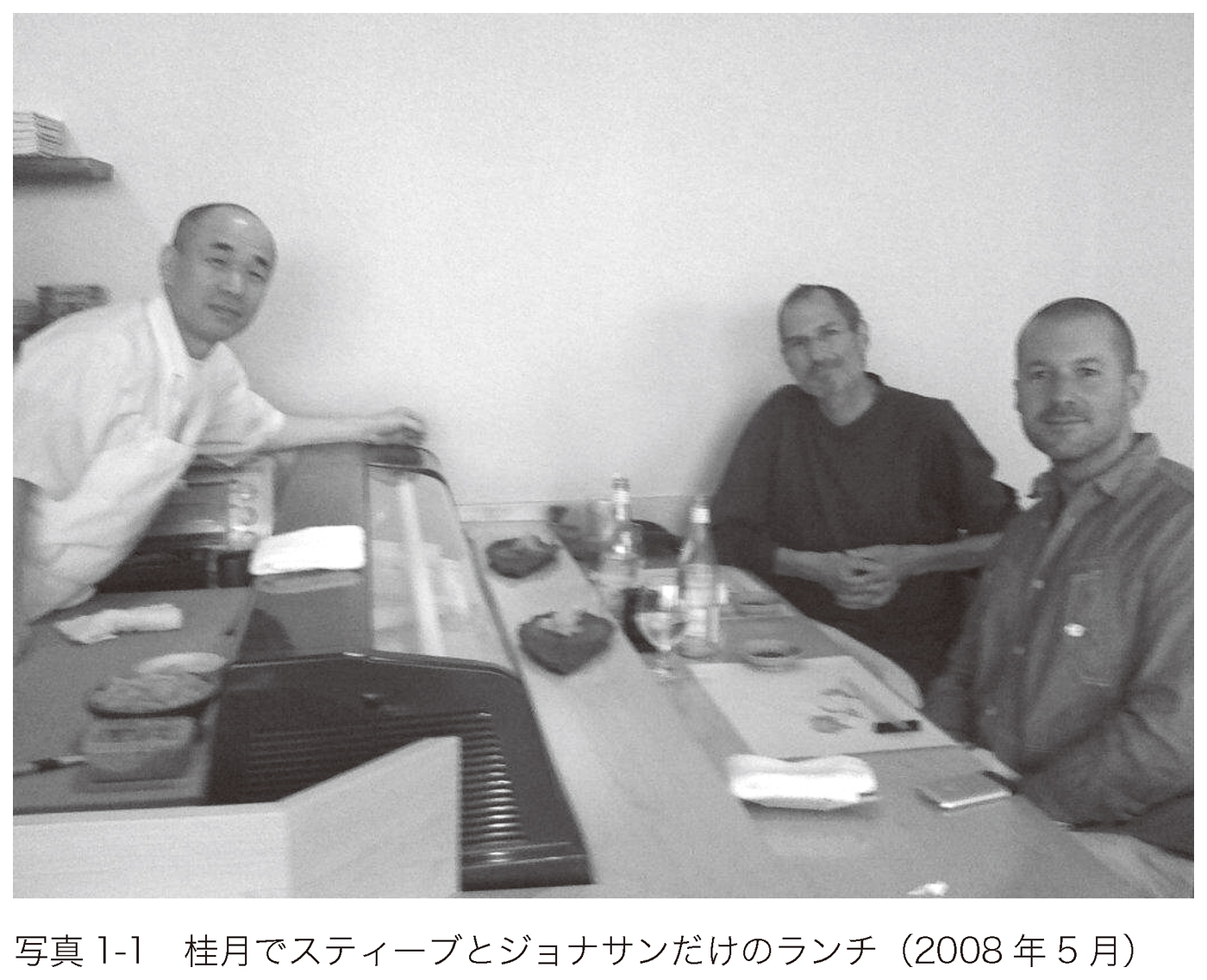 Given these circumstances, Jonathan probably visited Keigetsu with Steve the most, outside of his family.”
“When Steve ordered “five toro,” Jonathan would follow up by saying, “I’ll have three.” Jonathan consistently came across as reserved. He was a good person who was always polite to us.”
“Although Jonathan was certainly a regular customer, it was always Steve’s role to make reservations, and it was the first time Jonathan contacted us himself. (What could be going on?) This action just before closing seemed suspicious.”
“The secretary also emphasized further, “Jonathan says he would like the seat he always sat in with Mr. Jobs, can you arrange that?””
“Steve’s designated seat Of the six seats lined up in front of the sushi counter, Steve’s favorite was “number 1,” the one furthest to the left from the inside of the counter. In reality, rather than saying it was his favorite, it might be more accurate to say he had some firm preference or commitment. Whenever he visited, he would always say “Hi” to us. Then, looking eager to proceed without waiting for guidance, he would briskly walk toward seat number 1 and sit down as if it were his designated seat. He seemed to like looking around the store from there. If someone else occupied the number 1 seat, he would glare and sometimes become visibly displeased.”
“In his healthier days, his favorite ingredients were toro, salmon, and hamachi, but on this day, he wasn’t able to rhythmically order the next dish like he used to. Since he didn’t order any more dishes, I asked, “How about tempura?” to which he responded, “Sure.” So, as usual, I fried two shrimp and served them. I also added one slice of his favorite pumpkin.”
“After a short lunch, he stood up as usual. Due to Steve’s request, we already had the credit card details of Steve himself and Laurene, so there was no hassle with the payment. Even for a celebrity like Steve, we did not provide any special treatment at Kaigetsu. If the bookings were full, we would refuse even if a reservation was called in or emailed, often asking to change to another date.”
“(So many customers loved us this much.) Offering kaiseki cuisine in Silicon Valley was unprecedented and a great challenge, but we received the support of our customers. Looking back on this journey, I felt deep gratitude.”
“On the 6th at 11:30, Jonathan did not show up at the shop. Just before, a short email from his secretary said, “Unfortunately, we have to cancel the reservation,” and we replied, “We are filled with sadness upon hearing of Steve’s passing. Our condolences.” That afternoon, amidst a store bustling with regular customers, I silently continued to make sushi while looking at the two empty seats. The same was true on the final day, the 7th. After saying tearful goodbyes, we closed the store a little earlier than usual that day.”
“After tidying up lightly and returning home, I found out that Steve’s private funeral had just taken place on that day. Was it just a coincidence that our grand finale at Katsuratsuki and Steve’s funeral fell on the same day? I caught my breath for a moment in surprise.”
“One more thing that still bothers me is Jonathan’s reservation, which was made for the day after Steve’s death. What was that all about? (Maybe Jonathan believed in Steve’s recovery.) (Perhaps Steve was temporarily feeling better.) (Was it simply that he intended to come with guests unrelated to Steve?)”
“But when I actually face Jonathan, I still can’t bring myself to bring up the topic. What was Jonathan thinking when he made the reservation, and who was the “guest”? The truth remains a mystery.”
“At Yanagi Sushi, a regular nigiri was initially 280 yen, and three tekka rolls were 180 yen. Since a bowl of soba noodles cost 50 yen, sushi was not a particularly extravagant meal. Perhaps labor and material costs hadn’t risen much yet. Sushi was considered “casual takeout,” and orders frequently came in from the housing complex.”
“I had fulfilling days at Yanagi Sushi, but after about two years, my natural restlessness started to surface again.”
“Is it necessity that is the mother of invention, or is it perhaps called superhuman strength at times of need? It seems that when humans are cornered, they can exhibit unexpected abilities.”
“In September 1982, we rented an apartment in the Richmond District, not far from downtown San Francisco, and started our new life. Although the apartment, located midway up a gentle slope, was not particularly spacious at 1DK, it was conveniently situated near Clement Street, known as the second Chinatown, with restaurants and movie theaters within walking distance.”
“After being taken care of at Kansai for two years, I moved to “Mutsu” in San Mateo, about a 30-minute drive south from San Francisco. Today, San Mateo is home to many sushi bars, izakayas, and ramen shops, making it one of the largest concentrations of Japanese restaurants around Silicon Valley, but back then, there were only Mutsu and one other restaurant.”
“Currently, the downtown area is lined with Apple’s flagship store and upscale restaurants, with morning and evening traffic jams standing out. However, back then, there were only a few unique, small businesses such as cafes, bookstores, and sheet music specialty stores.”
“A café with the unlikely name “Sweet Surprise” had previously occupied the location, and it was hard to say it was in good condition when we saw it. However, since we would be taking over the lease contract the previous owner had signed, the rent was very attractive. It was a story from over 20 years ago, but the monthly rent of $485 was exceptionally low.”
“At the next bank, there was a stroke of luck as a regular at Mutsu was acquainted with the loan officer, and we managed to secure a loan. However, even with the maximum loan, funds were still insufficient. Remembering another regular customer who once said, “Contact me if you ever decide to start your own business,” I boldly gave a call. Although they had already returned to Japan, they agreed to help, allowing us to overcome the greatest hurdle of fundraising.”
“Incidentally, alongside the opening of Sushiya, I also obtained a car license plate “SUSHIYA” as advertisement. This continued to be used even after changing cars, continuing to this day. For the opening, we received a goodwill sign from Yanagi Sushi, and all the sushi tools were requested from Miyako Sushi to be sent from Japan.”
“Meeting Steve and Woz It was about two or three years after the sushi restaurant’s business was on track, so I think it was around 1987-88. While I was busy making sushi at the counter, one of the regulars in front of me glanced at a table in the back and whispered. “Do you know? That’s Steve Jobs in the back.” At the time, Steve had been ousted from Apple, which he founded, and was experiencing difficult times. However, I knew nothing of these circumstances back then. Still, I clearly remember my first encounter with Steve because his appearance at that time left such a strong impression. Even back then in Silicon Valley, a casual look of sneakers and jeans was “the norm.” Older professors from Stanford sometimes wore ties, but that was an exception. However, Steve, who was just over 30 at the time, was dressed in a suit with a bow tie.”
“Steve was sitting at a back table with a woman. The woman, dressed in what looked like a beige suit, was seen only from the back, but Steve’s manner was clear. I remember thinking how handsome Steve was upon first seeing him.”
“About two weeks later, by coincidence, Apple’s other founder, Steve Wozniak, also came to the sushi restaurant. Woz, who even back then looked like a bear, sat at the counter and nibbled on sushi. Dressed in a white shirt, Woz exuded an aura, making me wonder if he was a Hollywood star.”
“However, memories from the 1980s with the two founders of Apple are minimal. From the late 80s to the early 90s, Apple was in a slump and far from the center of attention. Other Silicon Valley companies centered around semiconductors were also struggling under the attack of Japanese forces. Hence, the opportunities for Apple or Silicon Valley to be extensively covered by the U.S. media were much less than compared to now. No one imagined that Apple would later significantly transform the IT industry and people’s lives, or that Steve himself would become a darling of the times.”
“In Silicon Valley, the IPO of the internet company Netscape Communications in 1995 ignited the internet and initial public offering (IPO) boom. A series of billionaires emerged, and real estate prices soared. However, when we were looking for a store in the early 1990s, it was, in retrospect, just before “the dawn.” There were still many vacant shops along the streets with signs that read “Vacant” and “Tenants Wanted.” “We want a place about the same size or slightly smaller than our current store.” Initially, the two of us had such conversations. Ideally, the location would be not too far from University Avenue in Palo Alto, where our restaurant Sushi-ya is located, so that regular customers could visit.”
“Toshizu Sushi-ya and the Internet This is how the new sushi restaurant managed by the two of us, “Toshizu Sushi-ya,” opened in September 1994. We shifted from a partnership to our own restaurant, with a renewed determination to serve even tastier sushi (Photo 3-1, Photo 3-2). In the end, the wall color, which was a major issue for us, was not repainted and remains the same with another sushi restaurant now occupying the space. However, its location near Stanford University and facing the main street was suitable for a dining establishment.”
“At that time, the last order was at 9:30 PM, but when it got too busy, we would stop the line at 9:00 PM, saying, “Today, we ask you to end here.” Even then, we wouldn’t finish until past 11 PM. During dinner hours, we had three full turnovers of customers. Once in the sushi preparation area, I was constantly making sushi without any break and even earned the nickname “Sushi Machine” from customers around that time. I was once again reminded of the good fortune of having trained in a busy shop in Shibuya, Tokyo. Such prosperity owed much to the spread of the internet.”
“When I entered “Sushi” into the search engine, I found only one sushi restaurant. Mysteriously, it wasn’t in big cities like New York or Los Angeles but was a country sushi place; nonetheless, at that time, only one sushi restaurant in the entire English-speaking world had a homepage. Toshi’s Sushi Bar also launched its website around 1996. The year 1995 marked the introduction of Microsoft’s “Windows 95,” making it a year that could be called the dawn of the internet, and over the next year or two, the internet quickly became familiar. By 1995 and 1996, IPOs had become a complete boom. We were no exception, and every morning at the fish company waiting room where we went to buy fish, the topic of conversation was all about stock investments.”
“Generally, in the restaurant business, or perhaps anywhere, there’s a tendency to gauge a customer’s financial standing based on their appearance. However, in the mid-1990s Silicon Valley, with the emergence of IPO magnates, even people who looked slightly untidy on the outside turned out to be very wealthy. Even if their meal totaled only $20 to $30, and they seemed to scrutinize the bill, they could actually be millionaires. Around this time, one thing frequently discussed with staff was “Don’t judge customers by their appearance or what they order on that day.” If they are satisfied with the food and service, they might introduce the restaurant to friends or acquaintances, or become regulars by hosting exclusive parties later. We had such experiences many times.”
““Is that Mr. Jobs?” I think it was three to four years after Toshi’s Sushi Bar opened. One day, a phone call came in to order takeaway sushi. Toshi’s Sushi Bar often received up to 20 takeaway orders a day. So, calls like these were not uncommon. What made this call memorable was that, just before hanging up the phone, I asked for the caller’s name, and from the other side, the answer “Steve Jobs” came back. Steve had been ousted from the Apple company he founded in 1985 and had been in a state of despair for a while. Later, he founded another IT-related company, which was acquired by Apple, leading to his return to Apple in 1997. At that time, Apple was not having hit products and was struggling in its management. Steve’s “comeback” to such an old company was widely covered in the U.S. media, especially his $1 salary upon returning, which was a hot topic. That’s why it clicked, even though about ten years had passed since I first saw Steve in the store.”