Steve Jobs
Strategic Concepts & Mechanics
Primary Evidence
"At one point, a notice for customers was posted on the entrance wall with a joke added: “Seats are guided in the order of arrival, and even Steve Jobs will have to wait if there’s no reservation.” Larry, arriving earlier, keenly noticed it. Apparently, Larry told Steve, who arrived slightly later, about this, and afterward, they both burst out laughing."
"We don’t hire smart people to tell them what to do. We hire smart people so they can tell us what to do. —Steve Jobs"
"“Because I didn’t know it couldn’t be done, I was enabled to do it,” Atkinson says in Walter Isaacson’s biography of Apple co-founder Steve Jobs."
"Musk admired Steve Jobs and studied the period of his departure from Apple. “That ship was sailing really well,” Musk observed of the interregnum between Jobs’s departure and return, “... towards the reef.”"
"“Hi, is this Lawrence?” “Yes, it’s me.” “This is Steve Jobs,” the voice on the other end of the line said. “I saw your picture in a magazine a few years ago and thought we’d work together someday.”"
"This is the story of how the little company that made the world fall in love with toys, bugs, fish, monsters, cars, superheroes, chefs, robots, and emotions emerged from the forces at work beneath it. It is about the choices and the absurd bets and risks that made it possible. It is about the tension between creative integrity and real-world necessities, and how that tension shaped those involved with it—Steve Jobs; Pixar’s creative, technical, and production teams; and me. It is a story about what it means to put the creative impulse first, and why that is so very hard to do."
"STEVE JOBS IS BACK IN THE SADDLE AGAIN, BECOMING A BILLIONAIRE IN PIXAR IPO The article said: There are plenty of analysts who think the market’s valuation of Pixar, at a total of $1.46 billion, is a sign of investors gone mad. Disney will get 80% to 90% of the revenue from “Toy Story,” and has locked Pixar into a three-picture deal through at least 1999 that promises to be a lot more rewarding for Disney than Pixar.5"
"In the past, I liked “make a difference in the world because of you.” Now, that is still my life goal. However, I care more about whether, besides having a grand ideal, I make everyone I meet happy. Do I enjoy every accidental encounter, and do I enjoy every moment of connection with fate? Steve Jobs once said, “Remembering that you are going to die is the best way to avoid the trap of thinking you have something to lose.” This phrase has become my motto, reminding me every day to see clearly what is important in life. All glory and pride, embarrassment and fear will vanish before death, leaving only what truly matters—those most beautiful experiences in life."
"“Friedland taught Steve the reality distortion field,” said Kottke. “He was charismatic and a bit of a con man and could bend situations to his very strong will. He was mercurial, sure of himself, a little dictatorial. Steve admired that, and he became more like that after spending time with Robert.”"
"Friedland found Jobs fascinating as well. “He was always walking around barefoot,” he later told a reporter. “The thing that struck me was his intensity. Whatever he was interested in he would generally carry to an irrational extreme.” Jobs had honed his trick of using stares and silences to master other people. “One of his numbers was to stare at the person he was talking to. He would stare into their fucking eyeballs, ask some question, and would want a response without the other person averting their eyes.”"
"Robert Friedland: Interviews with Steve Jobs, Daniel Kottke, Elizabeth Holmes. In September 2010 I met with Friedland in New York City to discuss his background and relationship with Jobs, but he did not want to be quoted on the record. McNish, 11–17; Jennifer Wells, “Canada’s Next Billionaire,” Maclean’s, June 3, 1996; Richard Read, “Financier’s Saga of Risk,” Mines and Communities magazine, Oct. 16, 2005; Jennifer Hunter, “But What Would His Guru Say?” (Toronto) Globe and Mail, Mar. 18, 1988; Moritz, 96, 109; Young, 56."
"Jobs was also beginning to have a little trouble stomaching Friedland’s cult leader style. “Perhaps he saw a little bit too much of Robert in himself,”"
"“Let me tell you a story.” Nobody is eager for a lecture, but everybody loves a story. And that was the approach Jobs chose. “Today, I want to tell you three stories from my life,” he began. “That’s it. No big deal. Just three stories.”"
"In order to raise some cash one day, Jobs decided to sell his IBM Selectric typewriter. He walked into the room of the student who had offered to buy it only to discover that he was having sex with his girlfriend. Jobs started to leave, but the student invited him to take a seat and wait while they finished. “I thought, ‘This is kind of far out,’” Jobs later recalled. And thus began his relationship with Robert Friedland, one of the few people in Jobs’s life who were able to mesmerize him. He adopted some of Friedland’s charismatic traits and for a few years treated him almost like a guru—until he began to see him as a charlatan."
"Jobs also absorbed how Friedland made himself the center of attention. “Robert was very much an outgoing, charismatic guy, a real salesman,” Kottke recalled. “When I first met Steve he was shy and self-effacing, a very private guy. I think Robert taught him a lot about selling, about coming out of his shell, of opening up and taking charge of a situation.” Friedland projected a high-wattage aura. “He would walk into a room and you would instantly notice him. Steve was the absolute opposite when he came to Reed. After he spent time with Robert, some of it started to rub off.”"
"“Robert always portrayed himself as a spiritual person, but he crossed the line from being charismatic to being a con man,” Jobs said. “It was a strange thing to have one of the spiritual people in your young life turn out to be, symbolically and in reality, a gold miner.”"
"if you act like you can do something, then it will work. I told him, ‘Pretend to be completely in control and people will assume that you are.’”"
"“Deciding what not to do is as important as deciding what to do,” he said. “That’s true for companies, and it’s true for products.”"
"“The best way to predict the future is to invent it” and “People who are serious about software should make their own hardware.”"
"“We learned to interpret ‘This is shit’ to actually be a question that means, ‘Tell me why this is the best way to do it.’”"
"I figured that it was always my job to make sure that the team was excellent, and if I didn’t do it, nobody was going to do it."
"As Blankenship began working closely with Musk, he found some similarities to Steve Jobs, but also key differences. Jobs had likewise been super focused on many aspects of the business. With Jobs, he had spent their hours-long meetings delving into such details as the wood grains to be used for the legs of the tables that the stores would need to showcase their products, or else weighing the position of the holes that would be cut into those tables to accommodate cords—even discussing the size and shape of those holes. While Musk could be super focused on engineering issues or car design, he had less interest in other parts of the business, such as how the stores should look. He wanted it to be like Apple—he wasn’t up to picking wood grains. With Jobs, Blankenship had gone through several iterations of the store design in a physical warehouse; for Musk, all that was needed were some renderings. “Is that what it should look like?” Musk would ask Blankenship, sincerely. Blankenship explained there would be graphics on the walls and places for storage for apparel and brochures. It would be reasonably inexpensive to build—an open layout with the car at the center of attention. “OK,” Musk said, and left it at that."
"Musk admired Steve Jobs and studied the period of his departure from Apple. “That ship was sailing really well,” Musk observed of the interregnum between Jobs’s departure and return, “… towards the reef.”"
"Gou set up the officially accredited Foxconn University on the Shenzhen campus, [offering twenty-five majors](private://read/01k3jwt46q240aq6fe12mqkyr0/16_Notes.xhtml#_idTextAnchor348), most of which were engineering related. Gou surrounded himself with deputies who worked nearly as relentlessly as he did, driving Foxconn executives to the factories six days a week and then to study sessions on Sundays. In earlier years, they studied engineering principles. One former employee told me that in more recent years, political education has been more prominent, meaning that they have to study the words of China’s top leader. The curriculum transitioned from “Steve Jobs thought” when Shenzhen was freewheeling a decade ago to “Xi Jinping thought” in the more disciplined present."
"Resources. You must start with the abilities you can bring to bear. Using the academic convention, I will call these “resources.” They might be as personal and idiosyncratic as Steve Jobs’ aesthetic sensibilities, or…"
"But Amelio deserves credit for three major actions—in hardware, finances, and software. The sale of the Fountain factory was the first. It gave Apple critically needed cash and would later spur a whole new strategy in how to build computers. Then Amelio and finance chief Fred Anderson orchestrated two deals to stave off bankruptcy: a week before Apple owed Japanese lenders $150 million, in April 1996, they got a six-month extension. Then in June, they raised $661 million in an oversubscribed bond sale. But Amelio will always be remembered for the third action. He realized that a multiyear effort to improve the Mac’s operating system was hopeless, and that Apple needed to acquire a new OS altogether. That insight set into motion the action that would get him sacked, even as it saved the company. He brought back Steve Jobs."
"By the time Jobs had left, Apple had already started building strong ties in Japan. Jobs had visited Tokyo frequently in the early 1980s, enamored with the Sony Walkman and the emergence of automated manufacturing capabilities. Jay Elliot recalls being with Jobs at a traditional kaiseki multicourse dinner with executives from Sony at an over-the-top restaurant that hosted only one group per night. The start was inauspicious. Elliot, six-four and wearing size 14 shoes, couldn’t fit into the ceremonial attire. “They didn’t know what to do about it—they were so upset,” Elliot recalls. He and Jobs sat on tatami mats and wore ritualistic masks between courses. The highlight, he says, was being given an ornate wooden hammer to break open a clay pot, revealing a delicately cooked dish inside."
"Taking in all that he saw, then looking at Ive, Jobs said, “Fuck, you’ve not been very effective, have you?” In the world of Steve Jobs, this was a compliment. He was recognizing them, surmising that their problem was an inability to communicate their own worth. According to Ive, the two started collaborating that day on an all-in-one computer code-named Columbus, because it represented the New World. At a software review meeting afterward, Jobs beamed about what a “great group” ID was, then told them about Columbus."
"Then Jobs started talking about what a disaster Apple was and how much had to change. It was all a lead-up to a pregnant pause. “I want to show you something that will change this company,” he told them. His hands moved toward the bowling ball bag, but then he stopped. “I don’t trust the Apple people in the room,” Jobs said curtly. “So, all of you Apple people—get out of here.”"
"After another three months, the site had been transformed again. By then Foxconn had installed new machinery, hired tens of thousands of people, and had the production line up and running. The iPod Nano that Foxconn would begin building in the millions weighed just 1.5 ounces, about three-quarters less than the original. Jobs, wearing a black V-neck and a pair of dark blue jeans when he showed off the “impossibly small” device in September 2005, presented it by saying, “You ever wondered what this pocket is for?” A camera zoomed in on the small inner section of the pocket of his jeans as he pulled out the iPod Nano. “Well, now we know.”"
"device,” Steve Jobs walked into a routine divisional meeting. He was in a bad mood and didn’t look good. Then he pulled out his prototype iPhone, which looked worse. The keys in his pocket had cut a huge gouge across its plastic screen. He threw the unit onto the boardroom table toward Steve Zadesky and demanded: “Make it glass.” It wasn’t the first time the idea had come up. In September 2006, just four months earlier, Jobs had grown angry about smaller scratch marks and complained to a mid-level executive: “Look at this, look at this—what’s with the screen?” The executive responded, “Well, Steve, we have a glass prototype, but it fails the one-meter drop test one hundred times out of one hundred times.” Jobs cut the executive off. “I just want to know if you’re going to make the fucking thing work.” Now, in January, Jobs wasn’t taking excuses. Apple had just"
"Around the same time, Steve Jobs needed a head of graphics, as Apple sought to design its own chips for next-generation iPhones. He’d narrowed his sights to Bob Drebin, a former Pixar engineer who’d done pioneering work for Nintendo and been the graphics technology chief at AMD, a chip designer. When Jobs heard he’d entered early retirement, he called him up with a job offer. Drebin demurred, saying he wanted a year to spend time with family and focus on hobbies like sports photography. “Okay,” Jobs said, hanging up the phone. Three hundred and sixty-five days later, Drebin’s phone rang. “So, you ready?” Jobs asked. Drebin accepted."
"By late 1996, NeXT had all but abandoned its goal of building an OS. Steve Jobs had told his staff “the ships are burning,” a metaphor signaling there was no turning back, in announcing WebObjects as the company’s new direction. But then a young staffer learned something intriguing: Apple needed a new operating system."
"As the details were being worked out, a group of NeXT employees sat in a room together, chatting. They’d all worked with Steve, and they just didn’t understand what Amelio was thinking. None believed Jobs would ever be a number two. Not anywhere, probably, but certainly not at the company he cofounded as a twenty-one-year-old."
"Jobs went on a tirade. “Ninety-five fucking hundred jobs are depending on you, and you’ve failed!” Jobs fumed to Jony Ive, hardware chief Jon Rubinstein, technology chief Glen Miranker, director of engineering Josef Friedman, and a few others. “You’ve screwed the pooch,” Jobs continued. “I’m going to sell my one fucking share of Apple stock!”"
"A practical compromise was reached. Apple took care of the guts inside the computer—basically the same circuit boards that were in its G3 desktop—but it would rely on a supplier to build the CRT. Then units would be sent to an Apple site for final assembly, test, and pack out, or FATP. That way, Apple had the last look before any computer was shipped, giving Jobs the level of control he desired. “Steve was adamant that we would manufacture the iMac internally,” says Joe O’Sullivan, who was by then leading operations in Singapore. Jobs asked O’Sullivan to kill the partnership with SCI in Colorado, a cancellation that cost Apple $5 million and infuriated SCI. Instead, Jobs asked O’Sullivan to turn Singapore into a pilot plant for iMac manufacturing. “It was our best, our cheapest manufacturing plant,” the Irishman says. “And I was running it. So he had a throat to grasp.”"
"The duo had proved themselves making the cube-shaped computer at NeXT, when Steve wanted “no draft angles, no parting lines,” meaning that the sides of the cast part would be perfectly parallel to the direction the part was ejected from in the mold. “Tim and Ken figured it out,” this person says. “And it was absurdly expensive, but that was a defining experience. So if Jobs was having a hard problem and these guys say, ‘It cannot be done,’ then it really can’t. But if these guys say, ‘It can,’ then it’s just really hard. Acorn was almost his brain trust or sounding board for, is this *possible* or is this *crazy?*”"
"Cook departed into a senior position at PC wholesaler Intelligent Electronics, bringing order to a distressed business with bloated costs and wasted assets. In 1997 he graduated into a vice president position at Compaq—a dream role. Compaq, whose origins trace back to three friends scribbling their business plans on a napkin in a Houston pie shop, was the first company to clone the IBM PC in 1982. By 1997 it was King of the Clones, with $34 billion of revenue. Cook had been there only a matter of months when recruiters from Apple began calling. He demurred, so they delivered what was quickly becoming a signature move: They offered a personal interview with Steve Jobs."
"By empowering ID, Jobs had created a design-first organization that had zero tolerance for imperfection from the earliest stages of product creation. That approach cascaded down the pyramid, so the Ops team couldn’t accept imperfection, either. Mike Bell, a vice president in the 2000s, recalls that for the Titanium PowerBook, an especially difficult-to-engineer laptop released in 2001, Product Design engineers “had to come up with methods of production nobody had ever done before.” He characterizes this whole time period as “designing the impossible, then manufacturing the impossible.” Engineers would joke that Jobs had asked for “anti-gravity” or wanted them to make the next product out of “unobtanium.”"
"Numerous executives who worked with both Jobs and Cook can’t help but contrast them. One executive says Steve Jobs was difficult because his emotions could abruptly go from zero to a hundred. “Tim,” this person adds, “goes from thirty-five to thirty-six.” And yet somehow that would be more disconcerting, because it was so unusual. A former vice president at Apple says the way you knew Tim Cook was upset was when he would say, “I just don’t understand.” This person adds: “When he’d say that, you’d see little puddles on the floor—the sweat coming off of people.”"
"Steve Jobs held a comparatively low-key event for the launch. The live audience didn’t seem to get it, and Apple got blasted for the $499 price point. More effective was a seven-minute marketing video set to pop music and featuring artists Seal, Moby, and Smash Mouth lusting after the device. “I might have to steal your prototype,” says Moby. “I don’t know who your product’s designers are, but boy, you’re not paying them enough.” In the holiday quarter Apple shipped 125,000 devices, a solid start. But a few months into 2002, sales petered out to just 20,000 a month. Cupertino worried the device was a bit of a dud. “The business was on the teetering edge,” says an engineer who worked on several generations of the iPod. “We had a few months’ sales where it was like, ‘Oh my god, should we even continue this business?’ And ‘Will this survive?’ ” Fadell, exhausted and frustrated, even tried to quit. Jobs persuaded him to stay, elevating his position to overseeing both hardware and software for the iPod. But there were conversations at a high level that if sales didn’t improve, the device wouldn’t be renewed. “We just kept our heads down and kept working on making the product better, better, better,” an iPod engineer says. “We were pretty worried about [the low sales] from an overall business standpoint.” The second-generation iPod came out in August 2002, just nine months after the original. But that unit didn’t sell in impressive numbers either. The underwhelming figures contributed to that year’s profit warning, its third in just four years."
"Tupman had another wedding to attend in two days and would need several weeks to get an H1B visa to work in the United States. No wedding and no time, Fadell explained. They didn’t have a production-build prototype yet, but Steve Jobs would be unveiling it in just four weeks. Fadell had already taken the liberty of getting Tupman hired on a temporary basis with Inventec, the iPod’s contract manufacturer, so he could begin work straightaway and work out his US visa issues—and his move to California—later. *Crikey,* Tupman thought. “Oh, and one more thing,” said Fadell: “I bought you a ticket for tomorrow morning. It leaves at eleven a.m. You’re flying to Taipei, so pack for two months and get going.”"
"When Jobs unveiled the unibody MacBook during a famous “one more thing…” moment, it marked the first time he spoke about Apple’s operational edge at a major event, showing off a video of how it was made, featuring Jony Ive, Dan Riccio, and Mac hardware chief Bob Mansfield. “It put MD on the map,” says one person involved in the effort, referring to Manufacturing Design, a part of Ops that intimately works with suppliers to figure out how to make Apple products. “We knew we had changed the world, from a design perception.”"
"So many marriages were broken up during the first years of Jobs’s comeback that informal preventive measures were established to contain further damage. Engineers called it the DAP, or Divorce Avoidance Program. In the late 1990s, the acronym referred to when an engineer couldn’t come in to work that day because his marriage was on the line. “It was like, ‘Where’s Glen this weekend? Why isn’t he working?’ ” one engineer recounts. “And a colleague would reply, ‘Oh, he’s on the DAP.’ The basic meaning was: Glen’s about ready to get a divorce if he doesn’t have a weekend with his wife. So Glen wasn’t working that weekend. That kind of stuff happened on the team all the time.”"
"Jon Rubinstein, who worked for Steve Jobs on and off for sixteen years, called the long workweeks “shattering,” and it’s what led to his own departure later on. “A lot of people got sick at Apple,” he once said. “The list goes on and on of people who got terminally ill or really ill… and I worried that if I stayed, I’d end up damaging myself, and my health was, frankly, more important.” He added: “Steve used to always tell the groups, ‘This will be the high point of your life,’ and I was thinking, *God, I hope not,* right? Because that’s really a sad way to think.”"
"The hard work paid off: In 1992 Mahe received a scholarship to Simon Fraser University, where she completed undergraduate and graduate degrees in engineering. She joined PDA maker Palm in 2002, staying for nearly six years as it struggled to reinvent itself for a smartphone future. Mahe had built a wireless team for Palm almost from the ground up, catching the attention of Cupertino, and a few months after the iPhone was unveiled, Apple recruiters started a year-long campaign to draft her. She rebuffed them, believing that leaving her team would be a betrayal. But the recruiting intensified, culminating in Steve Jobs inviting Mahe over for dinner. He impressed her, although he lied about the dinner. “Just water for the whole two hours,” Mahe once told *Fortune*. “So that was a little bit of bait and switch!” Jobs, listening to her concerns, allowed her to bring over key members of her Palm team. According to Mahe’s account, he clinched the deal with this line: “You can stay with Palm and drive a bus full of people off a cliff, or you can come to Apple and give them a better place to land.”"
"Two years after the death of Steve Jobs, Oracle CEO Larry Ellison claimed it was inevitable Apple would struggle under Tim Cook. You only had to look, he said, at what happened to the company in the period after Jobs was ousted in 1985. “We already know. We saw. We conducted the experiment,” Ellison told talk show host Charlie Rose in 2013. His finger tracing an upwards curve, he said Apple had been an extraordinary success during Jobs’s first spell at the company, only to slump—his finger dropped—when he left. “We saw Apple with Steve Jobs” when he returned in 1997—up went his finger. “Now, we’re gonna see Apple without Steve Jobs”—another drop. “He is irreplaceable. They will not be nearly so successful.”"
"The problem was, shareholder-first capitalism enabled—indeed, even encouraged—corporations to ignore, if not undermine, the national interest. Executives found that they could focus on actions to reap short-term benefits—gambits such as cutting costs and outsourcing jobs to Asia—and ignore wider societal impact. As this book has demonstrated, Cupertino’s interests have significantly diverged from Washington’s since the death of Steve Jobs; the wider implications could end up tarnishing Cook’s legacy."
"Chapter 36, “5 Alarm Fire,” is exclusively sourced from more than 1,000 pages of documents including emails among Apple’s top executives; internal studies of China, India, and Huawei; and depositions of key figures including Tim Cook. This material was made public in December 2023, several months before Apple settled the case, but through some miracle it hadn’t been noticed or reported on. I spent more than thirty hours sifting through the documents and the resulting narrative is, I believe, the first presentation of the material outside of a courtroom. Other chapters were supplemented by original material derived from unnamed sources. These include notes from a series of Steve Jobs–led meetings in the summer of 1997; internal surveys of Chinese consumer sentiment in 2010; internal presentations on labor demand and churn in Chinese factories; and other material discussing Apple/supplier relationships and its dilemmas with China from after 2015."
"Personal vehicles of players Player Personal vehicles created Bain Bain & Company; the unique Bain consulting formula; recommendations from client CEOs to other CEOs; Bain Capital Bezos Amazon; the Bezos business formula for Amazon Bismarck The Prussian state and army; North German Confederation; German state and military; successful wars against Denmark, Austria and France Churchill His opposition to Hitler; British state and Empire; their armies and people Curie Radium Disney Disney Studio; cartoons, movies and television; Mickey Mouse and later Disney characters; Disney’s personal WED corporation; Disneyland Dylan The folk movement; Columbia Records; songs and albums; fans Einstein Theory of Relativity; Zurich, Prague, Berlin, Caltech, Berkeley and Princeton universities; media Frankl Man’s Search for Meaning; lectures; awards; school of followers Henderson Boston Consulting Group (BCG); the Experience Curve and Boston Box concepts; Perspectives (short thought-pieces mailed to senior managers); BCG conferences Jobs Apple, NeXT and Pixar; Macintosh computers; Apple digital devices; Apple store; Apple apps Keynes The Economic Consequences of the Peace; King’s College Cambridge; The General Theory Lenin Iskra (Russian revolutionary newspaper); What Is To Be Done?; Bolshevik party; Russian state; military and secret police Leonardo His studio in Florence; his paintings, sculptures Madonna Record labels; albums, videos, movies; media; personal business ventures Mandela ANC; Robben Island prison; South African state Rowling Harry Potter Rubinstein Eponymous cosmetics empire; advertising and media; personality marketing and personal networking Paul of Tarsus City churches he founded; his letters (epistles) to them, Acts of the Apostles; Marcion and his pioneering New Testament canon Thatcher Conservative Party; British state and military; Falklands war; ‘Thatcherism’ programme in favour of free enterprise, against state business monopolies and abuses of trade union power"
"Like Bruce Henderson when he had discovered the Experience Curve, like Jeff Bezos when he and David Shaw worked out the blueprint for Amazon (and before Bezos left Shaw to start the new venture), like Bill Bain before he deserted Bruce Henderson to found Bain & Company, Einstein had been transformed. Like them all, he knew that he was privy to insights nobody else had, and that he would change the world. Similar transforming certainty affected three other people we have already met in these pages – Steve Jobs, Paul of Tarsus, and Viktor Frankl."
"the problem with pragmatism is that it rapidly becomes a habit, and short-term gratification – expressed in profits, cash and the praise which goes with them – becomes a drug that drives out long-term customer-related aspirations. It takes a rare visionary – people such as Henry Ford, Ray Kroc of McDonald’s, Ingvar Kamprad of IKEA, and Southwest Airlines’ Herb Kelleher – to insist on rock-bottom prices; or, as with Steve Jobs, fantastic products and a simple, intuitive customer experience. It takes an exceptional person to take on the risk of this approach – the risk of going bust."
"Steve Jobs’ breakthrough achievement was to create Apple as he envisioned it, to mould its DNA, charting its mission as a revolutionary digital simplifier. Under Jobs, Apple made devices never previously conceived, devices that are intuitive, superbly useful, beautiful, a joy to use. Walter Isaacson says that Jobs ‘built the world’s most creative company … to infuse into its DNA the design sensibilities, perfectionism, and imagination that make it likely to be, even decades from now, the company that thrives best at the intersection of artistry and technology.’"
"Neither NeXT nor Pixar proved to be good vehicles for Jobs. When he returned to Apple, he found a right mess; a whole series of projects and products, including the Newton handwriting recognition software, were loss-makers and cash-consumers. Apple had one product that was profitable and credible, the Macintosh. Jobs cut everything else, and then paused until his people created ‘the next big thing’, which proved to be the iPod and iTunes, and then all the delightful and simple new products they created. Apple had the DNA, and design capability, which Jobs greatly augmented, to go from strength to strength. Jobs took his rackety old vehicle, which was barely roadworthy in 1997, and endowed it with such a powerful new engine that it became for a time the most valuable vehicle in the world. The lesson? Don’t look for a new vehicle if the existing one has potential for success and can be radically reconditioned."
"An entrepreneur’s credibility and influence rest far more on his vehicle – his company and its products – than on his personality. You don’t buy an Apple device because you admire Steve Jobs; you buy it because of what it does for you. You can believe that he was a total asshole, yet happily pay a premium price for his inventions. The credibility that matters for entrepreneurs is not personal; it is based around the brand and the product."
"In his presence, reality is malleable. —BUD TRIBBLE on Steve Jobs"
"This was where Jobs’ reality distortion field came in. He told Larry Kenyon, an engineer working on the Macintosh prototype, that it was taking too long to start. Kenyon tried to explain to Jobs why it couldn’t boot quicker, but Steve was having none of it. ‘If it could save a person’s life,’ he interrupted, ‘would you find a way to shave ten seconds off the boot time?’ Jobs then multiplied ten seconds by the five million users of the Mac to show that it would save 300 million hours, which equalled 100 lifetimes saved a year. Kenyon was impressed, and came back a few weeks later, having found a way to save twenty-eight seconds. As a colleague said, ‘Steve had a way of motivating by looking at the bigger picture.’3 If something was defined as vital, it therefore became possible. Jobs didn’t have to know how to do it, just tell his people what was needed and that they could do it. They believed him, and they did it."
"Jobs was in New York for the press previews, and on a Sunday conference call the engineers back at head office gathered around the phone to break the bad news to him. The shipping could go ahead, the manager explained, but with ‘demo’ software, to be replaced with the real code two weeks later. A long pause. The software wizards expected an explosion from Jobs. But he was calm. He told them how great they were, so they could get this done on time: ‘You guys have been working on this stuff for months now, another couple weeks isn’t going to make that much of a difference. You may as well get it over with. I’m going to ship the code a week from Monday, with your names on it.’4 The engineers did what they thought was impossible. At 8.30 that Monday morning, according to Isaacson, Jobs arrived at Apple to find Andy Hertzfeld ‘sprawled nearly comatose on the couch’ after three all-nighters. Jobs gave the okay to the software, the product shipped as planned, and Hertzfeld drove his blue Volkswagen Rabbit, with its licence plate MACWIZ, home to sleep.5 The reality distortion field had worked again."
"Jobs’ terminology may have been unique, but all the players exhibited a reality distortion field. They changed reality because they thought they could. Not many people think this, and therefore not many people do it. Or to quote the Apple ‘Think Different’ commercial of 1997, ‘The people who are crazy enough to think they can change the world are the ones who do.’ If we want unreasonable success, we must first believe we can change the world. Really believe we have our own personal reality distortion field. It won’t always work, but on important occasions it can change reality, if you believe. After all, what is extraordinary achievement but bending existing reality to your vision and your will, by persuading yourself and your key allies that it is possible? Yet the very phrase, ‘reality distortion field’, as in ‘I have a reality distortion field’, or ‘Steve has a reality distortion field’, when spoken and recognised as a real force, can have the power of a magic incantation."
"Just as the legal attack on Microsoft was ending Bill Gates’s dominance, Steve Jobs’s return to Apple demonstrated the irreplaceable value of a company’s founder. In some ways, Steve Jobs and Bill Gates were opposites. Jobs was an artist, preferred closed systems, and spent his time thinking about great products above all else; Gates was a businessman, kept his products open, and wanted to run the world. But both were insider/outsiders, and both pushed the companies they started to achievements that nobody else would have been able to match."
"The greatest thing Jobs designed was his business. Apple imagined and executed definite multi-year plans to create new products and distribute them effectively."
"In the workshop, they prepare eight metal models. Simple, elegant, and essential frames. Well made. Storing them, lined up in the gallery of all Luxottica models in a dedicated room in the headquarters in Agordo, they make the effect of Steve Jobs's first Mac. A product that starts an icon."
"The translation in Agordo sauce of Steve Jobs' famous motto "Stay hungry, stay foolish" - be hungry, be foolish - are the words with which Leonardo closes the interview with the Corriere to explain the choice."
"That image leaves you with the same impression as photos of the American garage where Steve Jobs invented Apple."
"He's one of those like Steve Jobs or Sergio Marchionne, who believe they can achieve the impossible and just because they believe it, in some cases they manage to, succeeding in shaping reality to their liking. "And he wasn’t afraid of anything, of anyone," they add."
"They tell me that after the annual event at Villa d'Este, where Luxottica celebrates and presents itself to major customers, Leonardo sends a note to Andrea. "Thanks for everything." The manager is stunned, flabbergasted. He's out. It's the end of the Guerra era. The return of the hungry and visionary leader, as Steve Jobs would say."
"During this interregnum, Steve Jobs asked me to fly up to San Jose so I could see a movie he was in the middle of making for this unknown company he’d acquired called Pixar. But first he wanted to show me what he was doing with a “revolutionary” computer system at another new company of his called NeXT. It hadn’t been going that well because its complex yet elegant design couldn’t find a market, given the absolute domination of Microsoft. I went to the NeXT office, where Steve showed me a few scenes from *Toy Story*, and asked if I would join the Pixar board. I said I’d have to think about it. I didn’t want to commit myself and didn’t want to insult him, but I’d never been much interested in animation and had never made any animated movies. I don’t really understand the form and I thought this new Pixar work was awkward, and, separating me from most of the world, I didn’t get any of the charm of *Toy Story.*"
"In early October 2011, the Japanese restaurant “Keizuki,” which has been operating in the Silicon Valley on the West Coast of the USA, was about to close. That day, the restaurant was bustling with customers wanting to have their last meal at Keizuki, but by 9 PM, there was a little respite. It was then that I received a request to “write an article about Jobs.”"
"During various occurrences at Keizuki and with Jobs himself increasingly unwell, coincidence upon coincidence brought the offer “would you like to work at Apple” to Toshi-san. To me, this appeared as a “thank you for years of kunto” from Jobs to Toshi-san."
"Jonathan often came to have lunch at Keigetsu with Apple founder Steve Jobs. When the number of customers rapidly declined in 2008 and the general lunch service was temporarily suspended, the store had opened exclusively for the two of them at Steve’s request (Photo 1-1). 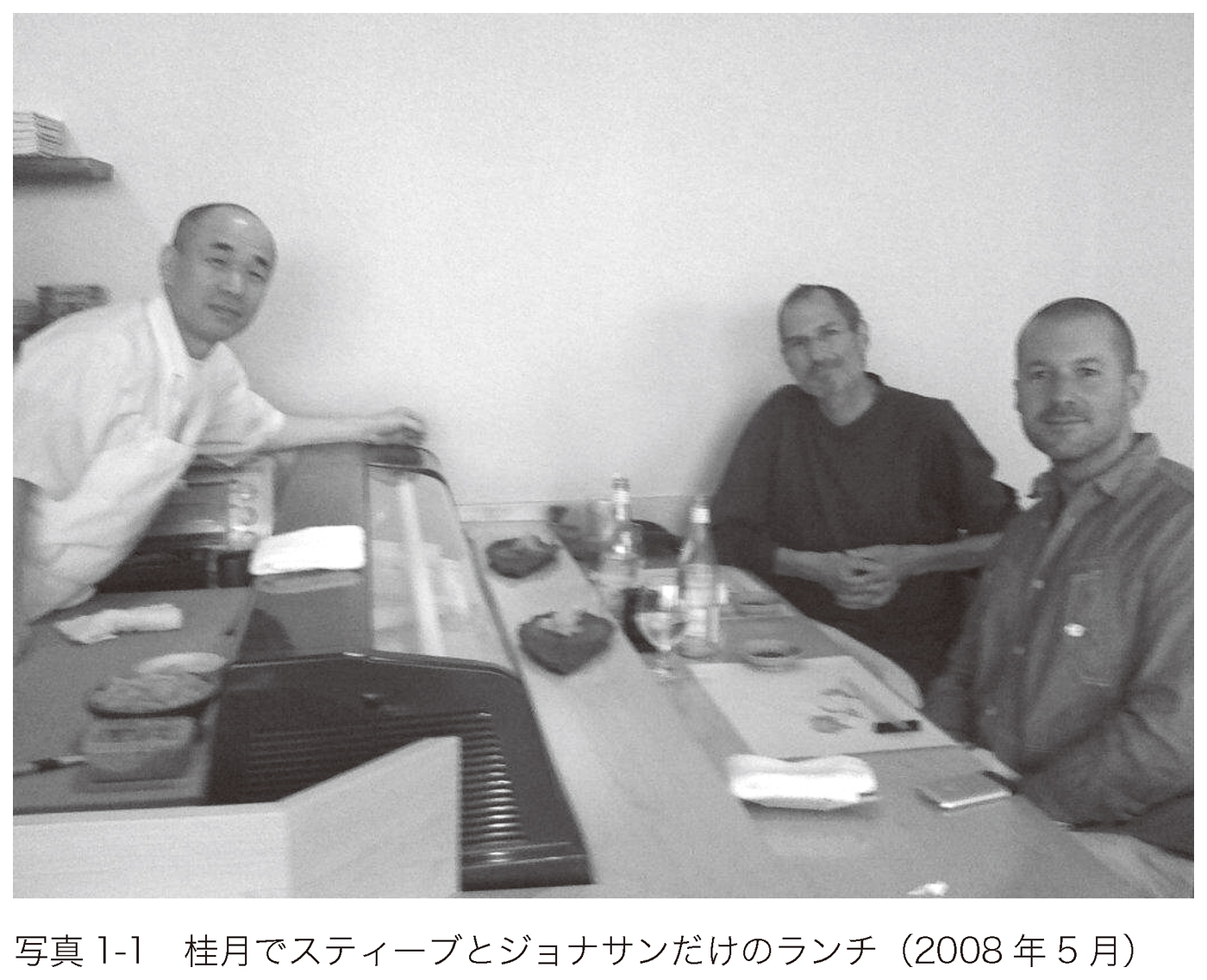 Given these circumstances, Jonathan probably visited Keigetsu with Steve the most, outside of his family."
"But when I actually face Jonathan, I still can’t bring myself to bring up the topic. What was Jonathan thinking when he made the reservation, and who was the “guest”? The truth remains a mystery."
"After a short lunch, he stood up as usual. Due to Steve’s request, we already had the credit card details of Steve himself and Laurene, so there was no hassle with the payment. Even for a celebrity like Steve, we did not provide any special treatment at Kaigetsu. If the bookings were full, we would refuse even if a reservation was called in or emailed, often asking to change to another date."
"When Steve ordered “five toro,” Jonathan would follow up by saying, “I’ll have three.” Jonathan consistently came across as reserved. He was a good person who was always polite to us."
"Although Jonathan was certainly a regular customer, it was always Steve’s role to make reservations, and it was the first time Jonathan contacted us himself. (What could be going on?) This action just before closing seemed suspicious."
"On the 6th at 11:30, Jonathan did not show up at the shop. Just before, a short email from his secretary said, “Unfortunately, we have to cancel the reservation,” and we replied, “We are filled with sadness upon hearing of Steve’s passing. Our condolences.” That afternoon, amidst a store bustling with regular customers, I silently continued to make sushi while looking at the two empty seats. The same was true on the final day, the 7th. After saying tearful goodbyes, we closed the store a little earlier than usual that day."
"One more thing that still bothers me is Jonathan’s reservation, which was made for the day after Steve’s death. What was that all about? (Maybe Jonathan believed in Steve’s recovery.) (Perhaps Steve was temporarily feeling better.) (Was it simply that he intended to come with guests unrelated to Steve?)"
"After being taken care of at Kansai for two years, I moved to “Mutsu” in San Mateo, about a 30-minute drive south from San Francisco. Today, San Mateo is home to many sushi bars, izakayas, and ramen shops, making it one of the largest concentrations of Japanese restaurants around Silicon Valley, but back then, there were only Mutsu and one other restaurant."
"After tidying up lightly and returning home, I found out that Steve’s private funeral had just taken place on that day. Was it just a coincidence that our grand finale at Katsuratsuki and Steve’s funeral fell on the same day? I caught my breath for a moment in surprise."
"Steve’s designated seat Of the six seats lined up in front of the sushi counter, Steve’s favorite was “number 1,” the one furthest to the left from the inside of the counter. In reality, rather than saying it was his favorite, it might be more accurate to say he had some firm preference or commitment. Whenever he visited, he would always say “Hi” to us. Then, looking eager to proceed without waiting for guidance, he would briskly walk toward seat number 1 and sit down as if it were his designated seat. He seemed to like looking around the store from there. If someone else occupied the number 1 seat, he would glare and sometimes become visibly displeased."
"In September 1982, we rented an apartment in the Richmond District, not far from downtown San Francisco, and started our new life. Although the apartment, located midway up a gentle slope, was not particularly spacious at 1DK, it was conveniently situated near Clement Street, known as the second Chinatown, with restaurants and movie theaters within walking distance."
"At the next bank, there was a stroke of luck as a regular at Mutsu was acquainted with the loan officer, and we managed to secure a loan. However, even with the maximum loan, funds were still insufficient. Remembering another regular customer who once said, “Contact me if you ever decide to start your own business,” I boldly gave a call. Although they had already returned to Japan, they agreed to help, allowing us to overcome the greatest hurdle of fundraising."
"However, memories from the 1980s with the two founders of Apple are minimal. From the late 80s to the early 90s, Apple was in a slump and far from the center of attention. Other Silicon Valley companies centered around semiconductors were also struggling under the attack of Japanese forces. Hence, the opportunities for Apple or Silicon Valley to be extensively covered by the U.S. media were much less than compared to now. No one imagined that Apple would later significantly transform the IT industry and people’s lives, or that Steve himself would become a darling of the times."
"Meeting Steve and Woz It was about two or three years after the sushi restaurant’s business was on track, so I think it was around 1987-88. While I was busy making sushi at the counter, one of the regulars in front of me glanced at a table in the back and whispered. “Do you know? That’s Steve Jobs in the back.” At the time, Steve had been ousted from Apple, which he founded, and was experiencing difficult times. However, I knew nothing of these circumstances back then. Still, I clearly remember my first encounter with Steve because his appearance at that time left such a strong impression. Even back then in Silicon Valley, a casual look of sneakers and jeans was “the norm.” Older professors from Stanford sometimes wore ties, but that was an exception. However, Steve, who was just over 30 at the time, was dressed in a suit with a bow tie."
"Generally, in the restaurant business, or perhaps anywhere, there’s a tendency to gauge a customer’s financial standing based on their appearance. However, in the mid-1990s Silicon Valley, with the emergence of IPO magnates, even people who looked slightly untidy on the outside turned out to be very wealthy. Even if their meal totaled only $20 to $30, and they seemed to scrutinize the bill, they could actually be millionaires. Around this time, one thing frequently discussed with staff was “Don’t judge customers by their appearance or what they order on that day.” If they are satisfied with the food and service, they might introduce the restaurant to friends or acquaintances, or become regulars by hosting exclusive parties later. We had such experiences many times."
"Steve was sitting at a back table with a woman. The woman, dressed in what looked like a beige suit, was seen only from the back, but Steve’s manner was clear. I remember thinking how handsome Steve was upon first seeing him."
"Looking back now, it might be a bit exaggerated to say, but at that time, I felt as if a challenge had been presented to me. The feeling was (I’ll serve a real anago, just wait a bit). When I asked Steve, “When are you coming next?” his answer was, “Next week.” I informed him, “If it’s Tuesday, anago will arrive.” Usually, the anago served in the shop was prepared, frozen in Japan, and flown by air. Of course, compared to when the available ingredients were limited, it was much better, but there were issues with a slight smell, and the flavor dissolving into the sauce was somewhat lacking. The following week, anago was procured fresh from Japan, only bled out. Transported this way, it maintained a firm, fresh state. The anago was prepared in the shop and sauce was made using the head and bones. The fat that seeped from these parts created an indescribably rich flavor, producing a very tasty sauce with just sake, soy sauce, and sugar. Steve was very satisfied with this anago. Steve was not one to express much about food, and he never used exaggerated American-style praises like “Fantastic!” or “Gorgeous!” Even at this time, that did not change, but he showed a rare smile. I think it was the first time Steve praised me by saying, “It’s good!” There were subsequent requests for anago. Some time later, he came with his daughter Lisa, who was visiting from London, and the two of them devoured 10 pieces of anago sushi."
"At Sushi-ya, Toshi’s Sushi, and Katsurei, we’ve welcomed many executives besides Steve, but Steve left a strong impression among them. Thinking about why that was, one thing that comes to mind is that Steve always called personally to order takeout sushi and came to pick it up himself in torn jeans. Even when visiting the store, he made his own reservations, and at some point, emails became more frequent, but he still sent those himself. Executives, who are naturally busy, typically have secretaries at their companies and often hire individuals personally for various tasks in their daily lives. However, Steve was an unusual executive who did everything himself. CEOs like that were hard to find."
"At that time, the last order was at 9:30 PM, but when it got too busy, we would stop the line at 9:00 PM, saying, “Today, we ask you to end here.” Even then, we wouldn’t finish until past 11 PM. During dinner hours, we had three full turnovers of customers. Once in the sushi preparation area, I was constantly making sushi without any break and even earned the nickname “Sushi Machine” from customers around that time. I was once again reminded of the good fortune of having trained in a busy shop in Shibuya, Tokyo. Such prosperity owed much to the spread of the internet."
"However, in November 2010, the last event, his health was not in good shape, and he left the table after only sipping miso soup. In any case, the board dinner was held at Keizuki for five consecutive years. Apple’s board of directors in 2006 included a distinguished lineup of members. Starting with Steve, there was former Vice President Al Gore, Bill Campbell from the finance software giant Intuit, Mickey Drexler from the apparel giant J. Crew, Arthur Levinson from the biotech giant Genentech, and Eric Schmidt from Google."
"Speaking of the year 2000, Apple’s management was not yet rock-solid, and it must have been extremely busy. Despite being in the midst of such a situation, he arranged his wife’s birthday dinner and paid attention to the details. I often saw Steve’s attitude toward valuing his family, but at the same time, he likely had a disposition where he couldn’t be satisfied unless he did everything himself."
"“Is that Mr. Jobs?” I think it was three to four years after Toshi’s Sushi Bar opened. One day, a phone call came in to order takeaway sushi. Toshi’s Sushi Bar often received up to 20 takeaway orders a day. So, calls like these were not uncommon. What made this call memorable was that, just before hanging up the phone, I asked for the caller’s name, and from the other side, the answer “Steve Jobs” came back. Steve had been ousted from the Apple company he founded in 1985 and had been in a state of despair for a while. Later, he founded another IT-related company, which was acquired by Apple, leading to his return to Apple in 1997. At that time, Apple was not having hit products and was struggling in its management. Steve’s “comeback” to such an old company was widely covered in the U.S. media, especially his $1 salary upon returning, which was a hot topic. That’s why it clicked, even though about ten years had passed since I first saw Steve in the store."
"I think it’s a story from around this time that when Steve was eating at a table, he walked briskly up to the counter, pointed to the ingredient case, and asked, “What’s fresh today?” However, here, being as busy as a sushi machine, unfortunately, I didn’t have the luxury of explaining in detail. I inadvertently replied brusquely, “Everything is fresh!” People around were watching this exchange nervously. I reflect a little, thinking there might have been a better way to answer, no matter how busy I was."
"Steve came to pick up his takeaway sushi through the back entrance from the parking lot side, opposite to the main street. He was in a T-shirt, wrinkled brownish shorts, and flip-flops. It was not the suit and bow tie look from the first time I saw him, nor was it the famous black turtleneck and jeans look. When I asked, “Are you the Steve Jobs?” he mischievously replied, “Probably, yes.” Steve, known for his inclination towards Zen during his youth, was also known as a Japanophile. However, in terms of dining, he was still a “novice” at this time. What is always ordered are only rolls such as pickled radish rolls, cucumber rolls, and plum shiso rolls. Occasionally, eel is ordered, but at first, they hardly touched raw fish."
"By the way, we secretly think that Steve, a beginner at Japanese cuisine, might have a “teacher.” That would be Larry Ellison, co-founder of the globally known software company Oracle, and still its CEO. Larry is also known as a great Japan enthusiast, maintaining a home in Kyoto and regularly visiting Toshi’s Sushi. Observing the orders, it seemed Larry was more familiar with Japanese cuisine than Steve. Larry’s favorites were tuna, yellowtail, and tekka maki, and he also enjoyed roll sushi made with deep-fried softshell crab. For a period in the late 1990s, there were frequent opportunities to gather around the table with the Jobs couple, Larry, and his partner. During this time, Steve seemed to pick up the taste of the sushi Larry ordered."
"orders for takeout sushi started coming in once a week. Around that time, Steve would always arrive earlier than expected, even if he said, “I’ll pick it up in 20 minutes.” When told, “It will still take time,” he would respond cheerfully with, “That’s fine,” but he would stand right next to those making the sushi and calculating the bill, intently watching their hands. (It’s hard to do with him watching so closely), I thought with a wry smile, but I saw Steve make this kind of observant gesture many times afterward."
"A while before this announcement, an Apple representative inquired, “Will the store be open on January 9th?” After telling them we were on holiday, there was no further discussion, so I paid it no mind. But while watching TV that night, I couldn’t help but exclaim aloud. The presentation on that day in which Steve declared, “We are reinventing the phone,” featured a famous scene where he prank-called Starbucks asking for “1,000 lattes,” but there was this exchange as well. In the part introducing the iPhone’s messaging function, Steve demonstrated arranging dinner with Phil Schiller, Senior Vice President of Marketing. The place they discussed heading to was some Japanese restaurant in the suburbs of San Francisco. The unvarnished feeling upon seeing this scene was (Oh no). The recent inquiry was probably for this reason. Soon after, I heard that a certain store was buzzing with the “Steve special demand.” Since they imprinted “Thank you, Steve” on the receipts, they must have benefited considerably. (If I had known, I would have ended my vacation a day early…) I thought, but it was too late. It might be considered trivial, but such PR is crucial in intense competition. However, after some time, I also started to think like this: (Perhaps Steve didn’t want to reveal his real favorite place). The store tried not to pay too much attention to Steve and basically treated him as one of the regular customers. Steve also frequented the place probably because he liked this kind of treatment."
"Steve officially returned to being Apple’s CEO in 2000 and created a big boom with the portable music player “iPod” in 2001. By the time Keigetsu opened in 2004, he should have already been “the world’s most attention-grabbing executive,” but actually, apart from the birthday party, there weren’t many memorable events from this time."
"What was amusing about Steve was that despite being so particular about every detail of the presentation, when I asked about the food, he was very vague, saying, “Sushi and sashimi. Other than that, whatever you decide.” So, the menu we prepared for that day was as follows: - Five kinds of appetizers (spinach ohitashi, kampachi kimbap, persimmon namasu, grilled whiptail, smoked trout) - Kenchin soup - Sashimi - Sushi - Dessert - Matcha"
"There was a sequel to the birthday dinner. Since we didn’t serve particularly luxurious dishes other than usual, and we intended to do it for our feelings rather than for money, we showed a fee slightly above cost. But Steve strongly insisted, “That’s way too cheap,” negotiated himself, and ultimately, the payment ended up being higher than initially proposed."
"Steve had strong preferences when it came to food, and even that day, he couldn’t do kenchin soup, matcha, or any dessert with eggs. When there was something he couldn’t eat, he’d just smile without touching it, which was Steve’s way. That day, we saw his “Steve Smile” several times. On the other hand, Laurene knew tea ceremony etiquette, rotating the teacup and drinking the matcha, eating almost everything"
"On January 9, 2007, Apple announced the first iPhone. In fact, there’s a little “mistake” related to this announcement on our part. At some point, Steve began visiting Katsuratsuki on the night of big presentations. He would sit in his favorite number one seat at the back of the counter and enjoy dinner with his wife, Laurene. On such occasions, he was usually very relaxed and in a good mood. Although hailed as a presentation “genius,” Steve reportedly practiced significantly beforehand, and his relaxed demeanor immediately afterward offered a glimpse into the pressure he was under."
"Unfortunately for Steve, Laurene didn’t seem very surprised, to be honest. Perhaps she already knew the plan for the day in advance, or maybe the impression from four years ago was too strong. Steve was a genius at presenting Apple products, but he might not have been very good at staging these kinds of scenes."
"The topic of the Kyoto trip was also a favorite for Steve. He would talk from across the counter about the gardens he visited, the food he ate, and the inns he stayed at in Kyoto. Steve didn’t particularly like being spoken to in the store, and he often advised the staff not to go around asking for his state but to only respond when called upon."
"One time, he proudly showed a business card with “Sushi Iwa” on it. On another occasion, he asked, “Have you ever been to Tawaraya?” referring to the inn they liked on their previous trip. Ordinary people cannot easily stay at Tawaraya, a prestigious inn representing Kyoto, but Steve’s unreserved manner was very typical of him and amusing."
"It was the first time Steve did something like this at the store. Sensing his feelings, the product he had poured his heart and soul into for several years was out in the world, and he was probably very happy. The iPhone sold explosively, transforming the mobile phone industry with its power, but this event made it an impressive product for us too. In December of that year, I thought of buying an iPhone and getting Steve’s autograph."
"The plan was for all the guests to be seated first, and then for the Jobs couple to arrive at the restaurant last. Perhaps Steve had told Laurene something like “let’s go for a meal” together. In reality, when they arrived at the restaurant, familiar faces were lined up, revealing the theme of a “surprise party.”"
"According to what I heard later, Steve had surgery for pancreatic cancer in July 2004. That may have reduced his opportunities to go out. However, at the time of the birthday party in November, he did not show any signs of poor health, and honestly, we did not notice at all that he had just recovered from an illness."
"Steve was known for having clear likes and dislikes, and this attitude was maintained even in the sushi restaurant. Order the same sushi twice and purposely leave one behind, or when a seaweed salad is presented in a somewhat elaborate manner unlike usual, do not touch it at all. There was a clear standard of judgment within him, and if something didn’t please him even a little, he would stubbornly not even glance at it. As expected, he was a difficult customer whose behavior was hard to predict."
"In June that year, on the day the iPhone was released in the US, Steve came over with Jonathon Ive, Senior Vice President of Design, during dinner time. I thought it was strange because there was no reservation, but he came specially to show us the iPhone. Standing near the counter, around “5” and “6,” he held an impromptu briefing session with us and the employees. I probably first saw a mobile phone when I was running a sushi place on University Avenue in Palo Alto, so it must have been in the late 1980s. A regular Japanese customer proudly showed off a Motorola product about the size of a lunch box at the counter. On the other hand, the first iPhone I held was very small, yet the screen was large and beautiful. Unfortunately, I don’t clearly remember the details of the explanation, but I remember the young employees being very excited."
"For openers, McCaw always hunted for new technology. Years later, some people would assume that the Craig McCaw vision was to lock on to one technology and ride it. Not true. MdCawalways attended presentations of new gadgetry. You could always find him playing with some new kind of phone or betting a few dollars on promising techno- logical 7dea<T that~might flop. Most did flop, or didn't succeed soon enough. McCawIiked~~ATcK:T's EO Personal Communicator, a small device that read handwriting, and Steve Jobs's black-cube NeXT computer, which featured an operating system to rival Microsoft's Windows. Both failed. But McCaw kept watching changes in technol- ogy, measuring each innovation against his sense of the future."
"It seems somewhat arbitrary, but I think Steve liked our store partly because he appreciated this kind of stance at its root."
"It’s not that we’re particularly contrary, but we ended up turning away from trends. The result of sticking to doing what we first want to do without worrying about the surroundings is our real feeling. When a new Japanese restaurant opened near Keigetsu, Steve once asked if it was a competitor. At that time, I just briefly answered, “No, it isn’t,” but I regret not explaining more thoroughly."
"A Japanese said to have influenced Jobs was Zen master Hiruma Kobunin. Since Jobs’ passing, numerous autobiographies and explanatory books have been published, so many people now know that he was exposed to various subcultures from a young age and was influenced by them. Among those who most influenced him mentally in the latter half of his life as he grew into an innovative leader is said to be Master Hiruma."
"The seat we occupied was positioned directly behind counter seat number “1,” a seat especially favored by Steve (I too saw him enjoying sushi at this restaurant several times). Behind seat number “1,” on the other side of the counter, Toshi-san stood with his usual composure, sometimes showing a slightly lonely smile, but giving his all until the last dish, maintaining his unchanged demeanor as always."
"The Reason for 26 Years From opening “Sushiya” in 1985 to closing “Katsuzuki” in 2011, we ran a Japanese restaurant in Silicon Valley for about a quarter of a century. It might be a cliché, but it was full of ups and downs. At times it was enjoyable, at other times it was hard, but every day we ran with all our might. Through this process, we realized many things and acquired many skills. Finally, I would like to reflect on what we learned."
"Reflecting back to two years ago, by extreme coincidence, on October 5th, the day Jobs died, I had booked a final dinner reservation at the “Keigetsu” restaurant, run by Toshi-san, the protagonist of this book. That week was the last week before the closure of Keigetsu, with many regular customers rushing to make reservations. Amid this, I managed to secure a table for four, accompanied by Hiroshi Mikitani from Rakuten and Phil Libin, CEO of Evernote. It was also a meeting to introduce these two to each other for the first time."
"However, saying this might make it seem like I’ve completely changed my way of thinking, but there are aspects that haven’t changed. I remain skeptical of the words of business consultants and accountants, whom people in Japan call “sensei.” No matter how sound the theory, without practical experience, it remains an armchair theory. Only by combining experience with theory can results be achieved. When young people ask for my advice, I always emphasize this point, often sharing my failures with them."
"The relationship between Master Hiruma and Jobs goes beyond that of merely teacher and student, or even friends. After Jobs was ousted from Apple in 1985, in disappointment, he appointed Master Hiruma as a “spiritual advisor” at the next company he founded, NeXT. When he married Laurene Powell in 1991, it was this Zen master who officiated at the wedding ceremony held in Yosemite. It is understandable that Zen and Japanese culture deeply influenced Jobs’ abilities and aesthetics, who was often called a genius."
"After this story became public, several people asked, “Why did Steve approach you?” but of course, we don’t really know. There’s no way to know now. But if I were to speak from imagination, maybe Steve liked Katsushige. Being such a famous person, he might be surrounded by noise wherever he goes, but at Katsushige, he was generally treated like any other customer. He was not a famous executive, but just a customer in the relationship with the store. Perhaps he found this atmosphere comfortable. And another one is probably sushi, which is Steve’s favorite. As sushi became more common and localized, Katsuzuki made an effort not to stray from traditional Japanese sushi. This seemed to match Steve’s preference for Japan, as he said, “Simple is best.” Looking back, I feel that the “selfish desire” to eat delicious sushi nearby was perhaps the catalyst."
"home. “Steve just left here, but he said he has an idea and wants to talk. He mentioned after lunch. Since I might not understand well if I talk to him, could you maybe call him tomorrow?”"
"Around this time, Steve had announced that he would take a long-term rest due to sickness and was actually on leave. However, the impression of illness was minimal, and he seemed full of energy. Even on this day, he appeared cheerful, but the interaction happened shortly after the start of lunch service. Letting him wait there for three hours was out of the question, so I told him, “I’ll have Keiko contact you later,” to which he replied, “Okay,” and left the store."
"Crazy Idea (Why did this happen?) Of course, I couldn’t immediately sort out my feelings. However, as the time for lunch opening approached, I somehow pulled myself together and proceeded to prepare for welcoming the customers as usual. Shortly after opening the store, one of the staff abruptly called out to me. “Steve is here.” (It’s unusual for him to come alone without a reservation…) Steve sat at his usual counter “number 1” seat, had a few pieces of sushi, and then started by saying, “I heard you’re putting the store up for sale?” It was sudden. (Why does Steve know about that…) However, at that moment, without feeling any doubt, I found myself blurting out, “I’m thinking of retiring soon.” Given the recent understanding of the “break-off” proceedings, the word “retire” came out. Steve, with a knowing demeanor, suggested, “I have an idea. Let’s talk after lunch.”"
"“It’s a crazy idea, but he asked if you would like to work in Apple’s cafeteria. What do you think? The timing is amazing, isn’t it? He shouldn’t know about the cancellation.” Indeed, the timing of the invitation was truly surprising. However, there were circumstances that prevented an immediate commitment. “The cafeteria, huh… But unless the store sells, we can’t do anything.” Keiko quickly added, “I told him that too, but he said he’d wait. He said it’s okay for when the store is sold,” as if she was recalling her earlier conversation with Steve. “I’ll wait.” - These words pierced the heart. Even just interacting with customers in the store, it was clear that the sick Steve was different from the Steve of the past. There would have been hesitation before, but on this day, the feeling of (being able to help Steve…) became stronger."
"Soon after, Keiko sent an email to Steve. “I’ve heard you have an idea for Toshi. What is it? I’ll be at home until 3, so please call me.” Keiko listed the home’s phone number at the end of the email, and shortly after, the phone rang. “What’s the idea?” she asked, and Steve said rather proudly. “It’s a bit of a crazy idea, but I heard you’re selling the store, so if Toshi is interested, I was wondering if he would like to come to Apple. I think it’s a good opportunity.” It was as if a boy was showing off his special treasure to his mother. That’s how he sounded. Keiko was surprised but at the same time felt a strange kind of understanding, (Ah, so that’s what it was). In fact, she had been approached by Steve before. However, at that time her true feelings were (I don’t really want to work at Steve’s place). She felt it would be exhausting to work under Steve, who was not easy even as a customer, and couldn’t immediately agree."
"Keiko knew these circumstances, so she couldn’t give a clear answer at once. “It’s a generous offer, but I have to ask Toshi… Besides, the sale negotiations that had been progressing suddenly fell through this morning. We have no idea when we can find a buyer. We can’t do anything unless the store is sold.” Steve can be impatient. Given his nature, he might have thought, “I made a good proposal, but if that’s the case, then never mind.” However, his reaction was different on this day. “Anytime is fine. Just let me know when the store is sold. I’m not in a hurry, so I’ll wait. Also, in about 30 minutes I’ll have the director of the company’s cafeteria call, so could you ask Toshi about it by then?”"
"By this time, the shop was operating centered around regular customers, so we weren’t too particular about having a prime location. I told Liz, “I prefer somewhere less conspicuous,” but she seemed a bit unsure about what I meant. “Why somewhere not conspicuous?” she wondered. “In Japan, there’s something called a ‘hideout style,’ where even prominent shops don’t have signs,” I explained, but she had a complex expression that suggested she understood yet didn’t."
"Five years after opening Keigetsu, various problems became apparent. Cost prices continued to rise, and the yen’s appreciation against the dollar became a strong headwind for imported goods from Japan. Due to the Lehman Shock in September 2008, restaurants, including neighboring ones, must have taken a big hit, but that didn’t mean cost prices decreased."
"The other person was Mr. Arriaga, a major donor to Stanford. His daughter, Laura, is married to the notable investor Marc Andreessen and also lectured at Stanford. Laura had been a regular customer since Toshiz Sushi-ya, and she had visited Katsuzuki several times with Laurene, Steve Jobs’ wife."
"ay. He often visited Japanese restaurants this much because, naturally, he loved sushi and sashimi and consumed an extraordinary amount. He would repeatedly place surprising orders like “ten pieces of tuna” or “three servings of sashimi.” He also enjoyed sake, and initially, “Kubota Manju” was his favorite. As he continued to drink, he gradually became more discerning, trying various brands, but the problem was his drinking style. He didn’t just drink heavily himself; he encouraged us to drink too. He always complained about the high bill, but with such eating and drinking habits, it couldn’t be helped."
"Steve Jobs from Apple would sit at his favorite “number one” seat at Katsuragi’s counter, commenting, “By watching the other visitors from here, you can tell how the economy is doing,” and indeed, customer traffic was a sensitive barometer to the economy."
"Before Christmas, when visiting the restaurant with his venture capitalist friends, he would persistently ask them, “What are you giving me this year?” which sometimes annoyed them. Hearing this, one might think he’s unpleasant, but he was actually an open-hearted, lovable character with no duplicity."
"Steve Jobs liked sitting in the “number 1” seat at his favorite sushi counter and looking around the store. At one point, when asked why he did that, he said, “From here, when I look at the other guests, I can tell how the economy is doing.” There was an article in the American economic paper The Wall Street Journal about “Katsuzuki being the barometer of Silicon Valley’s economy,” but Steve seemed to have realized this earlier than the article. We also watched the changing tides of Japan and the U.S. from there."
"Until the early 1990s, most bluefin tunas went to Japan, and for a while afterward, toro became extremely popular in the United States. However, when the IT bubble burst in the U.S., demand increased towards Russia, and now it’s China. Hearing about the destinations of bluefin tuna gives insight into where the economy is booming. I genuinely think bluefin tuna has become a global commodity. However, I still wish something could be done about the price. Bluefin has become truly expensive, making it hard for ordinary people to afford."
"On the day of the board dinner, we changed the table arrangement and lined them up in two rows. Ideally, everyone would be able to sit around one table, but with nearly 20 people attending at times, we had no choice but to divide into two tables due to the size of Keigetsu. During the five dinners, for some reason, the atmosphere at the two tables was completely different each time. At the table where Steve was sitting, everyone had serious expressions and was intently listening to Steve. The topic was probably work. It seemed like a board meeting was ongoing, even though I hadn’t actually witnessed it."
"The Steve I observed from across the counter showed various faces, including a charismatic leader, a great business leader, an eccentric, and a fanatic. Of course, it was fortunate to “confirm” the image of Steve I saw and heard through television, but perhaps my favorite side was the very ordinary aspect of him that revealed his true feelings as a husband, father, or just a manager."
"The plan that Steve shared with us for the day went like this: “I’ll arrive at the store by 7 PM, so first, I want you to turn off all the store lights to make it look like it’s closed. Once the two of us get close, turn on the lights suddenly to surprise Laurene, and then turn the lights off again. I want to have candles ready and dine by candlelight.”"
"The conversation may be a bit disjointed, but there was also an opportunity to learn about the unexpected troubles of a charismatic figure. This happened when I was sitting alone at the counter, and Steve asked me, “How’s business lately?” When I lamented, “There are a lot of headaches. Things like employees…” Steve also sighed and said, “Yes, me too.” Even though the scales are completely different between the global Apple and a local sushi shop, at times like this, I felt a connection as fellow business leaders of the same generation. Without fearing misunderstanding, I would say that Steve’s expression at such times wasn’t that of the charismatic leader of “Global Apple,” but was no different from any small to medium-sized business owner."
"Greg’s girlfriend worked at Apple and had a few encounters with her boss, Steve. Perhaps feeling as if Steve’s gaze was saying “Why are you guys here?” they eventually began visiting the store on Fridays when Steve was less likely to appear. Greg at one point said, “I’m having more business trips to Seattle.” Amazon has a subsidiary in Silicon Valley responsible for research and development. They were making the Kindle there, but he often also visited the Seattle area where the headquarters are located."
"Strange Folks Came Along “Can we book the whole place for dinner on November 8th?” This was the call I received from Apple’s representative, some time in the fall of 2006. On that day, Apple was scheduled to hold a board meeting at their headquarters in Cupertino, California. They wanted to host a dinner for directors and executive employees in the evening and were inquiring if they could use “Keizuki” as the venue. By that time, Apple’s CEO, Steve Jobs, had started visiting Keizuki regularly. However, I had never consulted with Steve directly about the board dinner."
"In 2010, just before Reed entered university, Steve seemed truly happy. When I happened to ask Steve, who was sitting alone at the counter, “How are your kids doing lately?” he replied, “My son got into Stanford. I’m very proud of him,” with a big smile. It was the face of a father joyfully proud of his son’s advancement."
"There were also occasions when he came to dine with his daughter Lisa, living in London, or his sister Mona individually. Steve’s appearance, cherishing time with special people, was impressive, but what I remember well is when he came with his son Reed. I think it was when Reed was in high school. Steve was listening intently to Reed’s story, giving advice with a serious expression. It might have been about schooling or something related. In the U.S., generally, when raising children, there seems to be a tendency to emphasize autonomy. The focus is often on developing their strengths, with so-called etiquette or deportment being secondary, but the Jobs family was different. With a father that famous, one might think it would be easy to become a bit conceited, but they were properly disciplined, and well-mannered in greetings. It’s probably largely due to Steve seriously engaging with his children."
"A Father’s Face Even after the private catering ended, his frequency of visits did not drop. At some point, Sunday dinners became a regular thing, but even if I got a call shortly before, I couldn’t easily prepare the seat he wanted. In 2008, when I said, “From now on, I’ll always keep a counter seat available on Sundays, so just let me know if you don’t need it,” he said, “That’s great!” As expected, it was his wife, Laurene, who accompanied him the most. Steve occasionally displayed gestures as if he were cozying up to Laurene. The two of them, seen across the counter, were always affectionate, frequently exchanging jokes and laughing together."
"I think this was also during the private lunch period. There was a time when he didn’t visit for a while, possibly because he wasn’t feeling well. When a reservation came in after a long time, and I was waiting, the Steve who passed through the entrance looked noticeably thinner. His steps were slightly unsteady, and I felt like I wanted to support him, so I impulsively asked, “Can I give you a hug?” Then, Steve, unusually for him, nodded with a slightly shy expression. When we hugged in the American way, I felt that Steve had indeed become very thin. However, I also felt a warmth from him at the same time. It was a moment when I felt a different relationship from just a business owner and customer. I wonder if Steve felt the same way. After the hug, he showed a pure smile like a child."
"When he visited, Steve would always sit at his favorite spot, “Number 1,” at the far end of the counter. Then, he would always let out a big sigh, “Phew.” It was a gesture he would never show when other customers were present. Seeing him relaxed like this, I thought, (It must be tough being Steve Jobs, with the world’s high expectations)."
"Before long, the chef from Jobs’ household truly came to Tsukigetsu. Entering the kitchen, he learned how to shave katsuobushi, how to make dashi using katsuobushi and kombu, and so on. This visit took place three to four times, and he quickly mastered recipes for Steve’s favorite dishes such as ochazuke and spinach with sesame dressing before returning home. He also took a katsuobushi shaver home, so perhaps they were making authentic katsuobushi dashi at Jobs’ residence too. Really, to think he would actually send someone for “training”… It might be an episode that demonstrates Steve’s commitment to his word."
"In mid-October of that year, the store received a phone call from Steve. He wanted to have a “surprise dinner” for his wife Laurene Powell’s birthday in early November. Since that day was a Monday, which was a regular holiday, I readily agreed, saying, “Sounds good.” However, as we progressed with the details, Steve’s meticulous side began to emerge, and I sometimes thought, “This might be quite troublesome.”"
"Even so, telling a California cuisine chef to cook Japanese food seemed like a tall order. However, upon further discussion, it turned out that the chef was always preparing two kinds of menus at Jobs’ residence: one Japanese cuisine for Steve and another for his family."
"The “manju commotion” was resolved without incident, but Steve showed his decisiveness in another way. Around the same time, he said he wanted to teach his personal chef at home how to make Japanese food. This chef came from the famous Berkeley restaurant “Chez Panisse,” which is known as the origin of California cuisine. California cuisine is based on American cuisine but includes elements such as using raw fish and incorporating miso for seasoning, giving it an international flair."
"At the end of the year, when Steve came to Keigetsu, I nervously brought it up as he was leaving, and his wife Laurene playfully said, “We don’t usually do this, but it’s special,” with a smile. On the other hand, Steve initially seemed reluctant. Holding the permanent marker I handed to him with a somewhat puzzled expression, he asked seriously, “It won’t erase if I write with this, but are you sure it’s okay?”"
"There were only a few people who took photos or approached him just because Steve was a celebrity. However, on rare occasions, some would talk to him out of curiosity or give him their business card. In such cases, Steve would accept the business card for the time being but would always leave it on the counter when going home. When we pointed out, “You’ve forgotten it,” Steve would say, “You can throw it away.” This probably happened routinely. It was a very Steve-like way to handle such situations."
"At Tsukigetsu, they once prepared manju as a dessert for Kaiseki cuisine, and even served it to Steve, who always ate sushi. In the beginning, he often complained, saying things like “the skin is a bit hard” or “the filling is not quite there”, which prompted us to make continuous improvements. One day, while sitting at the counter, Steve said, “It’s gradually getting better, but it’s still not up to Aono’s standard.” Then, suddenly, as if a good idea had struck him, he said, “I’ll cover all the costs, so why not send a chef out for training?” Jonathan, the senior vice president who was with him, also chimed in, saying, “That’s a great idea!” and they both got excited. When I retorted, “It can’t be that simple,” Steve was insistent, saying, “No, it’ll be fine.” From our perspective, managing the store, we had to avoid at all costs a situation where we would lose a valuable resource. Although the chef in question showed a certain eagerness to go, this “plan” was ultimately not carried out."
"Go to Japan to learn about manju. I think this was also in 2007. Steve, who had gone to Japan, came back really fond of the manju from the long-established wagashi store “Aono” in Akasaka, Tokyo. He talked excitedly at the counter and even sent an email afterward with the store’s address and such. One of Steve’s characteristics is showing incredible obsession once he decides he likes something. Steve also had a particular opinion about manju."
"Steve sometimes showed unreasonable strictness, but if you did a good job, he recognized the results. Regarding the anago incident, it felt as if I had glimpsed both Steve’s strictness and kindness."