Copying a Winning Formula
Success comes from inventing your own concepts and trail, not from copying someone else's proven approach — Koch's own firm floundered when they tried to replicate and succeeded only when they created original methods.
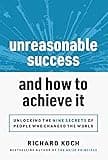
Richard Koch
163 highlights · 20 themes · 26 cited people/companies
Argues that unreasonable success comes not from superior talent or performance but from positioning yourself across nine specific 'landmarks' — four attitudinal (self-belief, Olympian expectations, thriving on setbacks, reality distortion) and five strategic (transforming experiences, own trail, personal vehicle, unique intuition, one breakthrough achievement) — proven by studying 20 historical figures from Bezos to Bismarck.
Success comes from inventing your own concepts and trail, not from copying someone else's proven approach — Koch's own firm floundered when they tried to replicate and succeeded only when they created original methods.
Competing on skill enters a race with many competitors and small prizes; competing on attitude (self-belief, expectations, setback resilience, reality distortion) enters a race with few competitors and enormous prizes.
Don't abandon or sell your personal vehicle prematurely — Jobs' return to Apple shows that a rackety old vehicle with potential can be radically reconditioned into the most valuable one in the world.
“Self-belief is the foundation of success. This is an iron rule. Nobody ever became unreasonably successful without a strong belief in themselves.”
“There are five interlinked components of Olympian expectations: • Expectations are set much higher than is normal. • Thinking big – not concerned with details but with changing the big picture. • Being unreasonably demanding of self and others – the standards had jolly well better be met, without exceptions or excuses. • Progressive escalation of expectations over time – no resting on laurels; more like an ever-expa…”
“Unreasonably successful people construct their own proprietary mental map to guide their steps. They create their own segment, which reflects their personality, their objective and their way of working, all at the same time. Nobody else can enter their skin; nobody else can enter their segment; it is impenetrable, because they fill it, and nobody else can.”
“Jobs’ terminology may have been unique, but all the players exhibited a reality distortion field. They changed reality because they thought they could. Not many people think this, and therefore not many people do it. Or to quote the Apple ‘Think Different’ commercial of 1997, ‘The people who are crazy enough to think they can change the world are the ones who do.’ If we want unreasonable success, we must first belie…”
“Here are examples of pool vehicles the players used. For Bill Bain, it was the theories of business strategy that had been originated by the Boston Consulting Group. BCG put its ideas such as the Boston Box out into the public domain to build reputation and sell business. When Bill Bain started Bain & Company, he was able to use all BCG’s concepts. They were high-octane stuff, fuelling a whole new industry. Jeff Bez…”
“It’s all about positioning yourself for success, not improving your performance The players we’ve met had unreasonable success because they ‘visited’ the nine landmarks, not, in most cases, because their performance was outstanding in other respects – indeed, in many cases, it wasn’t outstanding at all. This is very good news. If you can get the positioning right, your chances of high success rocket. You could spend…”
“Being anti-fragile does not mean being resilient – rather, it means positively benefitting from shocks, setbacks, risks and uncertainty. To innovate, he says, first get into trouble. Setbacks are a discovery mechanism; they also release excess energy, motivation and willpower. Exposure to failure is essential for success; we need ‘the light of experience gained by disaster’.11 Through imagination, courage and action…”
“One breakthrough achievement is another landmark. Our players mostly had one achievement which changed the world around them, propelling them to high fortune. Not several achievements; just one. If you know that, you must decide what your breakthrough achievement is, or could be, and how to hone it. Knowing you only need one such achievement – and the type of achievement that can work wonders – saves a lot of time,…”
“This chapter presents a simple but vital finding that is often neglected – for unreasonable success, we need our personal vehicle. All our players had a vehicle which multiplied…”
“• Be original. • Be different. • Be profitably different.”
“Transformations that occur in an unusual firm, before you start a new venture There was Jeff Bezos, working out the plan for Amazon while still working in that most remarkable of firms, D. E. Shaw & Co, one of the very few that knew how much the internet was going to change the world. Before Amazon was even born, Bezos was transformed, equipped, almost Messianic. There was Bill Bain, still within BCG, already transf…”
“Bain’s iconoclasm had six interlocking planks: • An extremely close relationship with the client organisation, and particularly its head. • Equality of status between the client organisation and the consulting firm (Bain & Company), and between the client’s CEO and the lead partner from Bain handling the client. • A long-term and continuous relationship, completely at odds with the consulting industry norm of specif…”
Sean Iddings and Ian Cassel
Shares Jeff Bezos, Amazon, and Bain & Company.
Tommaso Ebhardt
Shares Jeff Bezos, Apple, and Steve Jobs.
Barry Diller
Shares Steve Jobs, Amazon, and NeXT.
Patrick McGee
Shares Apple, Steve Jobs, and NeXT.
Edited by Nikkei Business Publications
Shares Apple, Steve Jobs, and Amazon.
Rory Sutherland
Shares Apple, Amazon, and Einstein.
“‘There is nothing,’ he wrote, ‘like returning to a place that remains unchanged to find the ways in which you yourself have altered”
“DESCO’s business bore no resemblance to that of the future Amazon, and yet DESCO gave Bezos the model for Amazon in four vital ways: • The template for a firm with incredibly high standards and brilliant people. • More specifically, the early discovery of the internet and its amazing growth potential. • Even more specifically, the vision for Amazon originated at DESCO. • Yet more precisely, the ideal first product for Amazon was identified at DESCO.”
“Shaw thought the most important decision any new firm can make is the type of people it will hire. He hired computer scientists and mathematicians because quantitative analysis was the firm’s power alley, but it wasn’t this focus which mattered most. What mattered was the intellectual firepower of his people.”
“How the Falklands experience transformed Thatcher • It gave her new, transcendent self-confidence. The Falklands crisis was the time of her life, said Robert Armstrong, when ‘she lived most intensely’.37 She was sure that only she could have done it. It was the defining moment, the greatest triumph of her whole career. • She thought it proved that Britain could regain its greatness. After her Falklands triumph, she went back to Downing Street, mingling with the people, young and old, singing Rule Britannia. ‘It was their triumph,’ she said. ‘We have ceased to be a nation in retreat.’38 • As Charles Moore said, her mindset was ‘both conservative and revolutionary. She saw herself as restoring an inherent British greatness … At the same time, she saw herself as bringing about enormous change.’39 • She went from being on probation with her Tory colleagues to complete dominance over them.40 • The full Thatcherite agenda to save Britain from socialism was now able to emerge. • Finally, the Falklands experience made Thatcher dangerously over-confident, intransigent and unwilling to listen to close colleagues. Her success in war made her increasingly intolerant, autocratic and unable to compromise.”
“The Boston team came up with some hypotheses that were to change business strategy forever: • Costs for any firm are not generally similar across all their products, even if these appear to be similar (e.g. ‘small motors’ or ‘grinding wheels’). • Prices across different products and to different customers may, however, be the same. If this is true, the high-volume products and customers will be more profitable. • Market share in carefully defined business segments (e.g., not ‘grinding wheels’, but ‘grinding wheels for car-makers’) is very valuable, because higher volume of the same product means lower unit costs. • A company probably has very different costs and profit margins across different products, depending on their volume in the correctly defined product/customer segment. It may make a lot of money on a few products and lose a bundle on most. • Typically, companies’ product lines are too broad. They should focus only on the ones where they are the market leaders or have the lowest unit costs – these two are usually the same. • A small company facing a bigger rival must segment the market and focus on one area or a few where it can become the largest in that segment, having the highest volumes of the relevant products and customers, and therefore the lowest costs. • Price is a potent competitive weapon. If lower prices enable a firm to gain market share and become the largest in a segment, and therefore have lower costs than any rival at that point, it is worth selling at a loss in the short term to build volume and competitive advantage. • Companies should strive to become and remain the lowest-cost competitor. Gain market share, then constantly reduce costs and prices to force rivals out of your heartland markets because they can’t make money there.”
“Transformations that occur in an unusual firm, before you start a new venture There was Jeff Bezos, working out the plan for Amazon while still working in that most remarkable of firms, D. E. Shaw & Co, one of the very few that knew how much the internet was going to change the world. Before Amazon was even born, Bezos was transformed, equipped, almost Messianic. There was Bill Bain, still within BCG, already transformed, already happily piloting the approach he would perfect in his own domain. This first model is the best – you can acquire ideas and authority, and start to experiment, while still employed by someone else. You become transformed on their dime. The firm you found is not really a start-up, more a continuation and personalisation – your personalisation – of a validated prototype. The new venture can be relatively low-risk, yet still high-return, both financially and, more important, psychically. Work for a strange, singular, surprising – and surprisingly successful – company. Look for one that is growing fast; that does things differently from its larger rivals; that focuses on a special subset of customers and that knows something the rivals do not know. Attain rare knowledge and confidence from what the firm knows. Next, work out how to use that special knowledge in a different way, just as Bezos did.”
“Like Bruce Henderson when he had discovered the Experience Curve, like Jeff Bezos when he and David Shaw worked out the blueprint for Amazon (and before Bezos left Shaw to start the new venture), like Bill Bain before he deserted Bruce Henderson to found Bain & Company, Einstein had been transformed. Like them all, he knew that he was privy to insights nobody else had, and that he would change the world. Similar transforming certainty affected three other people we have already met in these pages – Steve Jobs, Paul of Tarsus, and Viktor Frankl.”
“Transforming experience • Deliberately engineer possible transforming experiences • Search for defining moments – major events fuelling a sense of purpose and destiny • Become a different person because of transforming experiences”
“Churchill led Britain into total war without much thought for the morrow: he said he had ‘only one single purpose – the destruction of Hitler – and that his life was much simplified thereby’. —ROBERT TOMBS”
“There are four cardinal characteristics of a breakthrough achievement: • No one has done it before. • It encapsulates why each player left a permanent mark on the world. • Most of the players’ breakthrough achievements were forms of invention. • The achievements were highly personal and part and parcel of the individual’s character and idiosyncrasies. Perhaps their greatest achievement was to express themselves in a way which could not be ignored.”
“Jeff Bezos illustrates this. His breakthrough obsession and achievement was his peculiar vision for Amazon – the internet’s ‘everything store’ marked by unbeatable prices and customer service. Bezos made his vision a reality in a special, very unusual way. Do you realise how different Amazon is from almost all other companies? Can you imagine the fights there must have been in the boardroom when investors and managers wanted to raise prices so that the share price could be underpinned by real profits? Bezos alone clung to the creed that if you provide extraordinarily low prices and high customer service, your ultimate reward will be massive. Part of Bezos’ achievement comes from being pig-headed and dictatorial – he preaches; he insists that business should be done his way. There is a cult of Jeff at Amazon, just as there was – some would say, there still is – a cult of Steve at Apple. We can understand the Bezos cult from this – in March 2000 Amazon was worth $30 billion. Not bad. But today it hovers around $800 billion – twenty-seven times as much.”
“Steve Jobs’ breakthrough achievement was to create Apple as he envisioned it, to mould its DNA, charting its mission as a revolutionary digital simplifier. Under Jobs, Apple made devices never previously conceived, devices that are intuitive, superbly useful, beautiful, a joy to use. Walter Isaacson says that Jobs ‘built the world’s most creative company … to infuse into its DNA the design sensibilities, perfectionism, and imagination that make it likely to be, even decades from now, the company that thrives best at the intersection of artistry and technology.’”
“What about Bruce Henderson? He invented business strategy as we know it today, guiding BCG towards its two epoch-making displays, the Experience Curve and the Boston Box. He begat a unique and important company.”
“Disney was a harnesser and creator of visual and kinetic imagination, giving generations of children and adults part of their cultural heritage, and a spur to further originality and invention by many other ‘imagineers’, including many authors, film-makers and artists most beloved by children and adults today. His inventions are Disney’s legacy to the world, why he will always be remembered, and why, like every successful creator of unique characters, he still augments our imagination.”
“They all share this paradox – they are simultaneously varied in their work and it evolved markedly over time, yet each one’s whole range of output could not be the work of anyone else. They are their work and their work is them.”
“Einstein proceeded by deep thinking from first principles – he proceeded from irrefutable axioms and observations proven beyond doubt, building on each one to move towards a new hypothesis about the nature of the universe. Einstein’s breakthrough was his theory of relativity, altering forever the face of the Earth.”
“His strategic opportunism – which I have emulated, and commend to you as a route to unreasonable success – combined two elements usually seen as contradictory: • Extreme determination on strategy, yoked together with • Extreme flexibility on the means and timing of action, reacting to random events and grasping any opportunity they presented to advance his strategic objectives.”
“You may want to ask yourself: • What could I invent that would transform our lives and those of many other people? • What personal mission would energise me and transform my impact?”
“Summary and conclusion The breakthrough achievement of each player obviously depended on their unique circumstances and aspirations. But there are three important general findings: • By far the most common type of breakthrough achievement is invention. For most of the players, all their other achievements and efforts pale into insignificance when set alongside their single decisive invention. What might you invent? • Besides invention, strategic achievements seem most likely to arise from an overwhelming sense of destiny, mission, or desire to bridge seemingly irreconcilable gulfs of ideology, attitude or vested interests. Do you have any of these strong feelings? If so, nurture them. Singular achievement comes from singular convictions. • Strategic opportunism is one attractive route to a breakthrough achievement. You must know precisely what you want to achieve, but wait for the footsteps of opportunity to be audible before you strike. • The killer combination is extreme determination coupled with extreme flexibility regarding means and timing. If you are single-minded, yet patient, you will know the perfect time to act. Until then, keep your powder dry.”
“We have also seen the features of the breakthrough achievement which were common to all players; they invented something – a radical or revolutionary idea or objective – and knew how to carry it to fruition. They personified the idea, too, so that it was, and still is, associated with them.”
“Your skills – and improving them – are not the point. Far more important is what you try to do – the originality and reach of your mission, goal, destiny, whatever you call it, and your tenacity, nay, fanaticism, and luck in seeing it through to completion. • Your objective must be new, revolutionary, imaginative and almost laughably ambitious. • It must also be incarnated within your personality – it must come from the soul. • Ultimately, the ‘what’ – in Lenin’s stirring phrase, ‘What is to be done?’ – is more vital than the ‘how’. This landmark is the what. The other eight landmarks are the how.”
“One breakthrough achievement What will it be? 1. A new ‘invention’? 2. A personal mission? Desire deeply. Wait. Pounce.”
“You don’t want to be the best at what you do; you want to be the only one. —JERRY GARCIA”
“Unreasonably successful people construct their own proprietary mental map to guide their steps. They create their own segment, which reflects their personality, their objective and their way of working, all at the same time. Nobody else can enter their skin; nobody else can enter their segment; it is impenetrable, because they fill it, and nobody else can.”
“We can see this easily in the case of Jeff Bezos. It’s hard to describe Bezos except in terms of his own philosophy and vision for Amazon – the internet’s everything store with unbeatable prices and customer service. A business philosophy is not unusual – but what is rare is dedication to a philosophy, even when it appears to conflict with commercial common sense.”
“Companies – especially new ones, where capital is vital and costly, and the imperative is reaching cash break-even as soon as possible – almost never put their customers’ interests above those of their shareholders and employees. There is a struggle for survival which prevents that. There is always a tension between the long term and the short term, and the pragmatic corporate leader must strike a balance. In the short term it may be necessary to secure a company’s profitability and standing with its funders, even if this means compromising on customer service and value, because otherwise there may be no long-term future.”
“the problem with pragmatism is that it rapidly becomes a habit, and short-term gratification – expressed in profits, cash and the praise which goes with them – becomes a drug that drives out long-term customer-related aspirations. It takes a rare visionary – people such as Henry Ford, Ray Kroc of McDonald’s, Ingvar Kamprad of IKEA, and Southwest Airlines’ Herb Kelleher – to insist on rock-bottom prices; or, as with Steve Jobs, fantastic products and a simple, intuitive customer experience. It takes an exceptional person to take on the risk of this approach – the risk of going bust.”
“Bezos belongs in both camps. He is a price-simplifier and a proposition-simplifier. He wants customers to get a price never seen before, even if it means that break-even is deferred, and he also wants rapid expansion, to lower costs and prices, which might put the company in peril. At the same time he wants consumers to experience the joy of excellent products and service, at whatever cost to the company. Few businesspeople really believe in the creed of either the price-simplifier or the proposition-simplifier; yet Bezos believes in both.”
“In 1996, his favourite ‘Jeffism’ was Get Big Fast. The company that got the lead in online book retailing would probably keep it, would have the lowest unit costs and prices, the most customers, and could offer them even better service, and then move into other categories. But ‘when you are small,’ he warned, ‘someone bigger can always come along and take away what you have’.1 So he told Howard Schultz, founder of Starbucks, ‘We are going to take this thing to the moon.’”
“By early 1998, Bezos wanted to go beyond books and enter new product categories. Music and DVDs proved successful, but electronics less so, and toys were a disaster. Meanwhile, Bezos resisted every attempt by the board and his financial people to say when his seven expensive distribution centres would pay for themselves or when the company would break even – ‘If you’re planning more than twenty minutes ahead in this game, you’re wasting your time.’”
“Bain’s iconoclasm had six interlocking planks: • An extremely close relationship with the client organisation, and particularly its head. • Equality of status between the client organisation and the consulting firm (Bain & Company), and between the client’s CEO and the lead partner from Bain handling the client. • A long-term and continuous relationship, completely at odds with the consulting industry norm of specific and intermittent projects. • Exclusivity between the client organisation and Bain & Company both ways – as Bain told prospective clients, ‘We won’t work with your competitors, and you won’t work with ours.’ • Focus on increasing the value of the company organisation – strategy was the means to the end, not the end in itself; conversely, to Bain, ‘strategy’ meant ‘anything that we can help with which will increase the value of the client firm’. • Bill Bain believed in a top-down, quasi-military chain of command, both within his own firm, and in the client. What the lead Bain partner and the client CEO agreed should be done, would be done, by fiat, through the client organisation and in parallel with the Bain & Company organisation.”
“The Bain philosophy was audacious in the extreme. You can instantly see the benefits for Bain & Company – long assignments and ever-increasing consulting fees within the client company meant huge inbuilt growth and profitability. Yet it wouldn’t have worked if it didn’t reflect the reality that consultants could be vastly more useful within such a relationship. They could understand the company better than it understood itself, and ensure that the chief executive could implement whatever was necessary for radical profit improvement, without brooking opposition from powerful internal executives. These were ‘barons’ – heads of functions such as manufacturing or marketing, or of country operations – excoriated by Bain because they often acted to protect themselves and their people from profit-maximising change. When I defected from BCG to Bain & Company, I was amazed at how utterly dissimilar the two outfits were. They used the same intellectual capital, but in totally contrasting ways. Bain & Company worked within clients in a much more intensive, expensive and remorseless way, leaving very little to chance – so achieving extraordinary results.”
“• The first stage is to take a new field – or market – which is exciting and pregnant with possibilities, because knowledge is being discovered quickly, particularly knowledge or ideas which seem to contradict established theory or procedures. Part of the apparent genius of scientific or other discoveries is the choice of broad field from which to branch out into new speculation and discovery. • The next steps are progressively to narrow the field of enquiry, by building on the discoveries of the most unconventional and creative enquirers, and applying their insights, alone or in a new permutation, to a new avenue of speculation and experimentation, that could lead to a dramatically different picture of how the world works.”
“Success, when it comes, appears completely unreasonable – or at least surprising. Yet there may, after all, be some hidden subterranean rhyme or reason in the universe. Depth of willpower, depth of belief, depth of reach, depth of experience, depth of transforming skill and depth of character – good or bad – are needed to create change. Unreasonable success requires a singular path, and a singular personality. Our players were or are larger than life. All were profoundly original. Most were highly eccentric. To be ultra-successful requires the verve to be utterly different. To be unreasonably successful you need your own philosophy and deeply grounded beliefs. You need unique and authentic convictions before the world will take serious notice of you. Not only do you need to make your own trail. We are about to discover that you also need your own personal vehicle to drive towards your destination.”
“Make your own trail • High ambition often defined early or at start of career • Devise and follow own trail • Increasing focus over time • Develop unique philosophy”
“You must create something new which vastly increases your impact on the world. The players used their vehicles for three reasons: • Leverage – using the vehicles’ power, wealth, manpower, reputation, intellectual property and influence. • Collaboration – enabling the players to do what they couldn’t do themselves or couldn’t do well; supplying missing ingredients; building supporters. • Credibility and publicity – helping the…”
“Incidentally, Bain did not buy them with money – he kept most of that for himself. He mentored and inspired them, simultaneously giving them free rein, yet retaining control.”
“Bain & Company’s credibility came in a new way. Bain created a cult of secrecy around his vehicle. For many years his firm had no brochure, no website, wrote no memos or reports, had no business cards, and shunned publicity like the plague. All his sales were made by direct pitches to chief executives, and by references from existing clients to their peers in other companies.”
“Most basically, Bain & Company’s authority flowed from its unique positioning and intimacy with clients.”
“Jeff Bezos needs the leverage of his Amazon army to an even greater extent than Bill Bain did. Bezos too places enormous importance on the quality and ambition of those he recruits. To get big fast required him to build an enormous organisation. Collaboration was similarly vital. Because Bezos knew nothing about functions such as warehousing and logistics, when Amazon had to start investing very heavily in these Jeff hired the very best people he could find, backed them totally unless they failed, and fired them if they did. Credibility was also vital. It came by becoming the largest online retailer by far – later the largest retailer period – of books, and then of other products. And as we saw earlier, Jeff’s relentless focus on exceptional customer service and unbeatable prices underpinned Amazon’s rapid expansion. Again, the business formula was also the vehicle.”