Apple
Strategic Concepts & Mechanics
Primary Evidence
"Personal vehicles of players Player Personal vehicles created Bain Bain & Company; the unique Bain consulting formula; recommendations from client CEOs to other CEOs; Bain Capital Bezos Amazon; the Bezos business formula for Amazon Bismarck The Prussian state and army; North German Confederation; German state and military; successful wars against Denmark, Austria and France Churchill His opposition to Hitler; British state and Empire; their armies and people Curie Radium Disney Disney Studio; cartoons, movies and television; Mickey Mouse and later Disney characters; Disney’s personal WED corporation; Disneyland Dylan The folk movement; Columbia Records; songs and albums; fans Einstein Theory of Relativity; Zurich, Prague, Berlin, Caltech, Berkeley and Princeton universities; media Frankl Man’s Search for Meaning; lectures; awards; school of followers Henderson Boston Consulting Group (BCG); the Experience Curve and Boston Box concepts; Perspectives (short thought-pieces mailed to senior managers); BCG conferences Jobs Apple, NeXT and Pixar; Macintosh computers; Apple digital devices; Apple store; Apple apps Keynes The Economic Consequences of the Peace; King’s College Cambridge; The General Theory Lenin Iskra (Russian revolutionary newspaper); What Is To Be Done?; Bolshevik party; Russian state; military and secret police Leonardo His studio in Florence; his paintings, sculptures Madonna Record labels; albums, videos, movies; media; personal business ventures Mandela ANC; Robben Island prison; South African state Rowling Harry Potter Rubinstein Eponymous cosmetics empire; advertising and media; personality marketing and personal networking Paul of Tarsus City churches he founded; his letters (epistles) to them, Acts of the Apostles; Marcion and his pioneering New Testament canon Thatcher Conservative Party; British state and military; Falklands war; ‘Thatcherism’ programme in favour of free enterprise, against state business monopolies and abuses of trade union power"
"key takeaway here is that the steps of market development outlined in this book structured their entire effort: • They began with a target customer (disenfranchised citizens in developing economies who would be making their very first purchase of an Internet-enabled service) with a compelling reason to buy (access to all the content on the Web for free, plus communications for personal, family, and business purposes). • They figured out the whole product and determined for that product that the operators and the OEM device manufacturers were the critical anchor partners. • They then went after partners who shared their interest in the next two billion, with franchise interests in developing economies, and used their focused requests to create a big enough sales opportunity to get the attention of two world-class OEMs. • When it came time to “create the competition” (something we will get to in the next chapter), the whole ecosystem knew it was Apple and Google, two extremely powerful ecosystems"
"“Because I didn’t know it couldn’t be done, I was enabled to do it,” Atkinson says in Walter Isaacson’s biography of Apple co-founder Steve Jobs."
"Musk admired Steve Jobs and studied the period of his departure from Apple. “That ship was sailing really well,” Musk observed of the interregnum between Jobs’s departure and return, “... towards the reef.”"
"Musk decreed that PayPal be referred to as “X-PayPal” and that all stand-alone references to PayPal be scrubbed. X would prefix the entire ecosystem—including products like X-PayPal and X-Finance. “If you want to just be a niche payment system, PayPal is better. If you want to, say, Let’s, like, basically take over the world’s financial system, then X is the better name, because PayPal is a feature, not the thing itself,” Musk said. To him, naming the company PayPal “would be like Apple naming itself the Mac.”"
"Finally, of course, Steve had now regained the mantle of success. He had joined the ranks of billionaires. Nothing that happened at Apple would take that away from him. Even if Apple flamed out, his comeback would still be intact."
"When you added it up, there were many aspects of Pixar that had a big influence on Steve: becoming a billionaire, experiencing a stellar comeback in the eyes of the public, learning the ins and outs of the entertainment industry, enjoying a transformed relationship with Pixar, and bringing both business and creative imperatives into harmony. Combined with Steve’s aesthetic genius and product vision, these influences made for a very potent force as he jumped into the vortex at Apple. Indeed, Pixar may have been an interlude in Steve’s journey—one that remains the source of most of his wealth—but without Pixar one could make a case that the revolution ushered in by Steve’s second act at Apple might never have occurred."
"Steve was thrilled about selling NeXT to Apple. NeXT had launched its first computer in 1988 but had failed to compete in the burgeoning market for workstation computers. In 1993 it had shut down its hardware business to focus on selling its operating system and development software. In selling the company to Apple, Steve had found a face-saving parking place for NeXT, and a chance to keep its advanced software technologies alive. It was no wonder he was excited about it. “NeXT’s software will be the core of a new-generation operating system for Apple,” he told me after the sale. “They really need it.” As Steve’s responsibilities at NeXT began to wind down, I wondered if his day-to-day involvement at Pixar might increase from the weekly visits that were now his custom. But nothing changed. Pixar was steadily working on A Bug’s Life and Toy Story 2 and putting the expansion plan into place. Steve seemed happy with the way things were working at Pixar and he showed no inclination to change"
"On the best days, Steve would eagerly show me the products he was working on at Apple. I first listened on an iPod, talked on an iPhone, and played on an iPad in Steve’s office at his home. He invited me to all of Apple’s big product announcements where I sat quietly at the Moscone Convention Center in San Francisco as he mesmerized the world year after year. I even saw the stunning designs of a yacht that Steve dreamed about building. Steve’s aesthetic genius extended far beyond the domain of technology."
"On the other hand, Japan's business model was of a 'vertically integrated' type, where manufacturers assembling the final product co-develop and produce with parts manufacturers. However, they have become unable to compete in terms of cost with the business models of Apple and Samsung, which aim for massive scale with overwhelming network scale."
"If you want a long-lived brand, avoid strategy altogether — instead have an Ideal (like Nike, Apple) or an executional device (Andrex, The Economist). Anything with a strategy is doomed never to outlive your client. Discuss."
"The street finds its own uses for things, as someone once said. And isn’t it interesting how many successful brands eschew user imagery. easyJet works hard to deposition itself — to be socially neutral. Apple uses dead people or silhouettes. BMW for years had a rule that no people could be shown in its ads (an especially wise move as not even BMW drivers like other BMW drivers — or anyone else for that matter; note to BMW … don’t try starting a social network). Is Red Bull an energy drink or a mixer? What is the user-imagery of Amazon? Who is the typical Google user? What makes Google better? The fact that we cannot answer these questions simply would typically be considered a flaw."
"The super single-item strategy strengthened consumers’ high brand awareness of Moutai liquor while creating ample and leisurely marketing and profit space for channel merchants. Globally, only Apple’s iPhone in the United States achieved similar success."
"As Blankenship began working closely with Musk, he found some similarities to Steve Jobs, but also key differences. Jobs had likewise been super focused on many aspects of the business. With Jobs, he had spent their hours-long meetings delving into such details as the wood grains to be used for the legs of the tables that the stores would need to showcase their products, or else weighing the position of the holes that would be cut into those tables to accommodate cords—even discussing the size and shape of those holes. While Musk could be super focused on engineering issues or car design, he had less interest in other parts of the business, such as how the stores should look. He wanted it to be like Apple—he wasn’t up to picking wood grains. With Jobs, Blankenship had gone through several iterations of the store design in a physical warehouse; for Musk, all that was needed were some renderings. “Is that what it should look like?” Musk would ask Blankenship, sincerely. Blankenship explained there would be graphics on the walls and places for storage for apparel and brochures. It would be reasonably inexpensive to build—an open layout with the car at the center of attention. “OK,” Musk said, and left it at that."
"In early 1972, with his cash balance growing and acquisition multiples still high, Singleton placed a call from a midtown Manhattan phone booth to one of his board members, the legendary venture capitalist Arthur Rock (who would later back both Apple and Intel). Singleton began: “Arthur, I’ve been thinking about it and our stock is simply too cheap. I think we can earn a better return buying our shares at these levels than by doing almost anything else. I’d like to announce a tender—what do you think?” Rock reflected a moment and said, “I like it.”4 With those words, one of the seminal moments in the history of capital allocation was launched. Starting with that 1972 tender and continuing for the next twelve years, Singleton went on an unprecedented share repurchasing spree that had a galvanic effect on Teledyne’s stock price while also almost single-handedly overturning long-held Wall Street beliefs."
"Notice that ‘shaping the market” is different from a “first mover advantage.” The company that introduces a radically new product may not be the one that reaps the most profit—think of Apple with the Newton.106 Often the first mover—the one who invents the product or service—loses to a competitor who improves it, packages and supports it better, or establishes its version as a standard, as when the VHS video tape format replaced the technically superior Betamax."
"Consider the original Apple ad for the Mac that ran during the 1984 Super Bowl—it helped create a cadre of loyalists that have kept the company alive for 20 more years, despite the fact that for years, Apples were slower and more expensive than comparable PCs from Dell, HP, or IBM.96 It is not uncommon to read postings on the Mac Internet forums urging people to buy some accessory or software “to help support Apple.” Similarly, many people drive the 300 mile roundtrip from my home in Atlanta to Birmingham, Alabama, to fly Southwest Airlines, and…"
"But, you might ask, what about your bank account? If that information were public, wouldn't bad actors simply take your money? They might, which is why we need to construct systems that don't just require a number that you have already shared with others to authorize payments. Apple Pay and Android Pay are such systems. Every transaction requires an additional form of authentication at the time of transaction. Two factor authentication systems will become much more common in the future for any action that you will take in the digital world. In addition, we will rely more and more on systems such as Sift Science, another USV portfolio company, that assess in real time the likelihood that a particular transaction is fraudulent, taking into account hundreds of different factors."
"in 1985 Apple’s new chairman, John Sculley, gave in to Gates’s demand to discontinue development of the MacBasic language for Macintosh and sign over rights to the MacBasic name to Microsoft. According to Sculley, Gates indicated that if Apple did not give up the project, he would suspend Apple’s license to use the competing Microsoft language on its popular Apple II computer. “[Gates] insisted that Apple withdraw what was an exceptional prod¬ uct,” claimed an Apple software engineer. “He held the gun to our head.”70 In a similar vein, internal documents of Intel indicated that at an August 1995 meeting, Gates made “vague threats” to support com¬ petitors of the semiconductor producer if it did not cease development of software that he viewed as a danger to Microsoft’s interests. Intel did in fact, delay the project. Chairman Andrew Grove characterized that decision by saying that his company “caved in” to Microsoft’s de¬ mands.71"
"Musk admired Steve Jobs and studied the period of his departure from Apple. “That ship was sailing really well,” Musk observed of the interregnum between Jobs’s departure and return, “… towards the reef.”"
"Musk decreed that PayPal be referred to as “X-PayPal” and that all stand-alone references to PayPal be scrubbed. X would prefix the entire ecosystem—including products like X-PayPal and X-Finance. “If you want to just be a niche payment system, PayPal is better. If you want to, say, Let’s, like, basically take over the world’s financial system, then X is the better name, because PayPal is a feature, not the thing itself,” Musk said. To him, naming the company PayPal “would be like Apple naming itself the Mac.”"
"It wasn’t simply Apple dreaming up new ideas for its manufacturers to execute. Rather, it was a collaborative process between Cupertino and Shenzhen. “[[Apple products are] not designed](private://read/01k3jwt46q240aq6fe12mqkyr0/16_Notes.xhtml#_idTextAnchor356) and sent over. That sounds like there’s no interaction,” Apple CEO Tim Cook once told an interviewer. The idea of having something designed in California and manufactured elsewhere “requires a kind of hand-in-glove partnership.” [In 2019, United Airlines made](private://read/01k3jwt46q240aq6fe12mqkyr0/16_Notes.xhtml#_idTextAnchor357) a promotional banner about how valuable Apple was to its business. United wrote that Apple booked fifty business-class seats daily from San Francisco to Shanghai, from which the airline made $35 million each year. That’s over eighteen thousand business-class seats on one route."
"Apple and Tesla have made a huge effort to train its Chinese workers to manufacture their products—and earned fabulous sums of money by doing so. These stories are replicated in varying degrees across China’s other communities of engineering practice, production hubs for shoes and garments in the eastern city of Wenzhou, medical equipment in Wuxi and Suzhou, and, most wonderfully of all, guitars in the mountains of Guizhou’s Zheng’an County. Overall, China’s manufacturing workforce employs more than a hundred million people, around eight times that of the United States. That is a big stock of people who are fueling the creation of new process knowledge."
"The magic of Shenzhen is the combination of the world’s most creative hardware engineers sitting in a sea of components that improve every year amid a labor force of millions who know how to put together electronics. This buzzing ecosystem has produced many other products that follow in Apple’s wake, like hoverboards, electric scooters, virtual reality headsets, and who knows what’s next?"
"Low-wage ecosystems like Shenzhen became a giant magnet for US process knowledge. Beijing made a deliberate decision not to be like Japan, which kept its market limited to American companies; rather, China mostly welcomed foreign manufacturers to train its workers. It is some sign of China’s economic openness that so much of its exports are driven by Apple and Tesla, while Japanese exports have been driven almost entirely by its own companies. After it built up a critical mass of process knowledge, however, Shenzhen became as much an innovator of new electronics as an implementer of American ideas."
"In 2020, Foxconn employed nearly [a cool million workers](private://read/01k3jwt46q240aq6fe12mqkyr0/16_Notes.xhtml#_idTextAnchor346) globally. As iPhone production swung into full gear a decade ago in Shenzhen, workers might have seen someone zooming around the campus on a golf cart. That would be Terry Gou, founder of Foxconn (also known as Hon Hai Precision Industry). Gou might start the day by doing laps in the company pool and then drive [his own golf cart](private://read/01k3jwt46q240aq6fe12mqkyr0/16_Notes.xhtml#_idTextAnchor347), specially equipped with a bicycle bell, around the facility until late at night to monitor production. He is legendary in his native Taiwan for his dedication to work. Gou aggressively courted American companies like Dell and Apple to win contracts for manufacturing their products, earning their trust by guarding technical secrets and making products on time, at high quality, in massive volume."
"China leads the world in deploying ultrahigh-voltage transmission lines, high-speed rail, and 5G networks. Chinese manufacturers make machine tools—die-casting machines, steel presses, robotic arms—that approach German and Japanese levels of quality. They’ve muscled out most other Asian competitors on consumer electronics. Phone makers like Huawei, Oppo, Vivo, and Xiaomi tapped into the worker and component ecosystem that Apple helped to build. In 2025, the world’s largest phone makers are Apple, Samsung, and a half dozen Chinese firms that concentrate on sales to developing countries."
"[A 2012 story](private://read/01k3jwt46q240aq6fe12mqkyr0/16_Notes.xhtml#_idTextAnchor358) in the *New York* *Times* reported that Apple needed to hire nearly nine thousand industrial engineers in the earlier days of iPhone production. The company’s analysts expected recruitment to last nine months to hire that many engineers in the United States. In China, they were able to do it in two weeks. A large pool of good labor increases the speed of design and production cycles. As Tim Cook once said, “[In the US, you could have](private://read/01k3jwt46q240aq6fe12mqkyr0/16_Notes.xhtml#_idTextAnchor359) a meeting of tooling engineers and I’m not sure we could fill the room. In China, you could fill multiple football fields.”"
"the companies we highlight survived the peaks and valleys of business realities, and most thrived. With iterations of both failure and success, they developed the most advanced business systems on the planet. The very best defied the odds and became exceptional. The truth is that their secrets are hardly secrets at all—continuous improvement, rigorous benchmarking, disciplined investment, principled leadership, solid business systems—but these practices have been long forgotten, ignored, or dismissed by the businesspeople hypnotized by the Google-Amazon-Apple dream."
"To Balsillie, RIM was in an existential crisis, mired in what he describes as “strategic confusion.” The company’s business had been disrupted on several levels, with no obvious path forward. Was RIM supposed to defend the QWERTY keyboard, or jump all-in and become a touch-screen smartphone maker? Was it supposed to challenge Apple at the high end of the smartphone market or focus on the lower end with devices like its Curve and Gemini models, which were driving heady sales gains in foreign markets where Apple wasn’t yet a factor? Should the company stick to its closed, proprietary software technology or open its platform? One of the biggest puzzles was what to do about apps. For years Balsillie had fought carriers for the right to sell apps to customers, reassuring them RIM was “constructively aligned” with the wireless carriers. Then Apple waltzed in with an app store despite AT&T exclusion from any app revenues. Now RIM was forced to play catchup. Unlike RIM, Apple had an army of outside developers who had already built consumer apps for its computers and iPods and were primed to do the same for the iPhone. By the time BlackBerry launched its app store in spring 2009, iPhone customers had already downloaded 1 billion apps.2 But, Balsillie wondered, was RIM taking the right approach or should it stick to its “constructive alignment” narrative and leave the sale of apps to carriers? Balsillie struggled with each question. “I was strategically confused for a period of time when the game changed,” he says. “There was tremendous limbo-esqueness. Where do we dance? Apple had the same strategy clearly in 2007–08 that we had in 1999, and now we had to re-examine” every element of RIM’s approach. “The Storm failure made it clear we were not the dominant smartphone company anymore. We’re grappling with who we are because we can’t be who we used to be anymore, which sucked.… It’s not clear what the hell to do.”"
"Apple changed the competitive landscape by shifting the raison d’être of smartphones from something that was functional to a product that was beautiful. “I learned that beauty matters.… RIM was caught incredulous that people wanted to buy this thing.”"
"As the quality debate raged, Balsillie turned his attention to another dilemma: how to protect and build RIM’s nondevice revenues. RIM’s supremacy in wireless e-mail had left carriers beholden to paying for access to its complex data traffic system. RIM increasingly relied on those fees; they accounted for $2.2 billion of revenue, or 14 percent of the total, in the year ended February 27, 2010. But because the fees had significantly higher profit margins than handsets, they accounted for most of the company’s $2.5 billion net income. That left RIM in an awkward position against Apple and Google. Apple made money selling songs, movies, e-books, and apps to iPhone customers—content that consumers willingly bought. Google wanted Android on as many smartphones as possible to increase the reach of its powerful and popular advertising-supported search service. RIM’s dominant source of extra revenue, by contrast, was fees extracted from reluctant carriers, who despised paying them."
"CA’s hardheadedness in sales and marketing is paralleled in its pragmatic approach to software development itself. Unlike most companies, CA has been able not only to make decisions quickly—how and why, we'll get into shortly—but also to im- plement quickly. Its genius at software development is not the genius of inspiration but of putting together the right people to do the right jobs now so that it can all be ready next week, not next year. This is not academic but industrial, not science but engineering. When a new basic principle of thinking machines is discovered, CA will not be the one to do the discovering but will instead have a dozen commercially attractive products or enhancements to existing products up and running on com- puters as diverse as IBM mainframes and Apple Macintosh desktops, and many capable of working at the same time with different types of software. “Not invented here” is not a problem at CA. Maybe it wasn’t invented here, but hell, it works."
"The next time Foxconn really demonstrated its ambition and capabilities was for a product Apple hadn’t even commissioned it to build. In the early summer of 2003, Terry Gou’s company invited a group of people from Apple Product Design and Operations to Longhua for some show-and-tell. Gary Hsieh, a general manager at Foxconn whom one industry colleague describes as “a completely rogue entrepreneur,” led the meeting. He unveiled a third-generation iPod—only, it wasn’t made by Apple. It was a replica, made in-house. The Apple people passed it among themselves, marveling at Foxconn’s ability to reverse-engineer the iconic music player. The replica had a different skin on the outside, but the same display, scroll wheel, and buttons. Even how it operated and played music was nearly identical to the real thing. “It was as if our own software-hardware team had built it,” says an Apple engineer who was there. The point Foxconn was making was simple: *If we can build a replica of this quality without your training our staff or sending the official specs, imagine what we could build as real partners.*"
"But Amelio deserves credit for three major actions—in hardware, finances, and software. The sale of the Fountain factory was the first. It gave Apple critically needed cash and would later spur a whole new strategy in how to build computers. Then Amelio and finance chief Fred Anderson orchestrated two deals to stave off bankruptcy: a week before Apple owed Japanese lenders $150 million, in April 1996, they got a six-month extension. Then in June, they raised $661 million in an oversubscribed bond sale. But Amelio will always be remembered for the third action. He realized that a multiyear effort to improve the Mac’s operating system was hopeless, and that Apple needed to acquire a new OS altogether. That insight set into motion the action that would get him sacked, even as it saved the company. He brought back Steve Jobs."
"Daniel Vidaña, a director of iMac supply management, says the scale Cupertino required was “insane.” On average, Apple was selling 5,000 iMacs per day. The operations team had to be ultra-efficient to avoid hemorrhaging cash, as the iMac was meant to be a low-cost product that families would buy. The multiple color options, he adds, amplified complexity and uncertainty. “I was in charge of the planning side of things,” Vidaña says. “I was telling the factories every week which colors, which models, had to be built. That was sent to our logistics teams and the manufacturers, but they weren’t doing it. Every day we got a report saying, ‘This is what we built.’ They were not adhering to our plan. They were not building what we wanted; they were building what was easiest for them. And they were only building in quantities they could manage or handle in the supply chain.”"
"“What he was really saying was that it’s a typical thing for people—even in business negotiations with a supplier—to try to figure out: What’s a reasonable thing to ask them? What are they likely to be able to do?” Paley says. “Whereas he was kinda saying, ‘You have no clue! You have no idea what the supplier might actually be capable of. So don’t be afraid to ask for the moon. Ask for everything you want. Ask for everything you need. If they can’t do it, they’ll say no.’ ”"
"Cook established exceedingly high expectations the first time he held an operations meeting of worldwide managers. In the weekly review, attendees went over what had gone wrong in the prior days, what needed to be fixed immediately, and what was coming up. These meetings were typically ninety minutes; sometimes they could stretch beyond two hours. On the day Cook took over, the weekly review went nearly thirteen hours. He insisted on a granular level of understanding and demanded fluency in the intricacies of every project. If a manager one week, in a lengthy presentation, projected that their team would ship 200,050 of something by Friday, Cook would remember. So the next week, if the manager said, “Yep, we met our numbers. We did two hundred thousand,” Cook would look at them and ask, with deadly seriousness: “And fifty?”"
"The third floor of Inventec’s Taiwanese factory felt perfectly adequate when Apple was shipping iPods in the tens of thousands per month. When orders jumped to hundreds of thousands, it felt comically inadequate. “All of a sudden there were parts not only in the loading dock but up the stairwells in every cavern of that factory,” recalls a product designer. “There were boxes of parts that just literally took over the entire factory building. It was overflowing into the stairwells and emergency exits. There were parts *everywhere*. It went from nothing to ‘Oh my god, there’s not enough space to build these things.’ ”"
"David Tupman was in Scotland traveling to a wedding reception from the ceremony when an old friend said he’d just gotten a job at Apple. The chance encounter was in the summer of 2001, and it would alter the trajectory of his entire career. Both men had worked at Psion, a UK-based computing company that in the late 1990s made subnotebook PDAs, messaging devices with a full keyboard and packaged in a clever clamshell. Tupman was enamored with Apple designs and mentioned he’d love to work there. Well, good news: Apple was hiring engineers. Tupman sent over his CV, detailing his niche experience in Asia working with silicon and hardware to make handheld electronics. Within days he received a phone call from Tony Fadell."
"Thinking of Apple’s investment like a government program is instructive. Year in, year out, China didn’t have the talent or expertise to build the products that Jony Ive’s studio conceived, but the engineers Apple hired out of MIT, Caltech, and Stanford, or poached from Tesla, Dell, and Motorola, routinely got them up to speed. Apple could send a caliber of talent to China—what one Apple veteran calls “an influx of the smartest of the smart people”—that no government program ever could. And the culture was such that the Apple engineers would work up to eighteen hours a day. Moreover, whereas a government program could at best train a workforce to engineer products, it wouldn’t have the ability to actually purchase the goods. But Apple could and did."
"Jobs eventually canceled the other phone ideas and declared multi-touch the future. He was adamant there’d be no keyboard, so the phone would be as full screen as possible. Apple’s engineers suddenly had to find suppliers that could build multi-touch displays at scale—something that didn’t exist at the time. There was no way Apple could send the specs to some factory and wait for the parts to be built; instead, it sent teams of engineers to Japan, Korea, Taiwan, and China to find hungry vendors it could work with to co-create the processes. “There were a few truly groundbreaking mass production processes we were involved with, where we really had to go around to find the best people in the entire world—the peak of what humans have developed for some of these technologies,” says a product manager. By early 2006, they had a full-screen prototype enclosed in brushed aluminum. Jobs and Ive “were exceedingly proud of it,” journalist Fred Vogelstein would later recount. “But because neither of them was an expert in the physics of radio waves, they didn’t realize they’d created a beautiful brick. Radio waves don’t travel through metal well.”"
"Apple was different: under the design direction of Jony Ive, Apple’s product portfolio remained radically simplified. Even by 2015, Apple was only releasing two new iPhones a year. They were hand crafting luxury phones but doing it in mass-market quantities. In their search for suppliers, Apple gravitated toward quality, not price. To reach that quality, Apple had to come up with new processes to make the phones; but until Apple chose a new design these processes wouldn’t exist. So it had to work far more intimately with suppliers. “Apple influenced the entire manufacturing process because what they were doing was so unique. Nobody else was doing this, so Apple had to fund that equipment,” says Brian Blair, a tech analyst who repeatedly toured Apple’s suppliers back then. He uses an analogy from the automotive world: it’s one thing for Volkswagen or GM to make 10 million cars a year; what Apple was doing was akin to making 10 million Ferraris a year."
"Given Apple’s scale and manufacturing concentration, the result of this strategy is that Apple spawned the formation of major industrial clusters in which engineers from Cupertino would teach multiple factories how to, say, shape glass for the iPhone. So instead of being beholden to Lens Technology—the company that cut and tempered Corning glass for the first iPhone—Apple would constantly send engineers from Cupertino to train its rivals. That kept Lens on its toes, lest Apple choose a different supplier for the next-generation iPhone—a potential catastrophe as Apple, by 2015, was producing a quarter billion iPhones per year. Moreover, it kept Lens from raising its prices. So any company supplying Apple with some component was preemptively thwarted from believing it had any power to exert, because Apple made it known that it had options."
"Indeed, the industrial clusters supported by Apple’s gargantuan investments were so significant that other phone makers came under tremendous pressure to keep up. But lacking a playbook or the detailed knowledge of how Apple operations worked, they turned to Chinese suppliers for help, giving over intellectual property in exchange for a speedy response. “They all completely abdicated,” says Horace Dediu, the former Nokia executive who now runs the market intelligence group Asymco. Apple, in other words, set in motion a series of events that helped Chinese suppliers win more orders and advance their understanding of cutting-edge manufacturing. At the same time, Western manufacturing of electronics atrophied."
"Supporters of the R&D hubs say the negative view of them reflects the insecurities of engineers in Cupertino, who were losing their power as more decision-making got done in China. Before the hubs were built, Apple had been sending so many engineers to China on temporary trips that Cupertino convinced United Airlines to begin direct flights from San Francisco to Chengdu, three times a week, arguing that Apple would regularly buy enough of the thirty-six first-class seats to make it profitable. The 6,857-mile flight became United’s longest nonstop flight. Two years later, Apple again convinced United to begin flying nonstop—to Hangzhou, a tech hub on the outskirts of Shanghai. “Hangzhou is a bit of a schlepp from Shanghai,” says a former Apple executive. “Yes, you can take a bullet train, but for all the American guys getting off the plane from Cupertino, navigating the train station is kind of complicated. So Apple basically said to United, ‘Look, you put up a flight to Hangzhou and we’ll fill it for you.’ ” Apple’s signature line had long been that its products were “designed in California,” but the hubs began to indicate otherwise. China’s influence was growing, and as the hubs performed more work, the engineers there would openly question the need for so many of their counterparts to constantly fly in from America."
"Indeed, the industrial clusters supported by Apple’s gargantuan investments were so significant that other phone makers came under tremendous pressure to keep up. But lacking a playbook or the detailed knowledge of how Apple operations worked, they turned to Chinese suppliers for help, giving over intellectual property in exchange for a speedy response. “They all completely abdicated,” says Horace Dediu, the former Nokia executive who now runs the market intelligence group Asymco. Apple, in other words, set in motion a series of events that helped Chinese suppliers win more orders and advance their understanding of cutting-edge manufacturing. At the same time, Western manufacturing of electronics atrophied."
"The success quickened Apple’s consolidation into China. The low cost of manufacturing played a role, but it was the ubiquity of labor, workers’ flexibility, the presence of “next door” suppliers, and tailor-made export policies that were groundbreaking. “Any time you had some problem or change, you could get a mountain of people to follow you down to the X-ray room or to the testing lab or to the sourcing lab to get materials or parts, or to try some machining or something. It was all right at your fingertips,” says one PD engineer who also worked in Korea and Taiwan. “Anything we wanted, we could get it,” this person adds. “If they didn’t have it, they’d go buy it. We’d send ’em out to the store at two in the morning to get some measurement device or some material to remove something or to apply something so it would work better.” Summing up what made the experience so distinctive, he said, “It was just the total control of those factories and the people there—whatever we needed, it would happen.” A manufacturing engineer recalls trying to get somewhere during a shift change one day, when tens of thousands of people were exiting the factory and heading back to the dorms. “It would take you forty-five minutes or an hour just to go less than a kilometer,” this person says."
"Apple took extraordinary control over its suppliers to ensure it was getting the appropriate prices. It demanded access to every detail about the supplier’s operating costs, from the wages of its workers and the cost of its dormitories to the bill of materials and expense of the machinery. In fact, Apple often had a better sense of the suppliers’ operational costs than the supplier itself. Because rather than have the supplier purchase the raw materials needed for whatever component it was manufacturing, Apple procured these components on their behalf—a power move that obfuscated from the supplier what the prices were. The tactic had emerged around 2010, when Foxconn was trying to earn extra money by purchasing components at one set of prices, then billing Apple a higher cost. Apple responded by “disintermediating” Foxconn. Another motivation was simply that, when annual iPhone shipments ran into the tens of millions per year, and then into the hundreds of millions, Apple realized it wasn’t good enough to assume its suppliers would secure enough raw materials—the only way to ensure this was to be involved in negotiations directly. The power this team wielded was enormous: up to 1,300 people all reporting to Tony Blevins."
"Indeed, the industrial clusters supported by Apple’s gargantuan investments were so significant that other phone makers came under tremendous pressure to keep up. But lacking a playbook or the detailed knowledge of how Apple operations worked, they turned to Chinese suppliers for help, giving over intellectual property in exchange for a speedy response. “They all completely abdicated,” says Horace Dediu, the former Nokia executive who now runs the market intelligence group Asymco. Apple, in other words, set in motion a series of events that helped Chinese suppliers win more orders and advance their understanding of cutting-edge manufacturing. At the same time, Western manufacturing of electronics atrophied."
"It’s no exaggeration to say the iPhone didn’t kill Nokia; Chinese imitators of the iPhone did. And the imitations were so good because Apple trained all their suppliers. Cook didn’t want Apple to be the developer of the world, and it wasn’t. It did, however, become the developer for China."
"Apple’s messaging wasn’t public, but if it had been, it would’ve turned received wisdom on its head. In 2017, a *Wall Street Journal* article had opined: “Longer term, though, Apple’s business is out of step with the Chinese government’s goal to reduce its dependence on expensive foreign technology, and facilitate the development of homegrown competitors like Huawei.” In fact, the opposite was true. The technology transfer that Apple facilitated made it the biggest corporate supporter of Made in China 2025, Beijing’s ambitious, anti-Western plan to sever its reliance on foreign technology."
"Just twenty-two days after their meeting, Apple announced a $1 billion investment in the ride-hailing start-up. Liu said it happened “like lightning.” The investment stunned tech observers. Sure, Apple had acquired plenty of companies outright in the past, and it certainly had the cash, but the Cupertino behemoth almost never took a stake in a start-up—especially not an app developer that competed against rivals within its own ecosystem. It was the largest single investment Didi had ever received. Cook’s explanation didn’t exactly hold water: “We are extremely impressed by the business they’ve built and their excellent leadership team, and we look forward to supporting them as they grow.” His comments weren’t wrong so much as beside the point. Hundreds, even thousands of app companies would have been good investments since the App Store debuted in 2008, but Apple hadn’t bought a stake in any. Most observers had an inkling of what was really going on. “The deal seems like a calculated move by Apple to curry favor in China,” wrote *The Information*."
"The point, however, isn’t to condemn Cook or Apple. It’s to convey the predicament they’re in. At the turn of the millennium, Washington made a bet on China—a bet that free trade would liberalize the country and perhaps catalyze the creation of the world’s biggest democracy. Instead, trade enriched China and empowered its rulers. Cook shouldn’t be blamed by politicians for enmeshing Apple’s operations in China two decades ago, but he has erred by doubling down over the past decade despite mounting evidence that Xi has been ramping up repression at home and taking a more combative stance in international affairs. “You can say that we read them wrong, that we misunderstood China. But Jack Ma read China wrong, too. Every entrepreneur read China wrong,” says a supply chain expert who has lived in the country. “You look at what Deng Xiaoping and Hu Jintao were promoting—the [business class] didn’t see this coming. Xi changed the game completely. He’s another Putin in the making.” This person adds, “Look, I’m not a Cook fan. But you have to be sympathetic. He didn’t know what he was dealing with. Nobody did.”"
"Guthrie argued this was a mistake. And he was purporting to solve a major riddle: why Apple was perceived as a negative force in Beijing. Apple contributed greatly, creating millions of jobs and supporting a sophisticated supply chain that ricocheted well beyond its own needs. But its contributions were unknown because of Apple’s secretive, insular culture. He advocated something radical: Get the message out to everyone, sing it from the hilltops if necessary, until every government official understands just how much the country is gaining from Apple’s presence. “China wants the constant learning,” he says. “The fact that Apple helps bring up 1,600 suppliers for China—it’s an incredible benefit.”"
"Jobs’s newfound enthusiasm brought out the best parts of his character: curiosity, leadership, and an ability to articulate a product path. But it brought out his worst traits, too: arrogance and a habit of belittling others. De Luca, the head of Apple marketing, recalls his embarrassment. The “Apple people” Jobs was referring to were account managers for some of Apple’s biggest clients, and their boss was humiliating them. Griffiths felt bad for them. A third person present says: “Even the account manager, who is going to pay their mortgage based on whether Michigan buys this stuff or not, was told to leave.”"
"“I don’t remember, ever, a strategic withholding of information,” says a former Apple industrial designer. “All we cared about was making the most immaculate thing… We were inventing every day. Every day you’d invent your way through a problem. It was absolutely wonderful as an experience. But I guess we were unwittingly tooling them up with incredible knowledge—incredible know-how and experience.”"
"Jony Ive emerged from the hard reset with newfound powers and influence. Jobs had made it crystal clear that ID’s zero tolerance for defects was integral to a new culture that would cascade across product development and then throughout the organization. The new approach hit Apple in waves. “I remember these other groups being like, ‘I’m glad I’m not in your shoes!” ’ Hoenig says. “But sure enough, it just literally rippled through the organization over the course of a year, and every group eventually suffered.” Engineers in other departments gained a respect for Ive because of his diplomatic skill. “What Jony did was—he understood that Steve’s cruelty, his savagery, his impatience would cause people to split and just quit the company,” says a senior person on the project. “That happened a lot. And he would run interference with them. He was a Steve handler as much as he was a visionary, detail obsessed, brilliant designer.”"
"Amelio declared that he needed a hundred days of reflection before he’d lay out his plan. That left an already-distressed company, which had recently cut 1,200 jobs, rudderless for fourteen weeks. The hundred days came and went without any brilliant ideas emerging from the CEO’s office. Amelio cut Apple’s dividend and took other actions to improve finances, but he failed to steer the company in a clear direction. Desperate for a plan, Amelio hosted what he called “coffee klatch” meetings on Fridays, to which he’d invite employees at random in the hopes that someone, somewhere, had an idea."
"An electronics client didn’t necessarily understand this, but the reason Terry Gou’s factories had world-class machinery is that the local government had subsidized them, if not outright purchased them. This was part of a quid pro quo with government officials who were judged by, and desperate for, growth. “Uncle Terry,” as Apple would come to know Gou, was more adept than any of his rivals in convincing government officials to provide land and machinery and introduce a spate of policies tailor-made to promote exports."
"Cook, often asked how he feels about all this, has suggested Apple is some kind of change agent. “Your choice is, do you participate? Or do you stand on the sideline and yell at how things should be?” Cook said in 2017. “My own view—very strongly—is you show up and you participate. You get in the arena. Because nothing ever changes from the sideline.” But White says Cook isn’t participating so much as being used—like when he accepted, in October 2019, a role as chairman of the advisory board at the Beijing-based Tsinghua University School of Economics and Management. “The role that they want Tim Cook to play is Useful Puppet, one that they can use for propaganda purposes,” she says. In her view, Samsung operates at a considerable business disadvantage because South Korea is a democracy with NGOs, trade unions, and a vibrant press that, for instance, has interviewed grieving parents after some workers developed leukemia from working in factories. “Apple doesn’t have any of that possible pressure,” White says. “Apple actually has a government that prevents all of those key stakeholders in society from writing an article or appearing on television. They can’t even protest.”"
"Cook’s disdain for mediocrity was similar to that of Jobs, but it manifested itself in an entirely different way. He would persistently ask his managers for layer upon layer of information that flummoxed poor performers and exposed bullshitters. Parents know it takes only a few rounds of a toddler asking, “Why?” before their knowledge is exhausted, leading to frustration and made-up answers. Cook’s questioning was like that. He exhibited a memory and an understanding for data and planning that nobody in Cupertino had experienced before. A lower-level executive recalls Cook stopping people in the hallway ahead of a meeting to glance at their spreadsheets. Within a minute he might spot an error. “And if one number was wrong, he wouldn’t trust the whole spreadsheet,” this person says. “We just knew him as this Terminator machine. Like, he could tell if you were lying…. My boss would say: ‘If he calls on you and you get the number wrong, he’ll try again the next week. If that’s wrong, he’ll never call on you again.’ ”"
"As multi-touch developed, Apple believed they could use the technology to create a tablet. Hundreds of prototypes were built, including some models with electronics assembled by a small team in Foxconn, but the result was a tablet-like device that was fat, ugly, and slow. Semiconductors just weren’t speedy enough to power the touchscreen interface of an eleven-inch screen. And because it took too much power, the battery was huge, so the device was huge. Meanwhile, the fear that the iPod business would be cannibalized by the phone giants continued to fuel anxiety and innovation. “It was an existential crisis,” a senior engineer says. “[We were saying], ‘You realize what’s gonna happen here is this business we built on iPods is going to go away. We *need* to build a phone.’ ”"
"By expecting precision, he was basically teaching it, instilling its importance in all of his colleagues so that his underlings would teach their underlings. As exceptional as that first thirteen-hour meeting was, the Friday meeting Cook held with top executives routinely became a four-hour review, a deep dive of spectacular detail into more than 120 pages of Excel numbers related to supply and demand across the global organization. There were so many rows and columns of numbers that the text was printed on special larger paper. Not everyone in these meetings wore glasses when Cook was hired; after a few years, they all did."
"But Cook’s email to the board was a model of transparency relative to what he and Maestri would tell analysts on the earnings call just a few hours later. They informed Wall Street that Apple was expecting $89 billion to $93 billion of revenue in the holiday quarter, underwhelming investors. But they didn’t say a word about the muted sales of the XR, or the difficulties of forecasting, or that Cupertino now expected China revenues to shrink. Instead, they soothed investors with cheery sentiment. The obfuscation was brazen. Asked specifically about the XR, Cook replied that it’d been on sale for just five days so “we have very, very little data there.” Asked about “deceleration” in emerging markets including China, Cook said it was a “great question” and mentioned “we’re seeing pressure in… markets like Turkey, India, Brazil, Russia.” Then he switched to China, subtly moving from present tense—the nature of the question—and looked back a quarter: “In relation to China specifically, I would not put China in that category. Our business in China was very strong last quarter. We grew 16 percent, which we’re very happy with. iPhone in particular was very strong, very strong double-digit growth there.”"
"How Wang won that order has become part of Apple lore. The story is that procurement head Tony Blevins struck a deal for Luxshare to assemble the earbuds at cost—no margin at all. But unlike so many similar stories, this was less about Blevins’s ruthlessness and more about Grace Wang’s craftiness. She agreed to do the work for free on one condition: that Tim Cook visit her factory and be photographed on the assembly line. It’s difficult to confirm the margins really were zero, but on that day in December when Cook visited Luxshare’s factory northwest of Shanghai, he offered toothy grins and praised all that he saw. “This is an extraordinary example of a Chinese dream being realized,” Cook said. He even took to Weibo, China’s answer to Twitter, to proclaim that Luxshare was making AirPods with “phenomenal precision and care,” and that “Chairman Grace Wang has built a culture of excellence that starts with people. We are thrilled to work with them!”"
"Foxconn’s system could handle other tweaks to the configuration as well, such as different processor speeds and memory upgrades, so regardless of what the customer ordered, Foxconn could put it together without delay. The production lines Foxconn built were just for Apple, and around each assembly line, it formed a hub of sites to build everything else that was needed: the molding factory, plus production lines for the logic boards, keyboards, mice, and language kits. “The whole supply chain was built around the assembly line,” says an Apple employee who worked on setting it up. “Only when the order is triggered [would Foxconn] start to pull all the different components from the hub out and into the assembly line.” And once an iMac was assembled, it went immediately into Apple’s sales division. The system was designed so that Apple’s inventory was virtually zero—as soon as Foxconn delivered a finished iMac to Apple, it was placed en route to a customer. If there was no order, there was no inventory. Of course, Foxconn had to buy the necessary components in advance, but that was its problem, not Apple’s."
"Colleagues called Tony “the Blevinator” for being ruthless and stopping at nothing to get a good deal. He deployed tactics so detailed, aggressive, and consequential that a supplier ostensibly winning an Apple order might later regret it given the scale of investment required, the demands Apple would place on them, and the fact that the company could turn on a dime to another supplier if needed. “Apple has a trail of dead bodies miles long,” says a high-ranking executive at a contract manufacturer that worked with the company for decades. “When business is great, everybody wins. And when it’s not, they go under.” Blevins had a particular ability to read other people. One says it was “a mind-blowing thrill” just to watch him negotiate. “You could see where he was going, and you knew that he was going to get what he wanted, because he was so much smarter than the person he was talking to,” the colleague says. “He just steered the conversation to the ultimate ending of what he wanted. It was absolutely brilliant.” Another recounts how, the night before a negotiation, Blevins talked through his reasoning and foretold where his opponent would end up. The following day, after hours of psychological warfare and tit for tat over the smallest details, the opponent proposed the very thing that Blevins had predicted. Then Blevins acted like it wasn’t necessarily in Apple’s best interests to agree and signed the deal. The Apple team walked out, awed by what had transpired as Blevins chuckled about it."
"For years, Cupertino had flown engineers into China by the planeload to oversee the ramping up of new products. Prior to Covid, Apple was booking “50 business class seats daily” from San Francisco to Shanghai, according to an accidental leak from United Airlines revealing Apple as its largest corporate customer. Suddenly that wasn’t possible. But every product Apple made had an in-region support team, and they were forced to step up their game. Apple’s partners, too—from Foxconn, Luxshare, and BYD to deeper layers in the supply chain—knew what they were doing. Apple had trained their engineers and, at times, orchestrated mini-crises to let the schedule slip and see how the suppliers would react. “I intentionally let one whole build just basically crater,” says a former engineering manager, describing an event before the pandemic. “It was an example for them to learn what it takes.” It was like the old parable about teaching a man to fish. “All of these suppliers, or a lot of them, have gotten to the point where they understand what it takes to develop an Apple product,” this person says. “And so when we stepped away, there’s a machine that’s already enabled, that knows what it takes to build a product.”"
"Doug Guthrie recalls the first time he met Mahe. He was one of the people advocating for an official head of China, but he didn’t play a role in the selection process or know who she was. So he was surprised when, on one of his trips to Cupertino, she asked him to come by her office. It was after Chinese New Year, in early 2017, a time when Guthrie had developed real influence with senior executives. He walked to her office in Infinite Loop and exchanged pleasantries. Mahe gazed at him and said, “So I guess I have you to blame?” Guthrie’s eyes widened; the question felt aggressive. “We’ve never met,” he responded. “Have I done something?” And Mahe said, “Well, I’m getting on a plane and going to China, and it’s because Tim [Cook] said, ‘You better listen to Doug Guthrie.’ ” Within a few minutes it became clear Mahe wasn’t just referring to a typical jaunt over to China; she’d been asked to take on a major career challenge, one that would involve moving to Shanghai with her non-Chinese-speaking husband and their children."
"Another important supplier was TPK, which placed a special coating on the Corning glass, enabling the user’s fingers to transmit electrical signals. The Taiwanese start-up had been founded just a few years earlier by Michael Chiang, an entrepreneur who in the PC era had reportedly made $30 million sourcing monitors and then lost it all on one strategic mistake. In 1997 he began working with resistive touch panels used by point-of-sale registers. When Palm was shipping PDAs that worked with a stylus, Chiang worked on improving the technology to enable finger-based touchscreens, even showing the technology to Nokia. But nobody was interested until 2004, when a glass supplier introduced TPK to Apple. An iPhone engineer calls Chiang “a classic Taiwanese cowboy [who] committed to moving heaven and earth” by turning fields into factories that could build touchscreens. The factory was in Xiamen, a coastal city directly across from Taiwan. “The first iPhones 100 percent would not have shipped without that vendor,” this person says. He recalls Chiang responding to Apple by saying, “ ‘We can totally do that!’—even though [what we were asking was something] nobody in the world had ever done before.”"
"Within two years Apple had assembled a team. They called themselves the Gang of Eight. The group was composed of three new hires and five executives already working for Apple, spanning all major aspects of its business in China: operations and procurement, retail and marketing, government affairs, and Apple University. They would be Cupertino’s eyes and ears in the country. The first major task for the Gang of Eight was to work out what Apple’s story was. *Why was Apple in China? How was it contributing? What did Apple have to do to demonstrate its commitment?* Very little thought had been put into these questions. More broadly, their role was to find ways for Apple to contain its China risk and placate authorities so the company could continue to grow. It was an enormous mission. But even though Apple was under intense scrutiny and selling pressure on Wall Street, its biggest challenge was ill understood and all but ignored."
"Indeed, China sports a level of technical sophistication that multiple experts struggle to even comprehend. The layperson often believes Foxconn could just open a factory in a different country; but the Foxconn hubs in China are surrounded by hundreds of sub-suppliers all ready to compete for the next major order. “For Apple to give that system up is tricky,” says Jay Goldberg, founder of D2D Advisory, a tech consultancy. If Foxconn, for example, needs to install sonic welders—a process to merge different metals or plastics with ultrasonic energy—it can call up any number of firms to run the line and hire the labor. “There’s all these subcontracted, specialty niche firms, and nowhere else does that exist,” Goldberg says. What China offers, in other words, is not simply labor, but an entire ecosystem of processes developed over more than two decades."
"In the years since, two narratives within Apple have developed regarding what happened in those eighteen days. One is that CEO Tim Cook underwent something of a twenty-first-century show trial: Beijing had deliberately accused Apple of something it knew wasn’t true, to demonstrate its power. The whole episode was a spectacle designed to make Cupertino understand its junior position in the partnership and then publicly kowtow. Some hard-liners in China certainly saw Cook’s apology this way: On social media one rejoiced that Apple had been compelled to “bow its arrogant head.”"
". But Gou grasped earlier than anyone that the value of working with Apple wasn’t the profits, it was the *learning.* Foxconn might not win much profit from Apple—it might even lose money at times—but the work itself, as well as the lessons Cupertino offered by having its engineers work side by side with locals in the factories, gave his team a deep education. Foxconn’s goal was to absorb these lessons and apply the skills to its other, more lucrative clients. “His people used to hate us, because they used to make no money out of us,” says an Apple operations executive."
"Frustrated by Apple’s in-house manufacturing deficiencies, Gassée advocated for the Portable’s laptop successor, the PowerBook, to be outsourced to contract manufacturers in Japan. This ignited a contentious debate in Cupertino, and Gassée, a Frenchman, was branded “anti-American.” But he won the debate, partially. Apple designed three PowerBooks—the 100, the 140 and the 160, in order of price—and had the 100 assembled in Japan. Sony canceled other projects to take on the challenge and freed up seven of its top engineers. Working from a half-page document of Apple specifications, Sony crammed the innards of a $4,500 Mac desktop into the form factor of a five-pound laptop. The whole project went from drawing board to production in just thirteen months, wowing Apple. It was priced at $2,300."
"It’s not merely that Apple has exploited Chinese workers, it’s that Beijing has *allowed* Apple to exploit its workers, so that China can in turn exploit Apple."
"Apple itself estimates that since 2008 it has trained at least 28 million workers—more people than the entire labor force of California. China brilliantly played its long-term interests against Apple’s short-term needs."
"Apple itself could have played this dominant role; in fact, it *had* played this role. At the behest of Steve Wozniak—overruling Jobs—the Apple II featured an open architecture with eight expansion slots and a floppy drive. This allowed third-party software and hardware companies to build applications for it, widening its appeal beyond hobbyists and gamers to the workplace. That openness gave rise, in October 1979, to a breakthrough digital spreadsheet tool, VisiCalc, the first “killer app” for personal computers. Along with EasyWriter, an early word processor, VisiCalc helped transform the Apple II from a plaything to a workhorse."
"Apple’s corporate death was such a real possibility that it sought bankruptcy counsel. It hired a leading lawyer, Harvey Miller, of the law firm Weil, Gotshal & Manges. The company wasn’t quite at the point of telling Miller to draw up the necessary papers, but it explored options to understand what a Chapter 11 filing could offer. Fred Anderson, who joined Apple as chief financial officer in March 1996, would later say: “This company was in a death spiral.”"
"Apple’s investments in China, every year for the past decade, are at least quadruple the amount the US commerce secretary considered a once-in-a-generation investment."
"O’Sullivan, a self-deprecating, straight-talking Irishman who would spend fifteen years working in Apple operations on three continents and rise to the level of vice president, was in talks to sell the Fountain factory to SCI Systems, a contract manufacturer with little brand-name resonance relative to the profound role it played in the early history of personal computers."
"The Newton group had been shunned by the rest of the company, like it was a spin-off. But this curse was partly a blessing. Asking to have the Mac assembled in Asia would be fraught with politics, but nobody really cared where the Newton was built. Baker had freedom. The United States, he says, was bureaucratic and already falling well behind Asia in cost and quality. “If you decided you wanted to contract companies in Asia or in the US, you would hear back from the Asian companies within a day or two,” he says. “Then you’d hear back from the US companies two weeks later.”"
"Internal documents obtained for this book reveal that Apple’s investments in China reached $55 billion *per year* by 2015, an astronomical figure that doesn’t include the costs of components in Apple hardware—the so-called Bill of Materials, which would more than double the figure."
"As Apple established more of a presence in the country, Joe O’Sullivan from operations moved to Tokyo in 1993 to head up supplier quality—meaning he was to oversee production and ensure it was up to snuff. “I was in Japan about five minutes, and it was like, ‘Apple can teach the Japanese nothing,’ ” he says."
"By the time Jobs had left, Apple had already started building strong ties in Japan. Jobs had visited Tokyo frequently in the early 1980s, enamored with the Sony Walkman and the emergence of automated manufacturing capabilities. Jay Elliot recalls being with Jobs at a traditional kaiseki multicourse dinner with executives from Sony at an over-the-top restaurant that hosted only one group per night. The start was inauspicious. Elliot, six-four and wearing size 14 shoes, couldn’t fit into the ceremonial attire. “They didn’t know what to do about it—they were so upset,” Elliot recalls. He and Jobs sat on tatami mats and wore ritualistic masks between courses. The highlight, he says, was being given an ornate wooden hammer to break open a clay pot, revealing a delicately cooked dish inside."
"In the early days, King met all kinds of resistance. America really cared about manufacturing in the early 1980s. His idea wasn’t just new, it was offensive. “I’ve been thrown out of a lot of places,” King once recalled. “It was not socially acceptable to tell a manufacturer to give up his manufacturing.” But the economics of what he offered were deeply alluring. It was costly to run your own factory. Full-time workers are a fixed cost, paid for year-round even when product demand is low and the workers are idle. King offered manufacturing as a service. His clients had to pay for only what they needed, when they needed it. The more clients he had, the more efficiently he could allocate resources, and the more his team would acquire manufacturing know-how. He could unburden companies of fixed costs, and—depending on the contract—take on the liabilities of product defects."
"“SCI really is what made it operate—it was really the essence, the glue, of what made the computer run,” says Jay Elliot, who worked at both IBM and Apple in the 1980s. “They really introduced automated manufacturing.”"
"When Apple came calling, Jobs entranced Amelio and Apple’s board in a private presentation. “It was just mind-blowing to watch,” recalls a participant. “The heads started to nod affirmatively. They were very much taken with what he had to say, and taken with him—as people were—with his persona. It was obvious the board was going to approve it.”"
"Taking in all that he saw, then looking at Ive, Jobs said, “Fuck, you’ve not been very effective, have you?” In the world of Steve Jobs, this was a compliment. He was recognizing them, surmising that their problem was an inability to communicate their own worth. According to Ive, the two started collaborating that day on an all-in-one computer code-named Columbus, because it represented the New World. At a software review meeting afterward, Jobs beamed about what a “great group” ID was, then told them about Columbus."
"Only a dozen multinationals earn more than $10 billion a year in China, and Apple tops the list with around $70 billion."
"When the first iMacs started shipping in August 1998, Jobs held a celebratory, all-hands meeting in the atrium of Infinite Loop. Some of the same people he’d reamed out half a year earlier were there, and Jobs thanked them. Standing next to a blow-up iMac the size of a kids’ air castle, Jobs said, “I came here a year and a half ago, and people were laughing at us. They aren’t laughing at us now.”"
"He was an envisioning a plug-and-play computer for the internet age, competitive on cost because less complexity meant less hardware—and software updates would be handled centrally. “I can’t communicate to you how awesome this is unless you use it,” he said. But Jobs wasn’t yet wholly convinced by his own vision. He was just spitballing with developers."
"The Apple team kept pushing LG to try different things, to experiment using tools in novel ways—anything to make assembly work, but all attempts were failing. “We were doing tooling on things that just had never been done before—for injection molding parts,” Hoenig says. “I mean, just never.” He was worried about pushing too hard, creating even greater risks of production. “We were doing a lot of things called hydraulics,” he says. “If the hydraulics aren’t synced properly, the tool will crash and it will break. And then [the production line would be down] for like two months.” That risk never materialized, but it was a constant worry."
"“We will be first and [a] bull’s-eye will be drawn around what we are doing.”"
"Then Jobs started talking about what a disaster Apple was and how much had to change. It was all a lead-up to a pregnant pause. “I want to show you something that will change this company,” he told them. His hands moved toward the bowling ball bag, but then he stopped. “I don’t trust the Apple people in the room,” Jobs said curtly. “So, all of you Apple people—get out of here.”"
"For Dell, ever focused on efficiency, China’s advantages were all about cost and scale—that is to say, they were about *margin*. But Apple looked at the armies of affordable, available labor and saw a different potential: *unconstrained design*. Or to put it differently: Western PC companies were shifting to China because of what was *available*; Apple shifted because of what was *possible*."
"The response of the audience was curiously tepid, with little applause. But then, as in 1984, Jobs turned the machine on, revealing a montage of graphics ending with “Hello (again).” As a cameraman panned around the computer and gave a 360-degree view of the translucent plastic, the crowd roared. “It looks like it’s from another planet,” Jobs exclaimed. “And a good planet! A planet with better designers.”"
"“China invested an enormous amount of money,” says a senior Apple executive at the time. “Uncle Terry—they subsidized the shit out of him—but he doesn’t talk about that… They paid for a lot. I mean, I’d walk into a factory, and it’d be all brand-new machine tools—and the Chinese government paid for all of it.”"
"Cook’s reputation quickly extended beyond the Apple campus. When Jon Rubinstein, Apple’s head of hardware, invited Cook to the Netherlands to negotiate with a company called Lucent as they were trying to help make Wi-Fi a standard, Cook demonstrated a skill in negotiating that awed him. Apple wasn’t even a big company at the time, but Cook managed to grasp every facet of Lucent’s business to understand what the real costs were, so he could low-ball an offer and convince them they’d still earn profit at scale. “Tim hammered home the prices,” Rubinstein says. “It was basically a proctology exam.”"
"Cook would later describe his decision in almost mystical terms: “You have this voice in your ear that says, ‘Go west, young man, go west,’ ” he once recounted. “It didn’t make sense. And yet, my gut said, ‘go for it!’ And I listened to my gut.”"
"Cook would say in a calm, deliberative cadence: “Don’t… ever… be… afraid… to… be… unreasonable.”"
"Not prepping for a meeting with Cook was a surefire way to embarrass yourself. If a manager was explaining a situation, saying, “Look, if we can charter a 747, our problem will be solved,” Cook would reply icily: “If?” A deafening silence would follow. The manager who thought they’d be getting a pat on the back at this point would stumble into an attempted answer. “Well, there’s demand worldwide for 747s, and we’re looking for one at the moment.” Cook would interject: “So you don’t have the 747 chartered?” The manager would look down, mumble something until Cook would follow up: “You didn’t know you were going to produce a hundred thousand units that week? Why wouldn’t you know that?”"
"When one engineer, six-four, tried walking out of the hotel to go for an evening stroll, the concierge stopped him and warned it was too dangerous. “I’m a big guy,” he said, dismissing their worries. “A dozen monkeys can kill a gorilla,” the concierge responded."
"Cook was fond of teaching colleagues to “be aggressive and unreasonable” when negotiating with suppliers."
"On a tour of the facilities, he observed that only some of the buildings had air-conditioning units, but he was stumped trying to figure out why. He asked his guide, “How do you decide which facilities to put air-conditioning in?’ And they go, ‘Well, whichever facilities have the equipment that needs air-conditioning.’ ” Requesting the anecdote be anonymous, the executive underscores the point: “They cared more about the machines than the people.”"
"what Apple was realizing was that thousands of laborers cheaply handcrafting Apple hardware on a conveyor-belt production line allowed its designs to be maddeningly intricate, complex, and automation-unfriendly."
"Unbidden, Foxconn had orchestrated its own job interview and demonstrated a willingness to start that day. Hsieh and Gou took the Apple visitors on a tour, showing them a facility with capacity to build an immense quantity of iPods. “Terry’s like, ‘All this is at your disposal. We have all these great engineers. We’ve got all this stuff for you, and we’re here to help,’ ” says a person present."
"The Foxconn officials proposed to help in the development of the next iPod. They offered to do schematic layouts of the factory and perform much of the grunt work, like creating detailed digital models of the needed parts in CAD, or computer-aided design. Because it had such confidence in Apple’s future, Foxconn said it would take on this work for pennies on the dollar. Tony Fadell credits Terry Gou with understanding the value of working with Apple better than anyone. “Terry was all about the relationship. He knew he needed to be with somebody whom he could grow with,” Fadell says. “He just knew that if he had a really good relationship with us, he would be able to grow with it and get the capital he needed to be able to build the infrastructure ahead of everyone. And the other thing is, we trained all his engineers.”"
"The news was equal parts gratifying and terrifying. It validated all of Hillman’s efforts over the prior eighteen months, but it would also be a source of sleepless nights and anxiety for his team. It’s not that Riccio’s announcement implied that Hillman had to come up with wholly new designs, one more each for the “good” and “better” models; but his team would have to go to every supplier they’d been working with, in multiple countries, and get them to produce way more of whatever they’d been planning. Then they’d have to spec these units into three models with varying computer processors, memory, and other features."
"Apple kept close tabs on its suppliers, moving from one facility to another to ensure they could meet the caliber and scale it needed. One operations manager refers to “the Apple swarm effect” to describe how they’d descend on factories to teach the suppliers. “It was literally Engineering 101, showing them how to do everything,” says another person involved."
"The final design that emerged was wild, like seeing a Ferrari in a land of station wagons. It was the first computer that looked anthropomorphic, its flat screen of a face elegantly suspended in the air by a chrome neck comprised of metal used in aerospace. “They had to be forged, machined, heat treated, polished, and chrome plated, because their walls are so skinny to fit all the cables in, to flex and move, and support the bearings,” says a senior engineer on the project."
"As much as Inventec wanted to drive the shift, a lot of production stayed in Taiwan for months, upsetting Apple and creating tension. Apple put the burdens of the delay on Inventec, squeezing it on margins. “We were pushing them, like, ‘Look, you were supposed to move to China, and you haven’t done it, so you’re going to give us your “China cost” for this,” says a person on the project. “It’s not our fault you haven’t moved yet.’ ”"
"For Apple, still in the earliest years of transitioning from manufacturing computers itself to relying on production networks abroad, the trouble reinforced the need to take greater control of these networks, down multiple tiers. At the time, Apple had only dozens of people involved in its Asia operations, but the team would expand wildly over the next decade, exerting such a degree of control that the term *outsourcing* would become misleading if not wholly incorrect."
"[I](private://read/01jxcz4ts3b4bxbhhtw2hd062t/#footnote-000-backlink). In April 2002, Apple proposed a solution: a new all-in-one CRT with a G4 processor: the eMac. The CRT wasn’t dead after all. The all-white, non-translucent computer started at $999 and had a seventeen-inch monitor, up from fifteen inches on the previous CRT. Apple marketed it as “a new desktop line designed specifically for education,” but this was a half-truth. Really the eMac was just the “good” and “better” iMac that had been abandoned in Jobs’s earlier excitement for the flat-panel design."
"Joe O’Sullivan, in Operations, calls the iTunes-for-PC move “the single biggest strategic decision that has enabled the company to be what it is today.”"
"device,” Steve Jobs walked into a routine divisional meeting. He was in a bad mood and didn’t look good. Then he pulled out his prototype iPhone, which looked worse. The keys in his pocket had cut a huge gouge across its plastic screen. He threw the unit onto the boardroom table toward Steve Zadesky and demanded: “Make it glass.” It wasn’t the first time the idea had come up. In September 2006, just four months earlier, Jobs had grown angry about smaller scratch marks and complained to a mid-level executive: “Look at this, look at this—what’s with the screen?” The executive responded, “Well, Steve, we have a glass prototype, but it fails the one-meter drop test one hundred times out of one hundred times.” Jobs cut the executive off. “I just want to know if you’re going to make the fucking thing work.” Now, in January, Jobs wasn’t taking excuses. Apple had just"
"“The Mac team, guys that had been there for thirty years, were like, ‘Whoa, slow down there, whippersnapper!’ ” says a young iPod engineer. “They were gonna ship the next laptop in four years or something, and we’re like, ‘We ship products every six months, and we ramp the [production] lines to make orders of magnitude more units in a week than your product does in its lifetime.’ So it was just a totally different culture.”"
"Indeed, a decade later after Jobs created Apple University, a corporate institution meant to convey his values to a new generation of employees, Apple came close to codifying the principle that pushing employees to burnout was acceptable. In a slide deck called Leadership Palette, Apple states: “Fighting for excellence is about resisting the gravitational pull of mediocrity. It involves being dead tired and still pushing yourself, and others, to get it right, every time.”"
"The decision risked throwing Zadesky, who managed all the mechanical parts for the iPhone project, into a tailspin. He and Tang Tan, another iPod veteran, had to quickly put together a touchscreen supply chain, as glass and plastic function in totally different ways. Fadell likens this “crazy” phase to landing “a fleet of 200 jets on an aircraft carrier, all within minutes of each other. And all the jets were running out of fuel.” Apple needed to find manufacturers that were highly competent, but with enough capacity to free up their top talent."
"Much later, when production was set up, two-thirds of the line was devoted to testing and validation—an unheard-of idea at the time, indicating just how seriously Apple was rethinking the rules of mass manufacturing. “Nobody would do that because of the cost,” one of the engineers says. They were adamant that the thirty millionth unit be identical to the first. A Nokia engineer working within Foxconn in the late 2000s confirms this, recalling that Nokia had one test station for its phones. When he got a chance to see the Apple area—which was making fewer phones than Nokia—he was stunned to see fifty test stations. “It was incredible micromanagement of the whole process,” he says."
"The analyses were wrong. Apple was making spectacular investments in China; it’s just that the contributions weren’t found *within* the iPhone, but in the machinery and processes that made it. “Sure, the glass comes from Corning, but does it come in that shape?” says one manufacturing design engineer, referring to the US-made glass on the iPhone. “Corning glass is useless until Lens makes it useful.” As for wages, observers were often counting only the steps in final assembly, oblivious to all the labor that went into building the components. Even so, it’s true that Chinese wages per iPhone were a small percentage of the wholesale cost; however, this wasn’t reflective of their insignificance but, counterintuitively, a sign of the China-based factories’ importance. The low cost per unit reflected their efficiency."
"“Everyone could see Foxconn’s operational superiority,” says a PD engineer. Foxconn introduced an “all in one site” model for Apple projects, meaning FATP—final assembly, test, and pack out—would take place within a small area where it was also sourcing parts, making enclosures, and providing or facilitating services like stamping, molding, and forging. “Communication during development or when production issues arose was as easy as calling each other and meeting in five minutes in a meeting room to talk about issues, instead of summoning suppliers from a few hours away or another country,” says the PD engineer."
"What followed is perhaps the best-known anecdote on the manufacturing of the original iPhone. Jobs reached out to Wendell Weeks, CEO of Corning, a glassmaker in upstate New York, saying he needed the hardest glass they could make. Weeks told Jobs about Gorilla Glass, something Corning had developed for fighter-jet cockpits back in the 1960s. They’d never found a market for it and abandoned the project. Jobs convinced him to begin production immediately."
"“Terry has an intuition about how to get government incentives that is hard to rival,” says a former Foxconn executive. “Nobody in the West can ever understand how China [attracts] so many factories. It’s literally—you’re given land. They’ll build the infrastructure for you. If you expect the buildings, they’ll build them for you. They’ll help you with your interprovince migration. If there’s not enough labor in the zone they want you to go on, they’ll get you the people and they’ll bear that cost.” This person adds: “The caveat is: you better deliver on your export commitments.”"
"Blevins couldn’t be at every meeting, so he taught his subordinates the values he’d picked up working at a used-car lot as a teenager. When the procurement team would meet in Hong Kong or Shenzhen, each would be given the same amount of currency, then sent off to the local market for a set time. Whoever came back with the most silk ties was the winner. This game would be played over and over again, inculcating a sense of intense competition."
"The ads took Apple’s humiliatingly small market share and recast it as an advantage, as if being in this minority put you in a class of misunderstood mavericks. It ignited a conversation about Apple at a time when the company had nothing particularly “different” to sell. The campaign was brilliant, but for one snag. Among the people highlighted was the Dalai Lama, the Buddhist spiritual leader in exile from Tibet ever since China crushed an uprising in 1959, killing thousands. The ad campaign was global, but the Tibetan leader was “conspicuously absent” in Asia, having been removed “for fear of offending China,” *The New York Times* reported. There was a minor uproar that Apple, in an ad campaign meant to showcase its values, was instead hiding them. One newspaper columnist said if Apple was really brave, Think Different would have included “Tank Man,” the unarmed protester who stood defiantly before a formation of armored tanks amid the Tiananmen Square crackdown less than a decade earlier. Now *there* was a rebel. A troublemaker."
"Some Apple engineers can even rattle off the names of people who died on the production line or upon their return from yet another trip to Asia. The engineers were often in their forties and fifties, and while it’s not possible to conclude that overwork was their cause of death, many believe it was."
"Around the same time, Steve Jobs needed a head of graphics, as Apple sought to design its own chips for next-generation iPhones. He’d narrowed his sights to Bob Drebin, a former Pixar engineer who’d done pioneering work for Nintendo and been the graphics technology chief at AMD, a chip designer. When Jobs heard he’d entered early retirement, he called him up with a job offer. Drebin demurred, saying he wanted a year to spend time with family and focus on hobbies like sports photography. “Okay,” Jobs said, hanging up the phone. Three hundred and sixty-five days later, Drebin’s phone rang. “So, you ready?” Jobs asked. Drebin accepted."
"Blevins had already been a spectacular negotiator, and as Apple grew, he developed further ways to tilt the field. He’d organize suppliers into adjacent hotel rooms, then travel from one to the next, pushing prices lower and subtly indicating that some rival had just made a better offer. Blevins wouldn’t let the suppliers order food or leave the rooms, and depending on the situation, he’d toy with the temperature. If it was the kind of hot and humid summer in Hong Kong when nobody would think to have brought a jacket, Blevins would crank up the air-conditioning in the hotel room, to the point where only the Apple team was appropriately dressed. “Then they would go all night till they made them cave,” one colleague says. Apple’s terms could be hard to say no to. In the 2010s, Apple would often ramp a product from hundreds of thousands of units to the tens of millions. Margins might be risibly low, but a supplier could become rich off the volumes."
"By late 1996, NeXT had all but abandoned its goal of building an OS. Steve Jobs had told his staff “the ships are burning,” a metaphor signaling there was no turning back, in announcing WebObjects as the company’s new direction. But then a young staffer learned something intriguing: Apple needed a new operating system."
"As O’Marah says of Apple’s supply chain: “It’s not really a global supply chain. In principle, it is; but in practice it’s this totally engineered stack of process and product, engineering and production, and it’s all synced up in one place.” After thinking about this for another moment, he adds, “They’re going to have a helluva time getting out of there.”"
"Complicating the situation, the complaints of the yellow cows had been amplified throughout 2012 by ordinary customers who struggled to purchase iPhones at the prices set by Apple. And when customers had problems with their phones, booking an appointment could often prove tough as the resellers began using mainframe computers in warehouses that either reserved all the spots or crashed the system. Then they’d stand outside the stores selling the appointments. “It was much more sophisticated than you could possibly imagine,” a former Apple executive says of their tactics."
"But if hindsight is twenty-twenty, a former senior designer at Apple says it looks like Beijing’s strategy was to “brain drain” Taiwan, learn everything that is needed, then “cash them out,” and take over."
"Instead of selecting components off the shelf, Apple was designing custom parts, crafting the manufacturing behind them, and orchestrating their assembly into enormously complex systems at such scale and flexibility that it could respond to fluctuating customer demand with precision. Just half a decade earlier, these sorts of feats were not possible in China. The main thing that had changed, remarkably, was Apple’s presence itself. So many of its engineers were going into the factories to train workers that the suppliers were developing new forms of practical know-how. “All the tech competence China has now is not the product of Chinese tech leadership drawing in Apple,” O’Marah says. “It’s the product of Apple going in there and building the tech competence.”"
"As a former Apple manufacturing design engineer puts it: “The model we had developed was: We’re going to use your factory. We’re going to use your people. But we’re going to go in there and use them as our arms and legs. You know, ‘You do this, and you go do this,’ and ‘You set the dials here.’ ” This person adds: “There is no supplier out there where we could just send a package of drawings and a pack of specs and get what we wanted without lots of work on our side. It just didn’t exist.”"
"First is the higher-value functions of product conception and design; then the smile dips into the low-value function of logistics and manufacturing; then it curves back up to retail, branding, and services. By outsourcing the low-value functions, companies can avoid nitty-gritty details."
"The yellow cows’ responses astonished him. “You could never run me out of cash,” one told him. Ford wasn’t convinced, but the reseller took him on a short walk, down a few blocks and around a corner, then past some informal security types. They entered a room, roughly 2,000 square feet in size, lacking furniture or anything else, save for one thing: renminbi. Piles of cash in neat stacks were at the ready to hand out to migrant workers so they could buy iPhones in the tens of thousands. No experience in the Mormon missionary’s background had prepared him for this. Looking at the sea of renminbi before him, he estimated he was staring at a billion dollars. “I don’t know what the number is for a room that size, but it was more money than I’ve ever seen in one space,” Ford says. His estimate is, of course, imprecise. It could be wildly off. But as Apple’s popularity grew, it wouldn’t be uncommon for Ford and his team to spend hours counting a few million dollars’ worth of renminbi from a single day of sales, in preparation for an armored truck to haul it off. (Soon, these trucks were showing up several times per day, as the back room of the Apple Store wouldn’t suffice for the amount of cash coming in.)"
"To secure Apple’s China business, Cook amended its warranty policy in the country, pledging that eligible customers with broken phones would be given new units. The enhanced policy was like a godsend to the yellow cows. It turbocharged their illicit scheme to such an extent that Apple Stores in China soon had a separate line just for iPhone returns. When their turn came, some migrant workers would unpack entire backpacks filled with iPhones, returning each for a brand-new unit. The updated warranty policy had given the yellow cows a new source of iPhone supply: existing models. They began stealing them from consumers, in China and abroad, and then deployed special tools to amend the fifteen digit IMEI number—which in those days was printed on the back of the iPhone and again on the SIM tray inside. In some cases, the yellow cows would obtain a top-tier iPhone, take it apart and separately sell pricey components like the memory chip, replace them with inexpensive lookalike parts, and then return the tampered unit for a brand-new model. The yellow cows became so adept at this that even a well-trained Genius Bar worker couldn’t detect which phones had been tampered with."
"His handling of the situation earned him some credibility in Cupertino. It was now easier to accept that a soft approach to the reseller issue wasn’t the problem. But as Apple’s business boomed in China, the yellow cows were just one challenge. More broadly, Ford worried that Apple was losing leverage with the Chinese government and failing to exert its own power. As early as 2010 he’d told Bob Mansfield, Apple’s head of hardware: “All you gotta do is open up a factory in Vietnam and you’re gonna get some nervous Chinese government officials.”"
"Apple was under significant pressure to maintain its position as the lead innovator, justifying its higher prices. So the response by Cupertino was: “Let’s make the next iPhone so damn difficult to copy that they’ll go nuts or broke trying to copy it,” says a manufacturing design engineer."
"Years of living in Taiwan trying to convert people to the Mormon faith, coupled with his time in China, had taught Ford unwritten rules. He possessed street smarts that let him work the system in Apple’s favor. But he struggled to convey these concepts back to Cupertino and grew dismayed by some of their decisions. In 2012 higher executives chose to deal with the iPad trademark problem by paying Proview $60 million. It was a decision they could easily rationalize—global iPad sales that year would soar 61 percent to $31 billion. But to Ford, this rationalization missed what the fine signified."
"Jobs had little reason to know what Ive was capable of, and even less reason to care. Three weeks earlier, on July 9, 1997, Jobs stood before several dozen Apple staffers in shorts and sneakers, displaying an unkempt beard. “Tell me what’s wrong with this place,” he stated firmly. Without waiting for an answer, he exclaimed: “It’s the *products!* The products suck!” Then he offered remarkable clarity of vision, scribbling out a two-by-two chart on a whiteboard. Apple, he declared, would make desktop and portable computers, each coming in consumer and professional versions. Everything else was dead. In an instant, the number of Apple products in development was cut from forty to four. Reception to the strategy was mixed, but at least, finally, there *was* a strategy. “It felt like we may have all been driving off a cliff,” says product designer David Hoenig. “But at least we were all going together in the same direction for once.”"
"Apple’s ecosystem was being wildly underestimated. Whether it was the way its products synced content across devices or locked the consumer in, the company’s dual control of hardware and software acted as a protective moat from the onslaught of new competitors. Investors worried that cheap Chinese handsets would emerge as a massive threat—but they were more of a threat to Samsung’s dominance, not Apple’s. While Samsung, relying on Android, struggled to differentiate its phones and would see its sales in China plummet, Apple’s narrow focus on the high end paid off. In hindsight, Apple’s share price and media image were suffering for all the wrong reasons in 2013. The company *was* facing an existential threat—but it wasn’t from Android; it was from Beijing."
"Jobs went on a tirade. “Ninety-five fucking hundred jobs are depending on you, and you’ve failed!” Jobs fumed to Jony Ive, hardware chief Jon Rubinstein, technology chief Glen Miranker, director of engineering Josef Friedman, and a few others. “You’ve screwed the pooch,” Jobs continued. “I’m going to sell my one fucking share of Apple stock!”"
"Ford found the argument dubious. And when, during the dispute, a Chinese government authority attempted to confiscate iPads from the Apple Store, Ford walked to the inventory room where his staff was bundling them up for the official and told him to “fuck off”—in English—declining to hand over a single iPad. He had his team translate his frustration on his behalf, a face-enhancing move that gave him leverage. “You want to create an impression that you’re an executive who is at a level where it’s not required to speak their language,” he says."
"Thanks to this alliance of private and state interests, Foxconn didn’t just command low-cost labor, but also cutting-edge equipment. One Apple executive recalls, in 1999, being stunned by the dichotomy between the world-class machines in the Foxconn factory and the “shithole” conditions around them. “Terry’s office was, like, a trailer, with a plastic table-desk,” this person says. A photographer who visited a decade later described it as an “old, single-story, metal-roofed building that more resembles a landscape maintenance shed than a typical executive suite.”"
"Over the following three weeks, as the media attacks widened, Cupertino learned that treating Chinese government officials like vendors in their supply chain wasn’t going to fly. Only then did Cook pen an apology letter, in Mandarin, for Apple’s China website. (According to one person, the Apple CEO also flew to Beijing for a secret meeting with China’s top officials. “The Chinese would never accept a written apology,” this person says. “You have to lose face in front of them, and bow.”)"
"Within a few months, ID’s original work didn’t look like a flawed design so much as a leadership exercise. They’d weeded out engineers who weren’t willing to try the impossible. In driving too far with plastic injection molding, they’d found limits that would’ve otherwise been undiscovered. Or, as someone from ID put it, in skiing terms: “You gotta do a triple diamond to do a blue slope easily, don’t you?”"
"The system—what the scholar Chenggang Xu calls “a regionally decentralized authoritarian regime,” or RDA—is an enormous meritocracy for officials from provincial governors down to the local cadres. They’re given wide latitude to incentivize businesses and work with them hand in glove to achieve fast growth and high employment."
"A practical compromise was reached. Apple took care of the guts inside the computer—basically the same circuit boards that were in its G3 desktop—but it would rely on a supplier to build the CRT. Then units would be sent to an Apple site for final assembly, test, and pack out, or FATP. That way, Apple had the last look before any computer was shipped, giving Jobs the level of control he desired. “Steve was adamant that we would manufacture the iMac internally,” says Joe O’Sullivan, who was by then leading operations in Singapore. Jobs asked O’Sullivan to kill the partnership with SCI in Colorado, a cancellation that cost Apple $5 million and infuriated SCI. Instead, Jobs asked O’Sullivan to turn Singapore into a pilot plant for iMac manufacturing. “It was our best, our cheapest manufacturing plant,” the Irishman says. “And I was running it. So he had a throat to grasp.”"
"Through this lens, it wasn’t difficult to see why Samsung had attained best-in-class marks. The Korean giant had dozens of formal partners, its own multibillion-dollar manufacturing sites, and formal joint ventures going back decades that allowed Chinese partners to “capture” technical know-how. Samsung had prominently recognized the importance of China early on and had expanded from low-skilled production to cutting-edge chip fabrication. Apple had no formal joint ventures, did not engage in tech transfer, and operated in the shadows. Before 2012, when Apple came under pressure to publish a document listing its main suppliers, few people had any idea which factories supplied it with components."
"The flexibility of this exploited population was instrumental in China’s rise. There was no way Beijing was doing away with it; instead, the regime was designing legislation to compel companies like Apple to respond with favors. The labor dispatch law was federal, but enforcement was local. So if Apple realized its operations ran afoul of the new rules, it had three choices: overhaul the way it did business; leave China; or find out what the local officials wanted. In this circuitous fashion, Beijing was telling Western corporations that if they wanted access to China’s 1.4 billion people, they’d have to give up something."
"He took the issue directly to Danny Coster, the New Zealand–born industrial designer who was leading the iMac project. It was Coster, a surfer, who among other things had come up with the computer’s Bondi Blue color, naming it after a beach in Sydney. “Chris, you’re gonna have to do this,” Coster said. “This is what we want. And we know it can be done.” Novak, humbled, gathered every senior tooling engineer at Apple into a single conference room. He showed them the design and asked for ideas on how to pull it off. “And every one of ’em said: ‘No, can’t do it.’"
"Wanting to help Apple understand its predicament in China, Guthrie started traveling and interviewing suppliers. In his talks with dozens of them, a common theme emerged. “Working with Apple is really fucking hard,” suppliers would tell him. He’d respond: “So don’t.” And they would demur: “We can’t. We learn so much.” He soon grasped this dynamic wasn’t at all the industry norm. Suppliers to Apple’s rivals typically worked on a limited number of units, as Android phones and Windows-based computers catered across the price and geography spectrums. That meant each brand would sell dozens of different models per year, with varying components."
"The stress got to the team. “Everything was driven by ID,” Hoenig says, “and they weren’t taking no for an answer.” They demanded constant experimentation. A whole wave of senior engineers who wouldn’t get with the program were let go. Others quit. “They wanted ‘can do—we’ll figure it out’ attitudes,” Hoenig says. “It probably took about six months to a year for them to kinda weed out those more seasoned engineers who said, ‘No, you can’t do that.’"
"Foxconn began offering final assembly on the cheap for the same reason Costco sells hot dogs: It gets people in the door. Foxconn then upended the world of tooling by giving it away for free. That is, Gou would offer to pay the up-front costs of establishing the custom molds, dies, fixtures, and other equipment necessary to start building a product at scale. “That can be half a million or a million dollars,” says a former Apple engineer. “And that was absorbed by the manufacturer—by Foxconn. So Apple just paid for the production parts.” Then Foxconn would work to integrate all procurement, manufacturing, and logistics into a one-stop shop. It made its money back the same way a mobile carrier might—giving customers a free phone but earning fees in a two-year contract."
"The second thing LG didn’t know is that a little-known Taiwanese company called Hon Hai Precision was already reverse-engineering LG’s capabilities in building a CRT and was being “brought up” by Apple as a secondary supplier to build the iMac in China. The founder of Hon Hai had heard of LG’s twin fiascoes in Wales and Mexico and called up Apple with a simple message: “I can fix this.” That phone call would have enormous consequences and reverberate for decades, turning Hon Hai Precision into one of the world’s largest companies by revenue and a household name the world over. Most people would know it by its trade name: Foxconn."
"LG was desperate to win the order because the Korean economy had been rocked by the Asian financial crisis, in which currency turmoil in Southeast Asia spread to the rest of the continent and brought South Korea to the brink of default. The Korean currency lost roughly half its value amid the upheaval, with numerous banks facing insolvency because of their high exposure to dollar-denominated debts. One Apple engineer recalls that inside the LG factory was a large banner the workers walked past multiple times per day. It was two feet tall, twelve feet wide, and had just one word in big letters: SURVIVE."
"The success of the iMac gave Apple a problem it hadn’t experienced in years: overwhelming demand. It now sought to pay more attention to the efficiency of its production and day-to-day operations. These were the things that Gil Amelio had tried to improve, but he’d had the sequence backward: First Apple needed a hit product; only then could it focus on how to manufacture more efficiently."
"The tin roof of Terry Gou’s cramped and cluttered, cement-floored office served a subtle purpose. Foxconn, a Taiwanese contract manufacturer taking advantage of cheap labor on the Chinese mainland, was all about the client. The shabby quarters at Gou’s office indicated that Gou’s clients were getting the best deal. Every dollar he earned was going to the production line, not to marble floors in the reception area."
"“Apple is single-handedly responsible for bringing quality into Southeast Asia,” says Robert Brunner, the director of the ID studio from 1990 to 1997. “If you look at the capability they brought up in that region, from a manufacturing standpoint, it’s solely on their presence and their demands on these organizations that caused them to build that competency of being able to make quality things.”"
"Cook departed into a senior position at PC wholesaler Intelligent Electronics, bringing order to a distressed business with bloated costs and wasted assets. In 1997 he graduated into a vice president position at Compaq—a dream role. Compaq, whose origins trace back to three friends scribbling their business plans on a napkin in a Houston pie shop, was the first company to clone the IBM PC in 1982. By 1997 it was King of the Clones, with $34 billion of revenue. Cook had been there only a matter of months when recruiters from Apple began calling. He demurred, so they delivered what was quickly becoming a signature move: They offered a personal interview with Steve Jobs."
"The Apple-Foxconn relationship goes back to at least the early 1990s, but in a limited way. Foxconn had been championed by H. L. Cheung, a Singaporean Apple executive from 1981 to 1997, who would later join Foxconn. But Terry Gou’s company was mostly just a supplier of affordable components, like those connecting printed circuit boards to the housing. Apple engineers from the mid-1990s remember it as “the connector company.” But Foxconn quickly expanded its skill set, and approaching the year 2000, it was demonstrating its prowess as a jack-of-all-trades with a model different from the other Taiwanese companies expanding to the mainland."
"Yet it’s worth highlighting how recently Foxconn developed this reputation. In 1999, it was a company with $1.8 billion of revenue, far smaller than Solectron, SCI, or Flextronics, its US rivals. By 2010, Foxconn revenues were $98 billion, more than those of its five biggest competitors combined. And Foxconn’s extraordinary growth in those eleven years is the consequence of one client more than any other: Apple."
"Novak, pissed off and offended, was demoted, and replaced by David Hoenig, a thirty-three-year-old mechanical engineer who’d been with Apple since 1994. Hoenig brought new energy to the team but was no less mystified by what ID was trying to accomplish. “The product could not be built,” he says. The problem wasn’t just that you couldn’t *mass*-manufacture it. “It was as fundamental as you couldn’t build one *in the lab,*” he says."
"But the difficulties in manufacturing were a boon to Apple’s assembly partner and the factories around it. The Taiwanese were learning fast, evolving from taking orders to commanding respect as a genuine partner. Taiwan’s rapid growth led to soaring labor costs and capacity constraints."
"So Apple did something totally novel. It purchased hundreds of millions of dollars of machinery, placed it in the factories of its supply partners, and “tagged” it for Apple use only. “They were doing more capital equipment buying than anybody I could see in the world, and yet they were not owning it themselves—they were putting it in other people’s plants,” O’Marah says. From when the iPod launched in 2001 to when the iPhone went on sale in 2007, the “machinery” that Apple owns—equipment used in supplier operations—quadrupled from $245 million to $1.1 billion. Such capital expenditures stunned O’Marah, yet in the next five years that number would soar to $16 billion. The investments allowed its suppliers to operate at a level they’d otherwise be incapable of. And it gave Apple considerable advantages. Not only did Apple disallow the supplier from using the equipment on rival products, but at any point Apple could drive a truck to the vendor and reclaim the machinery. If Apple wanted to reduce orders at one supplier and favor its rival, “Apple would have the machines shipped to another factory—no question, no discussion,” says a manufacturing design engineer. In fact, around 2011 when Foxconn was attempting to exert leverage based on its dominant role assembling iPhones, Apple engineers showed up at a Foxconn assembly line and began unmounting expensive machinery from the floor, in broad daylight, before transferring it over to Pegatron. It wasn’t necessary to shift a large percentage of orders to the Foxconn rival—just making the point was enough to instill order."
"Ask Gou’s colleagues, subordinates, and rivals to describe him and there is often a pause. They hesitate to encapsulate such a figure in ordinary language. One rival executive praises Gou as “one of the world’s greatest entrepreneurs” and “absolutely charismatic,” but also “scary,” “demanding,” and an “asshole.” He was so multifaceted that any adjective would be true; it just depended on the circumstance. “Any word you need to throw at him—it fits,” this executive says. “Any word.”"
"By empowering ID, Jobs had created a design-first organization that had zero tolerance for imperfection from the earliest stages of product creation. That approach cascaded down the pyramid, so the Ops team couldn’t accept imperfection, either. Mike Bell, a vice president in the 2000s, recalls that for the Titanium PowerBook, an especially difficult-to-engineer laptop released in 2001, Product Design engineers “had to come up with methods of production nobody had ever done before.” He characterizes this whole time period as “designing the impossible, then manufacturing the impossible.” Engineers would joke that Jobs had asked for “anti-gravity” or wanted them to make the next product out of “unobtanium.”"
"Numerous executives who worked with both Jobs and Cook can’t help but contrast them. One executive says Steve Jobs was difficult because his emotions could abruptly go from zero to a hundred. “Tim,” this person adds, “goes from thirty-five to thirty-six.” And yet somehow that would be more disconcerting, because it was so unusual. A former vice president at Apple says the way you knew Tim Cook was upset was when he would say, “I just don’t understand.” This person adds: “When he’d say that, you’d see little puddles on the floor—the sweat coming off of people.”"
"But it’s not as though other divisions were simply taking marching orders. The respect went both ways. ID’s job was pushing the limits while conceiving only of products that were feasible to build. How they would be built was the role of PD and MD, where the ideal employees loved the steepness of the learning curve on every product. “It’s loads of hard work,” says a veteran of Ive’s ID studio. “But the engineer that you want to talk to is just like, ‘I have no fucking idea how to make that, but I’ll figure it out.’ ”"
"Cook could make grown men and women cry. A few screamed at him, leaving the room, never to come back. He was unapologetic about these episodes. Like Jobs, Cook wanted only A-list players. No hard feelings if you didn’t fit in. Those who stayed, adapted. It might not have been fun. But it was effective."
"The dotcom crisis reshaped tech manufacturing for years to come. In the prior decade, leading contract manufacturers had begun to purchase factories from major brands including IBM, Texas Instruments, Ericsson, Siemens, and Lucent. The deals were often seen as a win-win, with the big brands saving on costs. Negative media headlines could be avoided, since factories were not being shuttered so much as being put under new management. When Apple sold its Fountain, Colorado, factory in 1996, most of its 1,100 employees simply got a new uniform. But the result was a huge transfer in practical knowledge from the computer brands to the contract manufacturers."
"In 1999, Foxconn was already building the enclosure for the G4 desktop and supplying components for other Apple computers. Miller recalls Foxconn “just crushing it” in terms of production, cost, and speed, a combination nobody could really compete with. “It was mind-blowing how much manufacturing and tooling capability they had,” he says. “Terry Gou invested a lot of money, setting that place up to be fast and cheap.”"
"Steve Jobs held a comparatively low-key event for the launch. The live audience didn’t seem to get it, and Apple got blasted for the $499 price point. More effective was a seven-minute marketing video set to pop music and featuring artists Seal, Moby, and Smash Mouth lusting after the device. “I might have to steal your prototype,” says Moby. “I don’t know who your product’s designers are, but boy, you’re not paying them enough.” In the holiday quarter Apple shipped 125,000 devices, a solid start. But a few months into 2002, sales petered out to just 20,000 a month. Cupertino worried the device was a bit of a dud. “The business was on the teetering edge,” says an engineer who worked on several generations of the iPod. “We had a few months’ sales where it was like, ‘Oh my god, should we even continue this business?’ And ‘Will this survive?’ ” Fadell, exhausted and frustrated, even tried to quit. Jobs persuaded him to stay, elevating his position to overseeing both hardware and software for the iPod. But there were conversations at a high level that if sales didn’t improve, the device wouldn’t be renewed. “We just kept our heads down and kept working on making the product better, better, better,” an iPod engineer says. “We were pretty worried about [the low sales] from an overall business standpoint.” The second-generation iPod came out in August 2002, just nine months after the original. But that unit didn’t sell in impressive numbers either. The underwhelming figures contributed to that year’s profit warning, its third in just four years."
"The company once again established its hub model for iMac production, bearing the up-front costs. “Apple didn’t own any of the inventory parts that were there. Everything was borne by Foxconn,” says a Czech-based Apple worker. “Apple had zero capital expense or investment.” More than 300 people were hired to run multiple assembly lines, and Foxconn established a giant molding site for the plastic enclosures. Apple teams from Singapore were sent in to train the workers and ensure quality. Apparently smitten with the country, Terry Gou purchased a twelve-bedroom castle near the Czech factory in 2002, for a reported $30 million, and began spending his summers there. The fabulously rich CEO no longer had to worry about tin roofs."
"An Apple engineer recalls telling Foxconn: “If you guys want this business, you have to earn the business. You need to do all the same hard work that LG did to ensure that the tools meet the part quality, interchangeability, and everything, such that the final cosmetic fit and finish is consistent across each and every product, no matter how you mix them or where you ship them across the world.” It was a giant effort."
"Another colleague joked, in the early 2000s, that Gou was “worth about $2 billion in nickels and dimes.”"
"But Gou answered to no one. He took a long-term view, knowing that if his team could please Apple, they could please any client."
"The tricky thing about understanding the pyramid structure is that there were not firm barriers between the four divisions. It’s emphatically not the case that ID conceived of a product, threw it over the fence for PD to fit in the electronics, who then threw it over the fence for others to build the machinery and deliver the product at scale. Something like that was happening, but it was *concurrent*. The teams were in constant communication, so operational breakthroughs would feed back into design excellence."
"Tupman had no honeymoon period, no welcome, no introduction to Apple systems. But Fadell sent him schematics for the circuit board before he departed from Heathrow. During the twelve-hour flight, he made his mark spotting problems with the circuit diagrams—how the chips connect together and the resistors pass through the printed circuit layout. He knew this flight from his five years at Psion, which had also partnered with Inventec. The engineers did a double take when he walked in. They all knew him, and together, they got to work immediately on the problems he’d spotted. Then he got to hold a prototype iPod for the first time and immediately knew he’d made the right choice to join Apple. “It was like, ‘This is so cool!’ ” he says."
"Tupman had another wedding to attend in two days and would need several weeks to get an H1B visa to work in the United States. No wedding and no time, Fadell explained. They didn’t have a production-build prototype yet, but Steve Jobs would be unveiling it in just four weeks. Fadell had already taken the liberty of getting Tupman hired on a temporary basis with Inventec, the iPod’s contract manufacturer, so he could begin work straightaway and work out his US visa issues—and his move to California—later. *Crikey,* Tupman thought. “Oh, and one more thing,” said Fadell: “I bought you a ticket for tomorrow morning. It leaves at eleven a.m. You’re flying to Taipei, so pack for two months and get going.”"
"At one point, according to an ex-worker named Andrea, workers making Apple products didn’t receive an annual bonus as they were promised, so they threatened a “strike emergency” just before the ramp-up ahead of Christmas. “Afraid,” the Foxconn managers deposited the bonuses within a week. The incident triggered an audit by Apple, which interviewed workers about their experience. Apple, Andrea said, advocated for better conditions, but “instead Foxconn closed the division within half a year and 330 people were dismissed.” Around the same time, in August 2009, Foxconn shut its Fullerton site, too."
"“We wanted to machine aluminum,” says Tony Fadell. “High polish, very accurate, detailed metals—and that’s where Foxconn came in. Foxconn supplied all the metals for the Apple products, and Foxconn got tons and tons of money [from Apple] to go get all the equipment [needed] to make these high precision metals.” Jony was enamored with the stainless steel back of the original iPod. Earlier reviewers of the device critiqued the choice of material because of the way fingerprints marred the chrome look. But this wasn’t some oversight. It forced the user to polish the unit, and for Ive that created an unconscious, nurturing connection."
"Other teams contributed, too. At the Consumer Electronics Show someone chanced upon PortalPlayer, a nascent semiconductor company capable of making chips combining audio processing and power management. And the software group created an interface that, responding to a demand from Jobs, allowed the user to navigate from one song or function to another in just three clicks. Songs would be transferred from the Mac using FireWire, a blazingly fast standard developed by Apple before Jobs had returned."
"What convinced him was a visit to Cupertino where he absorbed the “infectious passion” of the place. “Everyone there had this mindset, ‘We’re going to change the world,’ ” he’d later say."
"In a Silicon Valley culture captured by book titles such as *Only* *the Paranoid Survive,* Fadell began to worry about the sustainability of these sales. “You hear these heavy, stomping footsteps of the mobile phone industry. *Boom!*” he later told an interviewer. “And it’s the feature phones at that time. They are adding cameras, they are adding color displays. And they are seeing the success of the iPod and going, ‘That’s just music. We have some storage. We can load music onto our phone, and we can do what the iPod does, plus more.’ *Boom!*… *Boom!*”"
"The article went viral, and after conducting an audit, Apple acknowledged that more than a third of workers exceeded its maximum workweek of sixty hours. Within a month Cupertino established a Supplier Responsibility team, vowing to improve conditions and hold vendors to account. This cat-and-mouse pattern—of the media finding problems in the supply chain and Apple pledging to do better—would be replicated over and again in the decade plus to follow. The periodic exposés helped to shine a light on working conditions and likely caused some positive change. But the media’s forays into what Apple was up to overlooked wider questions of company strategy, business development, and the management of product cycles. In histories of Apple, both in articles and books, China usually enters the conversation to explain the company’s problems, not its successes. But an early exception emerged in a wonky report on supply chain efficiency that came out just before the iPhone went on sale."
"Rubinstein was floored by Terry Gou’s ability to turn vision into reality at inexplicable speed. In America, he says now, nine months wouldn’t be enough time for a greenfield site to have attained the permits to start building. “These aren’t necessarily bad things, by the way,” he says. “It’s just not the way it is. And so we’re not competitive.” From a distance it appeared that Foxconn could go from zero products to 100,000 *per day* with ease. Other Chinese groups could best Foxconn in quality or match them in time to market—the period between taking a design and building the first batch. But nobody could match Foxconn in time to volume—how long it took to build a product in great quantities."
"The success of the iPod Mini all but assured Foxconn was getting the contract for the next iteration: the iPod Nano. But when Terry Gou invited Jon Rubinstein to Shenzhen to discuss the project, Apple’s hardware chief nearly had a panic attack. “Terry points to an empty lot. And he goes, ‘Here’s your factory.’ ” Rubinstein looked into the distance, his bewilderment turning to anxiety. “I’m terrified,” he recounts. “It’s a typical Chinese field filled with garbage. I’m panicking. And he says, ‘Don’t worry, I got you covered.’ ”"
"It was common to predict that the party’s role would simply wither away, but Guthrie observed that it was evolving. Government officials were no longer a heavy bureaucratic hand weighing on development; in their relationship with local and foreign companies, officials were acting more like venture capitalists—the kind that take a cut of equity, sit on the board, and aim to promote growth."
"When Jobs unveiled the unibody MacBook during a famous “one more thing…” moment, it marked the first time he spoke about Apple’s operational edge at a major event, showing off a video of how it was made, featuring Jony Ive, Dan Riccio, and Mac hardware chief Bob Mansfield. “It put MD on the map,” says one person involved in the effort, referring to Manufacturing Design, a part of Ops that intimately works with suppliers to figure out how to make Apple products. “We knew we had changed the world, from a design perception.”"
"Tim Cook had once described inventory as “fundamentally evil,” likening electronics to dairy products that might spoil. Another time he said, “I’d prefer to be able to talk inventories in terms of hours, not days.” The results showed this was not a mere aspiration. Apple had 2.5 times better inventory turns than Nokia or Tesco, a grocer lauded for its efficiency, and it was 12 times better than Coca-Cola."
"So many marriages were broken up during the first years of Jobs’s comeback that informal preventive measures were established to contain further damage. Engineers called it the DAP, or Divorce Avoidance Program. In the late 1990s, the acronym referred to when an engineer couldn’t come in to work that day because his marriage was on the line. “It was like, ‘Where’s Glen this weekend? Why isn’t he working?’ ” one engineer recounts. “And a colleague would reply, ‘Oh, he’s on the DAP.’ The basic meaning was: Glen’s about ready to get a divorce if he doesn’t have a weekend with his wife. So Glen wasn’t working that weekend. That kind of stuff happened on the team all the time.”"
"Gou even deployed a clever tactic to rotate his workers on Apple projects, to maximize the learning. “We trained all of them. Then one day we’d be like, ‘Where’d those engineers go?’ ” says Fadell. He’d learn that they’d gone to work on other projects, using their new skills in areas that were more lucrative. Then Apple would be forced to teach a new cohort of people, as if a new semester had started."
"Jon Rubinstein, who worked for Steve Jobs on and off for sixteen years, called the long workweeks “shattering,” and it’s what led to his own departure later on. “A lot of people got sick at Apple,” he once said. “The list goes on and on of people who got terminally ill or really ill… and I worried that if I stayed, I’d end up damaging myself, and my health was, frankly, more important.” He added: “Steve used to always tell the groups, ‘This will be the high point of your life,’ and I was thinking, *God, I hope not,* right? Because that’s really a sad way to think.”"
"O’Marah recognized that Apple’s strategy was brilliant. It accounted for why the company was running circles around the competition, turning revered companies like Nokia and BlackBerry into case studies of strategic failure. But it had one major flaw. Whereas smartphone rivals like Samsung could bolt a bunch of off-the-shelf components together and make a handset, Apple’s strategy required it to become ever more wedded to the industrial clusters forming around its production. As more of that work took place in China, with no other nation developing the same skills, Apple was growing dependent on the very capabilities it had created."
"And it wasn’t just a transfer of knowledge from America to China. Apple had a specific team of Subject Matter Experts, whose job was to research new processes, new materials, new tools, and new machines. “If the current machines, the current technologies in Asia, were not enough for what we were looking for, the SME team would go to Europe or Japan to search for new technologies,” says a former manufacturing design engineer. “They’d try to find new technologies, new labs, new research facilities, whatever—and if they could find it, they’d try to transfer that to China and make in China what we couldn’t do with the current technology.” This person adds: “This happened every year when we had to launch a new product. Because every year we were pushing the envelope and we’d need something new… Apple identified a lot of technology, for example, in the watch industry and jewelry industry in Switzerland, Germany, and Austria, and they’d go to those places, find these special machines—these special technologies for very refined high-end products—and try to adapt those machines into making an iPhone or iPad or Mac.”"
"With Project Purple, as the secret assignment to build a phone was called, Apple was creating something from scratch, but also relying on the expertise it had developed in the prior half decade building the world’s most popular handheld device."
"Cook, risk-averse by temperament, wasn’t so sure. But prior to the meeting, Gou had already met with Apple engineers in China, who were feeding him details and forecasts that were more optimistic than the views in Cupertino. So Gou made a handshake deal on the spot. He offered to personally facilitate the necessary actions to establish mass production, in exchange for taking all the orders when—he believed—they inevitably emerged. “Foxconn is going to underwrite the investment,” he told Cook. “I’ll build two campuses with Chinese government partners, along with the provincial and central government. And when your volume is there, I’m going to build the products for you.”"
"Terry Gou’s bet exemplified his tenacity, ambition, and daring disposition. What made him such a good competitor was his ability to predict his clients’ needs before his clients did. By the time Apple realized it needed to double production of some hit product, Foxconn would’ve already increased capacity by expanding its factory and moving the precision machinery into place. But more than that, the bet demonstrated Gou’s political savvy. When the global financial crisis hit, big investors and entrepreneurs based in Taiwan and Hong Kong retreated from China, a natural response, as demand for goods from North America and Europe sputtered. Gou, by contrast, was willing to invest, and he did so in ways that aligned his political interests with Beijing’s."
"Speaking to Cupertino, Ford struggled to convey just how powerful the demand was. One time, when he told an Apple executive visiting Beijing that he needed such and such number of iPhones, the executive looked incredulous. “You’re asking for a quarter of the entire planet’s supply of iPhones!” Ford looked back at the executive. “Yes! Welcome to China!”"
"O’Marah, by tearing open devices to examine the parts and going through Apple’s detailed job listings, was uncovering the least understood part of what makes Apple successful. It wasn’t that its artists designed great products and then employed capable factories in China to produce them at scale. Apple’s engineers were deep in the weeds building, and even inventing, those capabilities. Apple was doing this on such a scale that it created an entire organization within Ops dedicated to the procurement, planning, and deployment of this capital-intensive machinery. Apple understood manufacturing better than the manufacturers themselves. And when Apple cocreated processes with a supplier, it was often Apple that owned the intellectual property rights. True, how to enforce such rights in China could prove tricky, but the combination of ironclad contracts and large-scale orders was often enough to keep suppliers in line for a specified period, after which they might be allowed to use their newfound skills."
"By the end of 2010, the number of attempted suicides rose to eighteen. Foxconn became a household name for all the wrong reasons, and Apple was accused of “iSlavery.” Whatever his other skills, Terry Gou didn’t exactly come out of this crisis looking like a media-savvy CEO. He installed nets all around the factories, to prevent workers from jumping to their deaths, and compelled workers to sign a pledge not to commit suicide. Describing his hopes for the new factories in Zhengzhou and Chengdu, Gou said that workers living inland and closer to their families would feel less anxiety. “There will be hospitals, there will be other facilities, there will be sources of entertainment,” Gou said in September 2010. “And if people still decide to kill themselves, then no one can blame me.”"
"The Apple-Samsung partnership was more intimate than is widely known. The Korean company even had separately badged engineers working full time at Apple’s Infinite Loop campus, on the bottom floor of De Anza 3. The top two floors housed Apple’s semiconductor team, led by Johny Srouji, a chips savant who’d worked at IBM and Intel before Apple hired him in 2008. The two companies jointly worked on the design of the subsequent iPhone chips, so when Samsung then copied the iPhone with an Android-enabled device, Apple wanted to distance itself."
"The situation escalated until, after eleven p.m., central authorities in Beijing called in an elite special unit of police—100 guys wearing all black with expressionless faces that, according to a person present, handled security for senior members of the Chinese Communist Party. Another person present called them “the SWAT team.” This elite unit directed Apple store managers to cut the security cameras, cordon off the staff, and isolate the whole area. The black-clad cops told the villagers: “You’re either going to leave voluntarily or leave in body bags.” As the size of the crowd dwindled to under 1,500, a young female villager pulled out her smartphone to snap a photo. A member of the elite unit of enforcers knocked her on the floor, grabbed her by the scalp, and dragged her behind the Genius Bar. “They beat her pretty badly,” says a person present. Fourteen years after the episode, he still has nightmares about it. “She was screaming in pain.” For the next forty-five minutes the other villagers were beaten one by one. Part of the tiled floor was left so bloodstained that Apple had to replace the stones. Employees present had their phones wiped. No record of the event exists. “It shows you how quickly the Chinese can brush everything under the carpet,” says a person present. “It was like a mini–Tiananmen Square.”"
"Thousands of people who couldn’t afford iPhones found ways to buy them anyway. *China Daily* reported that a study of college students in Wuhan found that 20,000 had taken out loans with twelve-month interest rates as high as 47 percent to buy “fancy electronic products,” 90 percent of which were Apple. Perhaps the most widely publicized incident was that of a seventeen-year-old who underwent black market surgery to sell his kidney in exchange for enough cash to buy a new iPhone and an iPad."
"The Sanlitun store employees were selling Apple products with the same conveyor-belt logic, efficiency, and monotony of their comrades 1,300 miles south in Shenzhen, who’d assembled and packaged the same units just days earlier at Foxconn. Demand was so great that Apple closed the Genius Bar just to make room for cash registers, and at peak hours there were thirty registers running at once, each processing a transaction every two minutes. “Nobody had seen that kind of volume in retail before,” says another Apple executive. “It just happened. There were massive growing pains.”"
"In Hillman’s view, Apple hadn’t entered China with a clear strategy to build industrial clusters; it was just something that evolved with time as the company solved one problem after another. “That whole process started early on and kept growing and growing,” he says. “So it wasn’t some genius move; it was just a gradual accretion of capability, and Apple taking advantage of it, and then you combine that with our contracting getting ever more sophisticated, and the amount of control authority that Apple had. We could basically call the rules.”"
"So in 2016, when iPhone margins were 33 percent, Chinese rivals Oppo, Vivo, and Xiaomi were earning 7 percent, 6 percent, and 2 percent margins, respectively. In other words, the Apple Squeeze was instrumental to how Apple attained industry-leading margins. The message was: *We won’t pay you much, but the experience will be invaluable*."
"In light of Xi’s other actions, the *Consumer Day* attack on Apple the year before didn’t look, to Guthrie, like some one-off misunderstanding that Cook had neatly solved with an apology. It was a signal that Apple was in trouble. Guthrie began to see that Beijing was pivoting in ways that were bound to catch Apple off guard. It was becoming clear Xi would welcome foreign corporations only if they were “in China, for China”—and if they didn’t like it, they could leave. Guthrie began to fret that Apple’s enormous operations and retail presence in China were at great risk."
"Apple’s own balance sheet tells the story: The value of its “machinery, equipment and internal-use software”—namely the instruments placed in third-party factories for production—totaled less than $2 billion in 2009, but then soared beyond $44.5 billion by 2016—more than four times the value of all “land and buildings” owned by Apple—as the company took unprecedented control of its supplier network."
"This was the conversation when Ford realized just how much work awaited him. “We don’t have anything,” Cano told him. “You’ve got to figure everything out. You’ve got to figure out the whole operating process. We don’t really have anyone on the ground. We have a small marketing group there that works for Apple, but they’re a different entity than you. You’ll have to go set the entity up. You’ll have to figure all these things out.”"
"Washington immediately saw the plan as a rebuke of open markets and economic interdependence. “The program,” wrote the US Council on Foreign Relations, “aims to use government subsidies, mobilize state-owned enterprises, and pursue intellectual property acquisition to catch up with—and then surpass—Western technological prowess in advanced industries.” The Information Technology and Innovation Foundation, which counts Apple as a member, would later characterize the plan to Congress as “an aggressive by-hook-or-by-crook strategy that involves serially manipulating the marketplace and wantonly stealing and coercing transfer of American know-how.”"
"One former Apple executive points out that the auditing teams typically arrived on a schedule, which gave suppliers time to prepare in advance. Often, he recalls, the sequence of events was like watching bad actors in an amateur theater production. In one audit, a group of laborers were busily stacking a bunch of pallets, ostensibly demonstrating how they were recycling the trays as part of some new environmental initiative. “The trays were stacked on a pallet, and [one of the workers said], ‘These are going to the recycling center!’ ” At that point, the executive asked, “How are they getting to the recycling center?” And the worker replied, “They’ll get picked up by a forklift!” The executive looked around the room, noticing there was no exit wider than a standard door. So he asked, “How’s the forklift going to get in here and collect the pallet?” “That’s when you saw the penny drop,” the executive recalls, “when you realized that they got a couple of guys to bring the empty pallet in sideways, put the pallet on the ground, and stack a whole bunch of empty trays on there. They hadn’t thought about the fact that they were going to tell people that a forklift needed to come into the room to collect the pallet.”"
"Executives had presumed that doubling down on China helped their cause—“look at how many jobs we’re creating!”—but Ford’s understanding of Chinese culture was more nuanced. “They call it big potato, small potato,” he says. “It’s an analogy for social status.” Sure, Apple was creating a lot of jobs, but it was also making a lot of money, so these things balanced out—China didn’t “owe” Apple anything. The job creation didn’t give Apple leverage; it just deepened its vulnerabilities and reinforced that it was the small potato. “I didn’t think Apple understood China very well,” he says. “I don’t think the American government does, either. They don’t get the culture of how the Chinese operate or how the [Chinese] government works. We approach everything from this Western mindset of fairness. The Chinese approach it from positional power—who’s got more strength?”"
"Thinking of Apple’s investment like a government program is instructive. Year in, year out, China didn’t have the talent or expertise to build the products that Jony Ive’s studio conceived, but the engineers Apple hired out of MIT, Caltech, and Stanford, or poached from Tesla, Dell, and Motorola, routinely got them up to speed. Apple could send a caliber of talent to China—what one Apple veteran calls “an influx of the smartest of the smart people”—that no government program ever could. And the culture was such that the Apple engineers would work up to eighteen hours a day. Moreover, whereas a government program could at best train a workforce to engineer products, it wouldn’t have the ability to actually purchase the goods. But Apple could and did."
"He tried to sound the alarm in Cupertino, but he had little influence or clout. The company was racking up record sales. Whatever problems Xi had expressed when he first entered office had—apparently—been solved. So when Guthrie would show up in Cupertino trying to deliver the message that Xi Jinping was taking China back to the 1990s—an era of “technology transfer” when accessing the Chinese market also meant handing over secrets to a local joint venture partner—he was easy to ignore."
"The second function the Didi investment served related to Apple’s surprise at how slowly its digital payments platform, Apple Pay, was taking hold. It saw Didi as a solid platform for expansion. At the time, WeChat Pay and Alipay were vying for dominance, spending as much as RMB 40 million ($7 million) per day to acquire new customers. Apple was looking for a way to compete. An investment in Didi and a relationship with Liu helped Apple establish *guanxi*—political relationships—in two budding industries, aided by Apple taking a seat on the board. Meanwhile, the Apple investment gave Didi international name recognition, further fueled by Cook. The week Apple’s investment was announced—five days before his secret meeting at the CCP headquarters—Cook met with Liu in Beijing, where they hailed a ride together and visited an Apple Store. The next year Liu was named one of *Time* magazine’s 100 most influential people in the world. Her profile was penned by Cook."
"Hard-liners in Beijing had viewed Apple as an exploitative power because through their conventional lens, it looked that way. Samsung had several dozen formal partnerships in the country; Apple had none. Samsung had its own manufacturing plants; Apple had none. But Guthrie’s argument turned this logic on its head. He emphasized that Apple was embedding its top engineers into more than 1,600 factories, making a few dozen partnerships look paltry. The difference was that the likes of Intel and Samsung were trumpeting their joint ventures and investments in the country, while Apple was silent. Worse, Apple was allowing Foxconn to take credit for all manner of investments that ultimately traced back to iPhone and iPad demand."
"The paradigm shift Apple initiated was so consequential that it left Chinese officials convinced that its JV model was broken. In 2018, officials in Shanghai allowed Tesla to become the first foreign automaker to establish a manufacturing plant in the country without a local partner. It was characterized in the press as a sweetheart deal, as if government officials had succumbed to the charm of Elon Musk. But China was acting in its own interest. When Musk proposed to open the factory within two years, the mayor of Shanghai convinced him to fast-track the effort to just twelve months, offering big incentives, including affordable land and tax benefits. “It was probably the fastest and most CapEx-efficient factory ever built in the car industry, let alone EVs, in the world,” says Harsh Parikh, then the head of global supply management for CapEx at Tesla."
"Lawyers in Cupertino were frantic and confused about China’s newest ordinance—the labor dispatch law of mid-2014, which limited the share of temporary workers a company could employ to just 10 percent. The new rules wouldn’t be enforceable until March 2016, but as soon as they were Apple’s most important suppliers would be in violation. The lawyers looked at each other in dismay. “There’s no way we can comply with this!” When they called up Doug Guthrie in China, the professor’s response only confused them further. “That’s the point,” he told them. “You’re *supposed* to be out of compliance.” They’d protest: “How does that make any sense?” And Guthrie would explain: “Because you’re supposed to go figure out what the mayor of Zhengzhou wants from you.”"
"Qualcomm’s case was the most public. China possessed great leverage over the California-based chip designer, an instrumental force in creating the 4G and 5G tech used in smartphones. The case has broadly been seen as a shakedown. Qualcomm revenues rest on being paid a licensing fee for every smartphone using its technology. As China became the world’s largest market for smartphones, Beijing demanded the fees be cut. Qualcomm put up a fight, but there was little it could actually do. In 2015 it agreed to launch a joint venture and pay a $975 million fine, the largest in China’s corporate history, to end the state’s three-year antitrust investigation. “They held us hostage for a billion dollars and stole our intellectual property. And there was no negotiating. We were just grateful that we got to keep our business model,” says one Qualcomm executive. During one ten-day period, two Qualcomm executives say the company grew so concerned about arrests that it stopped sending its people to the country. “We were afraid they would get kidnapped,” says one. The single negotiator Qualcomm did send opted to sleep on the company’s private jet during his stay. “He’d go to the meetings, but then he’d go back to the plane and would spend the night [there].”"
"The regulatory move thwarted Apple as it expanded into entertainment and services, which made it more like a Google or a Facebook. Bloomberg noted that Apple had been “allowed to grow almost unimpeded in China” in the previous decade, but now it looked like Beijing wanted to tilt the field in favor of domestic companies."
"The presence of a single predator causes the whole tank of sardines to better themselves. Beijing, it’s often said, wanted Tesla to play the role of the catfish for the EV industry. The theory is partly misleading. It implies that Tesla just *inspires* competitors to do better, but Tesla works intimately with and improves its third-party vendors, who then supply the local EV brands such as BYD. This, of course, is the Apple model, and Parikh—who played a key role in establishing the Shanghai Gigafactory—specifically hired engineers with Apple experience to set the plan into motion. “Working with Tesla is not easy,” Parikh says. “But the mindset of suppliers is ‘We’re going to become very strong if we can adapt.’ It’s just like working with Apple. If they can unlock the scalability, then they can grow with Apple, or grow with Tesla, and become world-class suppliers.”"
"In numerous cases Apple wasn’t just training employees, it was purchasing equipment and placing it on the factory line of its suppliers. Recall that in the late 2000s, supply chain researcher Kevin O’Marah had been blown away when he observed Apple spending hundreds of millions of dollars on machinery to put in its suppliers’ factories. By 2018, the value of that machinery specifically for China—known as China “long-lived assets” in the company’s annual reports—had grown to $13.3 billion. These staggering expenditures allowed the factories to operate at a scale they otherwise couldn’t afford to."
"Apple was accustomed to setting the bar high, on tight deadlines. But it accomplished these feats by hiring individuals it considered the best in the world."
"Cook had cautiously chosen to broadcast Apple’s $275 billion deal with Beijing quietly, so Cupertino needed to take other action as well. In effect it deployed a two-track approach. The private investment demonstrated its positive impact across multiple industrial clusters, while a second track would more publicly showcase new partnerships, more job creation, and the local R&D hubs. Liu might not have known all the details of Apple’s predicament, but she was no amateur in getting deals done with strategic rivals and potential partners."
"Besides, Mahe wasn’t a threat to anybody. Cupertino concluded it was best just to leave her in a cushy role. When she tried to establish a media presence for herself, she wasn’t allowed to, so she sought out other work to create her image in other ways. She joined the board of Starbucks in 2019 and Lululemon in 2022, and now serves as a governor of the China division of the American Chamber of Commerce. To outsiders, these positions have made her look like a rock star. *Fortune* has repeatedly named Mahe to its “Most Powerful Women” lists. And in the rare instances she’s mentioned in the media, reporters make the natural assumption that Apple’s success in China is somehow reflective of her leadership. The company’s secretive, insular culture has masked the reality that she’s been playing a largely ceremonial role."
"The hard work paid off: In 1992 Mahe received a scholarship to Simon Fraser University, where she completed undergraduate and graduate degrees in engineering. She joined PDA maker Palm in 2002, staying for nearly six years as it struggled to reinvent itself for a smartphone future. Mahe had built a wireless team for Palm almost from the ground up, catching the attention of Cupertino, and a few months after the iPhone was unveiled, Apple recruiters started a year-long campaign to draft her. She rebuffed them, believing that leaving her team would be a betrayal. But the recruiting intensified, culminating in Steve Jobs inviting Mahe over for dinner. He impressed her, although he lied about the dinner. “Just water for the whole two hours,” Mahe once told *Fortune*. “So that was a little bit of bait and switch!” Jobs, listening to her concerns, allowed her to bring over key members of her Palm team. According to Mahe’s account, he clinched the deal with this line: “You can stay with Palm and drive a bus full of people off a cliff, or you can come to Apple and give them a better place to land.”"
"Even Apple executives were surprised. “That was a signpost event,” said one person who’d helped Apple build out its Asian supply chain in the early 2000s. “Like, this is how organized the graft is. It used to be a roll of hundreds out of your pocket, under a table in a restaurant. Now it’s in public: ‘You’re going to write us a billion-dollar check to invest in our autonomous driving and machine-learning start-up.’ ” Apple executives in the immediate aftermath told this person that Beijing had specified the investment and that Apple followed through to “show we’re committed to the CCP.” This, however, is unlikely. Chinese politics rarely work that way. Rather, officials set the conditions where such demonstrations of commitment are warmly welcomed, but the commitments are not well defined. That way, nothing untoward is put into writing, China avoids breaking WTO rules, and the corporation is left wondering if its actions are enough."
"Thinking of Apple’s investment like a government program is instructive. Year in, year out, China didn’t have the talent or expertise to build the products that Jony Ive’s studio conceived, but the engineers Apple hired out of MIT, Caltech, and Stanford, or poached from Tesla, Dell, and Motorola, routinely got them up to speed. Apple could send a caliber of talent to China—what one Apple veteran calls “an influx of the smartest of the smart people”—that no government program ever could. And the culture was such that the Apple engineers would work up to eighteen hours a day. Moreover, whereas a government program could at best train a workforce to engineer products, it wouldn’t have the ability to actually purchase the goods. But Apple could and did."
"Besides Luxshare, the other three major indigenous contract manufactures making Apple products are BYD Electronic, a major supplier of hardware enclosures and assembler of iPads; Goertek, a maker of AirPods and AirPods Pro; and Wingtech, which manufacturers Mac Mini desktops and MacBooks. These groups collectively reported $6 billion of total revenue in 2015; by 2020 their revenues had quadrupled to $25 billion, and in 2025 their sales are expected to exceed $52 billion. Apple has been instrumental to their success, shifting orders from Taiwanese leaders Foxconn, Wistron, Pegatron, and Quanta. As David Collins, an Asia-based manufacturing consultant, said of the Red Supply Chain in late 2020: “Foxconn’s share price is down roughly 50% from two years ago. They see blood in the water.”"
"As I write this, Apple is expected to pull in $414 billion of global revenue in 2025, a company record. Since 2007, the iPhone alone has already earned a cumulative $2 trillion in sales. Apple’s business is so large and lucrative that in 2024 its $94 billion of net profit exceeded all revenue at NVIDIA—the chips architect worth $3 trillion that rivals Apple for world’s most valuable company."
"As Xi took power, he emphasized a policy of “in China, for China,” and it didn’t look like Apple was sharing the wealth."
"If Cupertino was looking for signs that this new plan was working, all they had to do was tune in to China Central Television—the state broadcaster that had laid into Apple for its warranty deficiencies. “Apple had no investment strategy in China before. Its strategy used to be ‘sell products only and invest nothing,’ ” an analyst said on CCTV. “Its investment now may not necessarily reverse its downtrend for good, but it may contribute to formulating a layout for the next growth engine.”"
"There’s a parallel here to Apple’s own negotiating tactics. People familiar with Tony Blevins say he was averse to drawing red lines or asking for specific prices; rather, his feedback, until a contract was signed, would consistently involve uncertainty. He created the conditions where suppliers would pitch selling components well below the price he’d hoped for. But now the tables had turned, and these tactics were used by a nation-state against Apple."
"“Apple is playing with fire,” Marco Rubio, Republican vice chair of the Senate Intelligence Committee, told the *Financial Times* in September 2022. “It knows the security risks posed by YMTC. If it moves forward, it will be subject to scrutiny like it has never seen from the federal government. We cannot allow Chinese companies beholden to the Communist Party into our telecommunications networks and millions of Americans’ iPhones.” In Congress, a bipartisan group of senators including Democrats Chuck Schumer and Mark Warner had urged the Biden administration to put YMTC on a Commerce Department blacklist that would effectively bar US companies from providing technology to the Chinese group. Apple acknowledged it was “evaluating sourcing from YMTC… to be used in some iPhones sold in China,” but it was adamant these chips wouldn’t be used in iPhones in America. Yet that’s almost beside the point. As Michael McCaul, the top Republican on the House Foreign Affairs Committee, put it: “Apple will effectively be transferring knowledge and knowhow to YMTC that will supercharge its capabilities and help the CCP achieve its national goals.” Apple, under pressure from US lawmakers, said it had suspended the partnership."
"Then there was Apple’s signature line: “Designed by Apple in California. Assembled in China.” For some, the statement diminished the importance of China’s contributions. The country had developed extensive world-class industrial clusters on a previously unknown scale. Thousands of skilled engineers using sophisticated machinery had played a critical role in making Apple products functional and beautiful. Assembly wasn’t at all the crux of the partnership. The signature line looked outdated, seemingly structured to keep China in its place."
"But the “strictly business” narrative fails to grasp the nexus between supply chains and local politics. As Taiwanese scholar Wu Jieh-min argues, the role of the Chinese state “is exceedingly understated” in most research. The “underpoliticized” narrative, he writes, overlooks how “the Chinese government invested capital and selectively nurtured” certain industries, including telecommunications and cellphones. Such help allowed local suppliers to purchase their way into Apple’s supply chain. Luxshare, for instance, got into iPhone assembly after buying two China-based subsidiaries of Wistron, a Taiwanese rival, for $472 million, in July 2020. The following year, BYD Electronic spent $2.2 billion to purchase the Chengdu- and Wuxi-based electronics manufacturing facilities of Jabil, a US contract manufacturer that had been supplying Apple for fifteen years. And with cheap access to capital, they could acquire workers from Foxconn and other suppliers who already had Apple experience. These tactics have been so successful that they’ve helped to drive a shift of geopolitical proportions. According to Apple insiders, 100 percent of final assembly, test, and pack out of Apple hardware was performed by Taiwanese companies in 2012; in the years since, that percentage has fallen below 50 percent—reflecting a staggering shift toward Chinese suppliers that has made Apple hugely popular in government circles."
"David Landes: “If the gains from trade in commodities are substantial, they are small compared to trade in ideas.”"
"Cupertino understands that openly supporting Xi’s plan for tech supremacy is politically taboo. But Apple’s message in Chinese media is, if not wildly supportive of the effort, then at least in sync with it. When *China Daily* reporters met Isabel Mahe in 2023, they quoted her saying: “Apple is happy and willing to help the country’s transition to smart manufacturing.” It paraphrased her, saying: “Previously, smart manufacturing equipment in Apple’s supply chains came mainly from non-Chinese companies, but now such equipment of local origin has become more common.” Mahe, like Cook, has portrayed these partnerships as “win-win,” seemingly oblivious to a quip that goes back at least a decade: “In China, ‘win-win’ means China wins twice.”"
"Every supplier knows that if it can’t meet its commitments to deliver a defined number of units, it faces a legal fight with Apple or risks not being chosen for the next product. So when push came to shove, suppliers knew what to prioritize. “They were always willing to do the right thing until it wasn’t economically feasible to continue to do the right thing,” says an Apple engineer who managed product launches. “If you make an organization choose, they will choose profits.”"
"Apple wasn’t just creating millions of jobs in the country; it supported entire industries by facilitating an epic transfer of “tacit knowledge”—hard-to-define but practical know-how “in the art of making things, in organizing practical matters, and in the way people produce, distribute, travel, communicate, and consume,” as the China-born Federal Reserve economist Yi Wen defines"
"Tim Cook’s obfuscations and omissions on the November 1 earnings call infuriated investors. The revenue warning he issued two months later caused Apple’s market value to fall $75 billion, and investors, led by the UK’s Norfolk county council, sued. When the case moved forward and lawyers for Norfolk asked that documents from “relevant” individuals be made available in discovery, Apple surprised the opposing lawyers by not including emails from Isabel Mahe. The plaintiffs thought they were onto something. They accused Apple of “attempting to unjustifiably circumscribe discovery” by excluding such an important individual. They demanded her inclusion, perplexed that Apple “somehow concluded” that the managing director of Greater China wasn’t relevant in a lawsuit concerning the economic conditions, sales, forecasts, and production of iPhones—*in China.*"
"Tesla’s investment in China has worked out brilliantly for China’s EV sector, with quality improving across the board. The share of EVs and plug-ins soared from under 5 percent in 2019 to 38 percent in 2023. And the investment has certainly worked out well for Tesla: Shanghai now accounts for half of the company’s global production. But there are longer-term uncertainties and unanswered questions. “In this game, one American company—Tesla in cars and Apple in phones—gets to win,” says another former Tesla executive. “They don’t care if all their US competitors lose. It’s actually better for them. But on the other side, all the Chinese companies win. They all get to step up and create a massive market where none previously existed.”"
"In the end, Mac Pros were indeed shipped from Texas, and Apple made a snazzy video demonstrating the processes—scoring whatever political points it could. But the project made it only because Apple leveraged relationships with suppliers in the one country where it knew the talent existed. “We flew people from China to get it fixed,” one of the engineers says. “People working for Foxconn.” The irony is hard to overstate. After more than a decade of sending its top engineers to China, to train staff on how to build things at Apple quality, Cupertino needed to fly Chinese engineers into America’s heartland to complete the project. Apple had closed its American factories only a decade earlier, but as one of the engineers put it, “It was a very formative decade.”"
"Close readers of Cook’s letter pointed out that the reasons he cited didn’t really add up. “Cook said two months ago that Apple’s China business was ‘very strong,’ even amid signs of an economic slowdown and months of headlines about trade tensions with the US,” wrote Bloomberg columnist Shira Ovide. She said the trends Cook pointed to were obvious to anyone outside the Cupertino bubble. “Apple failed in the No. 1 mission of being a public company: being honest with investors about its business,” she concluded. “The company simply denied the reality that was staring it in the face, until denial was no longer an option.” At Yahoo Finance, Brian Sozzi said Cook now had “a major credibility problem” with investors. Daniel Ives, a Wedbush Securities analyst known for his bullish takes on Apple, titled his note to investors: “Apple’s Darkest Day in the iPhone Era.”"
"Every high-ranking executive aligned against Jobs to convince him to let Apple write iTunes software for Windows—an idea he loathed. He backed down only after multiple experts demonstrated the revenue potential of expanding the iPod and iTunes markets. “Screw it,” he told colleagues. “I’m sick of listening to you assholes. Go do whatever the hell you want.”"
"Still, Cupertino wanted to send engineers to China and offered bonuses between $500 and $1,000 a day for people to go. But flights had been dramatically reduced. United halted nonstop flights from San Francisco to Shanghai from March to October 2020. So Apple scrambled the jets. In the spring, Cupertino began sending engineers to Shanghai on private planes departing from San Jose, with a pit stop in Alaska. “Each jet could hold thirteen people, but we only sat six,” says a person familiar with the flights. “We wanted room and, you know, we’re Apple.”"
"If you’re shipping a million of anything a day, there are only a handful of companies on the planet that can do it, and Apple found itself in that place with many technologies. You look at all the innovations, all the bespoke things Apple was doing—electronic components, surface mount technology processes, test processes—everything, even the data management for manufacturing one million units a day, all of that was proprietary to Apple. All protected in-house. Apple engineers were the general managers for this manufacturing supply base. But there wasn’t any way to do it, anywhere, but in China."
"Apple, meanwhile, had become too intertwined with China. Guthrie had been hired to help understand the country and to navigate it. And Apple had followed through—very successfully. But it had burned so many boats, as the saying goes, that Guthrie felt its fate was married to China’s and there was no way out. “The cost of doing business in China today is a high one, and it is paid by any and every company that comes looking to tap into its markets or leverage its workforce,” he later wrote in a blog. “Quite simply, you don’t get to do business in China today without doing exactly what the Chinese government wants you to do. Period. No one is immune. No one.”"
"The Apple CEO’s visit was a stroke of brilliance on the part of Wang, described in the puff piece as someone who knows “the various Apple products like the back of her hand.” What she understood is that profits from the deal hardly mattered relative to the public prestige of working with Apple. Cupertino has long been famously secretive about its supply chain operations; companies can face penalties for even mentioning that they make goods for the tech giant. But Cupertino’s desire to enhance its narrative in China presented an opportunity. Wang orchestrated an event that elevated the perception of Luxshare from “one of many suppliers” to a real partner. As the website article proclaimed: “Birds of a feather flock together.”"
"Unannounced visits from Apple could get around these problems. But suppliers have clever work-arounds. They might play a particular song throughout the factory, which serves as an urgent signal: ALL UNDERAGE WORKERS LEAVE THROUGH THE BACK DOOR. Apple could get wise to that sort of tactic if it really wanted to, but “you’ve got the fox guarding the henhouse,” says Friedman. He quit Apple’s advisory council after concluding that few of the things he wanted to accomplish were possible. “Why would Apple want to rigorously enforce things that would hurt their bottom line?”"
"There was a bunch of stuff that we at Apple were very used to doing, that just didn’t work anymore. Like, we’re very fond of making custom fastening hardware, custom screws—you know, little nuts and stuff like that. Well, in China, if you’re building and it’s like, “Oh, shit, the screw is too short,” and like, “I need a longer one,” you call someone on a cellphone and 1,000 are at the factory tomorrow. That was not a thing in Texas. It would take two months. It was absurd."
"Two years after the death of Steve Jobs, Oracle CEO Larry Ellison claimed it was inevitable Apple would struggle under Tim Cook. You only had to look, he said, at what happened to the company in the period after Jobs was ousted in 1985. “We already know. We saw. We conducted the experiment,” Ellison told talk show host Charlie Rose in 2013. His finger tracing an upwards curve, he said Apple had been an extraordinary success during Jobs’s first spell at the company, only to slump—his finger dropped—when he left. “We saw Apple with Steve Jobs” when he returned in 1997—up went his finger. “Now, we’re gonna see Apple without Steve Jobs”—another drop. “He is irreplaceable. They will not be nearly so successful.”"
"As Cupertino attempts to diversify to India for manufacturing, TSMC is in the process of diversifying chip fabrication to the United States, with direct aid from Washington. In May 2020, TSMC announced a major investment to build an advanced semiconductor fabrication facility, or fab, in Phoenix, Arizona, and by 2024 the plans had expanded to include three new fabs for a total cost of more than $65 billion, underscoring pressure from its customers and the seriousness of Washington’s efforts. The three fabs will be the “largest foreign direct investments in a greenfield project in US history,” TSMC says. However, amid reports of culture clashes and a shortage of American talent to fill 6,000 planned roles, the start of production was delayed by a year to early 2025."
"Such tactics accelerated after 2017 but had been going on for years. One former Apple executive recalls, around 2012, being with one of Terry Gou’s top executives when they saw indigenous Chinese companies holding signs outside the Foxconn factory, recruiting talent. “Holy shit, I’m gonna lose my best guys here!’ ” the Foxconn executive exclaimed. Recognizing the two, a top engineer walked over and offered his hand: “It was a pleasure working with you. I’m working for Huawei now.” As the engineer walked away, the two executives were silent for a few seconds. Then the Apple executive turned and said, “Who the fuck is Huawei?”"
"In the engineers’ hotel rooms, APO staffers had left “goodie bags” with a yoga mat, a collapsible camping bucket for washing clothes, and what appeared to be a long-stemmed lint roller. Folded sheets were on the bed. The guests soon figured out what the lint roller was for: If you rolled it across the bed, it came back disgusting. Somehow the APO colleagues had arranged for China Eastern Airline to provide first-class food. That sounded better than it was. It’s a decent meal on a single flight, but three times a day, for two weeks, was a bit much. Trapped in their rooms at all hours of the day, the engineers had only one other option for finding nutrition: They could order a cup of noodles on Taobao, a shopping platform. And every night, the White Guards plunged long Q-tips deep into the team members’ nasal passages, leaving the probes in for ten seconds as the COVID testing rules required."
"But the situation continued to deteriorate. China Mobile, the world’s largest carrier, sent Apple two requests to stop shipments. Apple had delivered 254,000 XR units to the carrier, over and above the 241,000 requested—which counted as additional revenue—but customer demand was low, and the carrier didn’t want to be stuck with inventory. “Partner explicitly said if Apple cannot keep our practice to maintain healthy channel inventory, [China Mobile] will consider hold payment to future shipment,” internal emails said. China Unicom also had too many units and told Apple it “will consider not accepting shipment and hold future payment.”"
"“You have to add in that time cycle—from that part coming from China and into India,” this person says, pointing out that the lower labor costs of India get offset by the added logistics of sending freight from China. Historically, this engineer points out that when Japan, then Taiwan, and then China made their mark in global electronics manufacturing, they all started by supplying components, creating a foundation of technical expertise. Only afterward would a supplier of, say, motherboards, begin to vertically integrate and expand into taking on final assembly, test, and pack out; by contrast, Apple in India has been doing FATP for seven years and is only now trying to build up the competency of suppliers making parts. “My sense of it is, [Apple is] doing it ass-backwards,” this person adds."
"(3) Then there is Apple’s push into “services,” the company’s fastest-growing and, on a margin basis, most lucrative division. Services becoming part and parcel of Apple products have varying consequences. On the one hand, they are a source of recurring revenue that, unlike hardware, are largely outside the control of China. Apple’s push into services has likely played a far larger role in diversifying its revenue than any shifts in the supply chain. But this push also causes Apple to be sensitive. When in 2019 the company rolled out Apple TV+, its Netflix-style streaming service, software and services head Eddy Cue issued just two directives to Apple’s content partners: no hard-core nudity and “avoid portraying China in a poor light.” A few years later, political comedian Jon Stewart canceled his show on the platform, citing disagreements over upcoming episodes—including one on China."
"Today, Apple works with more than 1,500 suppliers in fifty countries. But all roads lead through China: 90 percent of all production occurs in the country, and its much-vaunted assembly operations in Vietnam and India are no less dependent on the China-centric supply chain."
"In the words of Democrat Mark Warner, chair of the Senate Intelligence Committee, removing AirDrop was tantamount to “doing the bidding” of the Chinese Communist Party."
"Moreover, wages in China have soared, but they’ve soared for a reason—reflecting the skill sets of experienced workers, the competitive edge of its industrial clusters, and world-leading investments in automation. Or to put it simply, the Chinese worker comes *with* a robot. According to the Information Technology and Innovation Foundation, robot adoption in China is in “a class of its own, with its national and provincial governments committing massive amounts of money to subsidize adoption of robots and other automation technology.” As of 2022, the number of industrial robots deployed in China was above 290,000, more than half the global total; in India, it was 5,400, according to the International Federation of Robotics."
"One supply chain executive characterized the confrontation as “the worst forty-five seconds of Cook’s career.” But his biggest, most astute critic might have been… himself. In 2017, explaining why corporate executives should be more up-front about their values and “lead accordingly,” Cook had told journalist Megan Murphy that “silence is the ultimate consent.” He went on:"
"If you see something going on that’s not right, the most powerful form of consent is to say nothing. And I think that’s not acceptable to your company, to the team that works so hard for your company, for your customers, or for your country. Or for each country that you happen to be operating in."
"The problem was, shareholder-first capitalism enabled—indeed, even encouraged—corporations to ignore, if not undermine, the national interest. Executives found that they could focus on actions to reap short-term benefits—gambits such as cutting costs and outsourcing jobs to Asia—and ignore wider societal impact. As this book has demonstrated, Cupertino’s interests have significantly diverged from Washington’s since the death of Steve Jobs; the wider implications could end up tarnishing Cook’s legacy."
"Chapter 36, “5 Alarm Fire,” is exclusively sourced from more than 1,000 pages of documents including emails among Apple’s top executives; internal studies of China, India, and Huawei; and depositions of key figures including Tim Cook. This material was made public in December 2023, several months before Apple settled the case, but through some miracle it hadn’t been noticed or reported on. I spent more than thirty hours sifting through the documents and the resulting narrative is, I believe, the first presentation of the material outside of a courtroom. Other chapters were supplemented by original material derived from unnamed sources. These include notes from a series of Steve Jobs–led meetings in the summer of 1997; internal surveys of Chinese consumer sentiment in 2010; internal presentations on labor demand and churn in Chinese factories; and other material discussing Apple/supplier relationships and its dilemmas with China from after 2015."
"There are signs that Warren Buffett, Apple’s biggest single investor, *is* nervous. In early 2023 he sold his stake in TSMC, worth nearly $5 billion, citing geopolitical risks. Buffett called the Taiwanese chipmaker “one of the best managed and important companies in the world,” but added: “I don’t like its location, and I reevaluated that.” Then, between August and November 2024, Buffett slashed his stake in Apple from $178 billion to $69.9 billion, a reduction of nearly two-thirds. The moves went unexplained, but the logic behind his sale of TSMC stock is just as valid for Apple."
"Apple is a famously secretive company—more so than the US military, according to some sources with experience at both. To the more than 200 people I interviewed who took great risk to speak with me: I’m forever grateful for your trust, time, patience and honesty—without that, quite simply, there’d be no book. Not being able to mention you all is frustrating; I hope you’re proud of what came out of our conversations."
"Apple continues to spur Chinese development of cutting-edge processes, Americans may soon look up and see that China has become self-sufficient in advanced electronics, robotics, and chip fabrication. And from there it may be only a short leap to Xi Jinping’s goal of bringing about “the ultimate demise of capitalism,” as he pledged in 2013."
"As one former Apple engineer puts it: “We’ve trained a whole country, and now that country is using it against us.”"
". Even if things go smoothly, China’s economy is likely to overtake America’s as the world’s largest, which will surely prompt more people to ask: *How did they do it? How did China advance so quickly, particularly in such complex areas as advanced electronics?* Some portion of the disquieting answer is that Apple taught them. Year in, year out, Apple took the most cutting-edge designs, processes, and technical understandings from around the world and scaled them in China. One supply chain expert even adopts the language of a crime scene as he considers the whodunit at the heart of China’s advances in electronics. Look around, he says, “There’s Apple DNA everywhere.”"
"The CMU 200, an RF frequency testing machine the size of a large stereo from specialty group Rohde & Schwarz, cost $146,000."
"Jeff Bezos illustrates this. His breakthrough obsession and achievement was his peculiar vision for Amazon – the internet’s ‘everything store’ marked by unbeatable prices and customer service. Bezos made his vision a reality in a special, very unusual way. Do you realise how different Amazon is from almost all other companies? Can you imagine the fights there must have been in the boardroom when investors and managers wanted to raise prices so that the share price could be underpinned by real profits? Bezos alone clung to the creed that if you provide extraordinarily low prices and high customer service, your ultimate reward will be massive. Part of Bezos’ achievement comes from being pig-headed and dictatorial – he preaches; he insists that business should be done his way. There is a cult of Jeff at Amazon, just as there was – some would say, there still is – a cult of Steve at Apple. We can understand the Bezos cult from this – in March 2000 Amazon was worth $30 billion. Not bad. But today it hovers around $800 billion – twenty-seven times as much."
"Steve Jobs’ breakthrough achievement was to create Apple as he envisioned it, to mould its DNA, charting its mission as a revolutionary digital simplifier. Under Jobs, Apple made devices never previously conceived, devices that are intuitive, superbly useful, beautiful, a joy to use. Walter Isaacson says that Jobs ‘built the world’s most creative company … to infuse into its DNA the design sensibilities, perfectionism, and imagination that make it likely to be, even decades from now, the company that thrives best at the intersection of artistry and technology.’"
"Neither NeXT nor Pixar proved to be good vehicles for Jobs. When he returned to Apple, he found a right mess; a whole series of projects and products, including the Newton handwriting recognition software, were loss-makers and cash-consumers. Apple had one product that was profitable and credible, the Macintosh. Jobs cut everything else, and then paused until his people created ‘the next big thing’, which proved to be the iPod and iTunes, and then all the delightful and simple new products they created. Apple had the DNA, and design capability, which Jobs greatly augmented, to go from strength to strength. Jobs took his rackety old vehicle, which was barely roadworthy in 1997, and endowed it with such a powerful new engine that it became for a time the most valuable vehicle in the world. The lesson? Don’t look for a new vehicle if the existing one has potential for success and can be radically reconditioned."
"An entrepreneur’s credibility and influence rest far more on his vehicle – his company and its products – than on his personality. You don’t buy an Apple device because you admire Steve Jobs; you buy it because of what it does for you. You can believe that he was a total asshole, yet happily pay a premium price for his inventions. The credibility that matters for entrepreneurs is not personal; it is based around the brand and the product."
"NeXT expected to sell its factory capacity of ten thousand computers a month. Only four hundred a month were sold. NeXT was a magnificent flop – Jobs at his most expansive, and least commercial. Yet the venture served a function for Jobs – it distracted him from being fired from Apple, it kept him in the digital game, it preserved his self-respect as a player in the brave new world, it gave him valuable lessons in how not to create a viable business, and most of all it eventually paved the way for his return to Apple, when it was in even worse straits than NeXT."
"Jobs was in New York for the press previews, and on a Sunday conference call the engineers back at head office gathered around the phone to break the bad news to him. The shipping could go ahead, the manager explained, but with ‘demo’ software, to be replaced with the real code two weeks later. A long pause. The software wizards expected an explosion from Jobs. But he was calm. He told them how great they were, so they could get this done on time: ‘You guys have been working on this stuff for months now, another couple weeks isn’t going to make that much of a difference. You may as well get it over with. I’m going to ship the code a week from Monday, with your names on it.’4 The engineers did what they thought was impossible. At 8.30 that Monday morning, according to Isaacson, Jobs arrived at Apple to find Andy Hertzfeld ‘sprawled nearly comatose on the couch’ after three all-nighters. Jobs gave the okay to the software, the product shipped as planned, and Hertzfeld drove his blue Volkswagen Rabbit, with its licence plate MACWIZ, home to sleep.5 The reality distortion field had worked again."
"Jobs’ terminology may have been unique, but all the players exhibited a reality distortion field. They changed reality because they thought they could. Not many people think this, and therefore not many people do it. Or to quote the Apple ‘Think Different’ commercial of 1997, ‘The people who are crazy enough to think they can change the world are the ones who do.’ If we want unreasonable success, we must first believe we can change the world. Really believe we have our own personal reality distortion field. It won’t always work, but on important occasions it can change reality, if you believe. After all, what is extraordinary achievement but bending existing reality to your vision and your will, by persuading yourself and your key allies that it is possible? Yet the very phrase, ‘reality distortion field’, as in ‘I have a reality distortion field’, or ‘Steve has a reality distortion field’, when spoken and recognised as a real force, can have the power of a magic incantation."
"The future is a land of which there are no maps. —A. J. P. TAYLOR Man cannot create the current of events. He can only float with it and steer. —OTTO VON BISMARCK The people who are crazy enough to think they can change the world are the ones who do. —Apple ‘Think Different’ commercial, 1997"
"If you are in business, have you started a company that is sufficiently different from any other, with a great business formula, like Amazon or Apple or the Boston Consulting Group or Bain & Company or Helena Rubinstein or Walt…"
"The relationship between Master Hiruma and Jobs goes beyond that of merely teacher and student, or even friends. After Jobs was ousted from Apple in 1985, in disappointment, he appointed Master Hiruma as a “spiritual advisor” at the next company he founded, NeXT. When he married Laurene Powell in 1991, it was this Zen master who officiated at the wedding ceremony held in Yosemite. It is understandable that Zen and Japanese culture deeply influenced Jobs’ abilities and aesthetics, who was often called a genius."
"“It’s a crazy idea, but he asked if you would like to work in Apple’s cafeteria. What do you think? The timing is amazing, isn’t it? He shouldn’t know about the cancellation.” Indeed, the timing of the invitation was truly surprising. However, there were circumstances that prevented an immediate commitment. “The cafeteria, huh… But unless the store sells, we can’t do anything.” Keiko quickly added, “I told him that too, but he said he’d wait. He said it’s okay for when the store is sold,” as if she was recalling her earlier conversation with Steve. “I’ll wait.” - These words pierced the heart. Even just interacting with customers in the store, it was clear that the sick Steve was different from the Steve of the past. There would have been hesitation before, but on this day, the feeling of (being able to help Steve…) became stronger."
"Soon after, Keiko sent an email to Steve. “I’ve heard you have an idea for Toshi. What is it? I’ll be at home until 3, so please call me.” Keiko listed the home’s phone number at the end of the email, and shortly after, the phone rang. “What’s the idea?” she asked, and Steve said rather proudly. “It’s a bit of a crazy idea, but I heard you’re selling the store, so if Toshi is interested, I was wondering if he would like to come to Apple. I think it’s a good opportunity.” It was as if a boy was showing off his special treasure to his mother. That’s how he sounded. Keiko was surprised but at the same time felt a strange kind of understanding, (Ah, so that’s what it was). In fact, she had been approached by Steve before. However, at that time her true feelings were (I don’t really want to work at Steve’s place). She felt it would be exhausting to work under Steve, who was not easy even as a customer, and couldn’t immediately agree."
"Steve Jobs from Apple would sit at his favorite “number one” seat at Katsuragi’s counter, commenting, “By watching the other visitors from here, you can tell how the economy is doing,” and indeed, customer traffic was a sensitive barometer to the economy."
"rom the moment Al Gore stepped into the restaurant, he stood out differently from other patrons. He continuously cracked jokes, shaking hands with everyone indiscriminately. Eventually, he even barged into the kitchen and shook hands with the employees washing dishes. His immediate handshaking habit was perhaps innate for a politician who has gone through many elections. He once entered the store with a white flimsy plastic bag in hand, despite wearing a well-tailored suit, after visiting the grocery store next to the restaurant. Those who happened to be at the supermarket probably didn’t realize it was Al Gore. His appearance was somehow humorous and didn’t resemble a former vice president. Thanks to Apple’s board dinners, I was able to catch a glimpse of an unexpected side of the former Vice President not conveyed through television."
"The conversation may be a bit disjointed, but there was also an opportunity to learn about the unexpected troubles of a charismatic figure. This happened when I was sitting alone at the counter, and Steve asked me, “How’s business lately?” When I lamented, “There are a lot of headaches. Things like employees…” Steve also sighed and said, “Yes, me too.” Even though the scales are completely different between the global Apple and a local sushi shop, at times like this, I felt a connection as fellow business leaders of the same generation. Without fearing misunderstanding, I would say that Steve’s expression at such times wasn’t that of the charismatic leader of “Global Apple,” but was no different from any small to medium-sized business owner."
"Greg’s girlfriend worked at Apple and had a few encounters with her boss, Steve. Perhaps feeling as if Steve’s gaze was saying “Why are you guys here?” they eventually began visiting the store on Fridays when Steve was less likely to appear. Greg at one point said, “I’m having more business trips to Seattle.” Amazon has a subsidiary in Silicon Valley responsible for research and development. They were making the Kindle there, but he often also visited the Seattle area where the headquarters are located."
"Strange Folks Came Along “Can we book the whole place for dinner on November 8th?” This was the call I received from Apple’s representative, some time in the fall of 2006. On that day, Apple was scheduled to hold a board meeting at their headquarters in Cupertino, California. They wanted to host a dinner for directors and executive employees in the evening and were inquiring if they could use “Keizuki” as the venue. By that time, Apple’s CEO, Steve Jobs, had started visiting Keizuki regularly. However, I had never consulted with Steve directly about the board dinner."
"Unfortunately for Steve, Laurene didn’t seem very surprised, to be honest. Perhaps she already knew the plan for the day in advance, or maybe the impression from four years ago was too strong. Steve was a genius at presenting Apple products, but he might not have been very good at staging these kinds of scenes."
"On January 9, 2007, Apple announced the first iPhone. In fact, there’s a little “mistake” related to this announcement on our part. At some point, Steve began visiting Katsuratsuki on the night of big presentations. He would sit in his favorite number one seat at the back of the counter and enjoy dinner with his wife, Laurene. On such occasions, he was usually very relaxed and in a good mood. Although hailed as a presentation “genius,” Steve reportedly practiced significantly beforehand, and his relaxed demeanor immediately afterward offered a glimpse into the pressure he was under."
"Steve officially returned to being Apple’s CEO in 2000 and created a big boom with the portable music player “iPod” in 2001. By the time Keigetsu opened in 2004, he should have already been “the world’s most attention-grabbing executive,” but actually, apart from the birthday party, there weren’t many memorable events from this time."
"A while before this announcement, an Apple representative inquired, “Will the store be open on January 9th?” After telling them we were on holiday, there was no further discussion, so I paid it no mind. But while watching TV that night, I couldn’t help but exclaim aloud. The presentation on that day in which Steve declared, “We are reinventing the phone,” featured a famous scene where he prank-called Starbucks asking for “1,000 lattes,” but there was this exchange as well. In the part introducing the iPhone’s messaging function, Steve demonstrated arranging dinner with Phil Schiller, Senior Vice President of Marketing. The place they discussed heading to was some Japanese restaurant in the suburbs of San Francisco. The unvarnished feeling upon seeing this scene was (Oh no). The recent inquiry was probably for this reason. Soon after, I heard that a certain store was buzzing with the “Steve special demand.” Since they imprinted “Thank you, Steve” on the receipts, they must have benefited considerably. (If I had known, I would have ended my vacation a day early…) I thought, but it was too late. It might be considered trivial, but such PR is crucial in intense competition. However, after some time, I also started to think like this: (Perhaps Steve didn’t want to reveal his real favorite place). The store tried not to pay too much attention to Steve and basically treated him as one of the regular customers. Steve also frequented the place probably because he liked this kind of treatment."
"“Is that Mr. Jobs?” I think it was three to four years after Toshi’s Sushi Bar opened. One day, a phone call came in to order takeaway sushi. Toshi’s Sushi Bar often received up to 20 takeaway orders a day. So, calls like these were not uncommon. What made this call memorable was that, just before hanging up the phone, I asked for the caller’s name, and from the other side, the answer “Steve Jobs” came back. Steve had been ousted from the Apple company he founded in 1985 and had been in a state of despair for a while. Later, he founded another IT-related company, which was acquired by Apple, leading to his return to Apple in 1997. At that time, Apple was not having hit products and was struggling in its management. Steve’s “comeback” to such an old company was widely covered in the U.S. media, especially his $1 salary upon returning, which was a hot topic. That’s why it clicked, even though about ten years had passed since I first saw Steve in the store."
"Speaking of the year 2000, Apple’s management was not yet rock-solid, and it must have been extremely busy. Despite being in the midst of such a situation, he arranged his wife’s birthday dinner and paid attention to the details. I often saw Steve’s attitude toward valuing his family, but at the same time, he likely had a disposition where he couldn’t be satisfied unless he did everything himself."
"However, in November 2010, the last event, his health was not in good shape, and he left the table after only sipping miso soup. In any case, the board dinner was held at Keizuki for five consecutive years. Apple’s board of directors in 2006 included a distinguished lineup of members. Starting with Steve, there was former Vice President Al Gore, Bill Campbell from the finance software giant Intuit, Mickey Drexler from the apparel giant J. Crew, Arthur Levinson from the biotech giant Genentech, and Eric Schmidt from Google."
"About two weeks later, by coincidence, Apple’s other founder, Steve Wozniak, also came to the sushi restaurant. Woz, who even back then looked like a bear, sat at the counter and nibbled on sushi. Dressed in a white shirt, Woz exuded an aura, making me wonder if he was a Hollywood star."
"Meeting Steve and Woz It was about two or three years after the sushi restaurant’s business was on track, so I think it was around 1987-88. While I was busy making sushi at the counter, one of the regulars in front of me glanced at a table in the back and whispered. “Do you know? That’s Steve Jobs in the back.” At the time, Steve had been ousted from Apple, which he founded, and was experiencing difficult times. However, I knew nothing of these circumstances back then. Still, I clearly remember my first encounter with Steve because his appearance at that time left such a strong impression. Even back then in Silicon Valley, a casual look of sneakers and jeans was “the norm.” Older professors from Stanford sometimes wore ties, but that was an exception. However, Steve, who was just over 30 at the time, was dressed in a suit with a bow tie."
"Currently, the downtown area is lined with Apple’s flagship store and upscale restaurants, with morning and evening traffic jams standing out. However, back then, there were only a few unique, small businesses such as cafes, bookstores, and sheet music specialty stores."
"However, memories from the 1980s with the two founders of Apple are minimal. From the late 80s to the early 90s, Apple was in a slump and far from the center of attention. Other Silicon Valley companies centered around semiconductors were also struggling under the attack of Japanese forces. Hence, the opportunities for Apple or Silicon Valley to be extensively covered by the U.S. media were much less than compared to now. No one imagined that Apple would later significantly transform the IT industry and people’s lives, or that Steve himself would become a darling of the times."
"Jonathan often came to have lunch at Keigetsu with Apple founder Steve Jobs. When the number of customers rapidly declined in 2008 and the general lunch service was temporarily suspended, the store had opened exclusively for the two of them at Steve’s request (Photo 1-1). 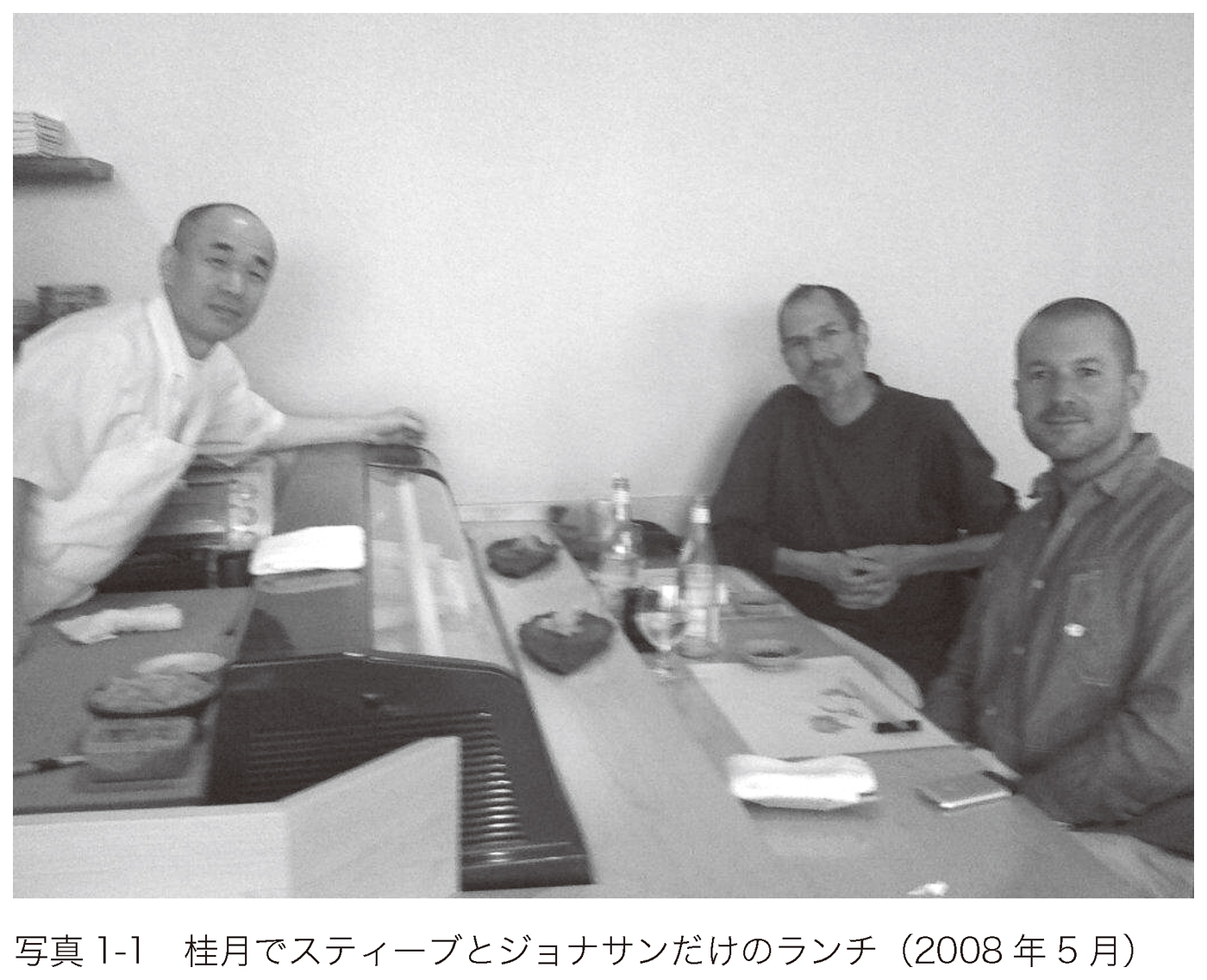 Given these circumstances, Jonathan probably visited Keigetsu with Steve the most, outside of his family."
"During various occurrences at Keizuki and with Jobs himself increasingly unwell, coincidence upon coincidence brought the offer “would you like to work at Apple” to Toshi-san. To me, this appeared as a “thank you for years of kunto” from Jobs to Toshi-san."
"Then comes the next big hit: Oakley, the Apple of glasses, the coolest brand around, almost a religion."
"That image leaves you with the same impression as photos of the American garage where Steve Jobs invented Apple."
"Apple’s value crucially depended on the singular vision of a particular person. This hints at the strange way in which the companies that create new technology often resemble feudal monarchies rather than organizations that are supposedly more “modern.”"
"Apple’s value crucially depended on the singular vision of a particular person. This hints at the strange way in which the companies that create new technology often resemble feudal monarchies rather than organizations that are supposedly more “"
"The greatest thing Jobs designed was his business. Apple imagined and executed definite multi-year plans to create new products and distribute them effectively."
"Just as the legal attack on Microsoft was ending Bill Gates’s dominance, Steve Jobs’s return to Apple demonstrated the irreplaceable value of a company’s founder. In some ways, Steve Jobs and Bill Gates were opposites. Jobs was an artist, preferred closed systems, and spent his time thinking about great products above all else; Gates was a businessman, kept his products open, and wanted to run the world. But both were insider/outsiders, and both pushed the companies they started to achievements that nobody else would have been able to match."