Fighting the Last War
Making major strategic changes based primarily on the last experience locks you into an outdated orientation just as the world changes again.
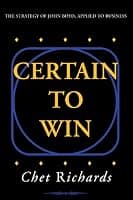
Applies John Boyd's military OODA loop strategy to business, arguing that competitive advantage comes not from size, speed, or technology but from cycling through observe-orient-decide-act loops faster than competitors — using trust, intuitive competence, and the ancient cheng/ch'i (expected/surprising) interplay to shape markets rather than react to them.
Making major strategic changes based primarily on the last experience locks you into an outdated orientation just as the world changes again.
Micromanagement and perk-based caste systems destroy the mutual trust that enables fast OODA loops, even when they feel like responsible management.
If your Schwerpunkt doesn't help a confused employee resolve a real trade-off on the spot, it's a slogan that drives attention inward rather than toward the customer.
“In fact, the period of greatest Japanese success was the following decade. During the 1980s, for example, General Motors’ US market share went from 52% to around 30%, with most of this lost to the Japanese. What happened? Ask anyone who bought a Honda, Toyota, or Datsun (as Nissan products were known until 1984) back then. They came expecting to get great gas mileage, which they did, but, “Surprise!” The things ran…”
“Boyd called this, “building snowmobiles,” from an observation that a snowmobile is made up from pieces of other things (treads from a tractor, engine from an outboard motor, etc.) that someone in a spark of creativity visualized could be ripped apart and put back together to serve this new purpose.”
“always remember the mantra: promote those who do, remove those who do not.”
“Too often they represent successful attempts by competitors to shape the marketplace—customers “want” something because a competitor has offered it to them. Every government and many commercial requests for proposal, for example, contain a “statement of work” (SOW) describing in some detail what the customer wants. The question is, who wrote the SOW?”
“Fingerspitzengefühl: Intuitive Skill Literally a fingertip feeling or sensation, it is usually translated as “intuitive skill or knowledge.””
“Although “mutual trust” gives us all a soft, warm feeling, how does it actually help win? Simply, it speeds execution of OODA loops. The reason? For starters, it permits implicit communication among team members, where very little needs to be written down. Obviously, people can communicate this way much faster than through any form of writing—it’s much quicker not to say something than to spell it out in detail. Imp…”
“A garden analogy may help summarize implementing Boyd’s operational climate. The duty of senior managers is to design the garden, decide what they want to grow, and prepare the proper conditions. Obviously to do this well, they must be highly experienced gardeners, with a sure feel for the soil conditions, the nature of their plants, the climate, and the local rabbit population. Once conditions are right and seeds a…”
“The rule is simple: The side with the stronger group feeling has a great advantage.”
“the definition floated in chapter II, the ability to rapidly change one’s orientation, since it is orientation locking up under the stress of competition and conflict that causes OODA loops to slow and makes one predictable, rather than abrupt and unpredictable. Speed, that is physical velocity, may provide an important tactical option, but it is not The Way.77 In fact, speed increases momentum, which can make one m…”
“How Long Will It Take? You can’t blame people for wanting instant results. Time is money, and quickness, especially quick OODA loops, is good. But when it comes to adopting maneuver conflict / Boyd’s principles to your business, there is a lot to be learned and a lot to be done. Consider that: • According to its principle creator, Taiichi Ohno, it took 28 years (1945-1973) to create and install the Toyota Production…”
“In the last chapter, we saw that to create an explicit model of combat, business, or the economy, we had to assume that these activities proceeded according to predictable, mathematical patterns—that they form systems.42 We also found that on many occasions, the smaller or less technologically advanced side won, confounding the predictions of the models. The reason for this reversal, in business and in war, appears…”
“Boyd decided that the F-86 won because it could generate something he called “asymmetric fast transients.” A “transient” is a shift from one state68 to another, “fast” refers to the time it takes to make the shift (not, as is often thought, the velocity of the aircraft itself), and “asymmetric” means that one side is better at it than the other.”
Hidenori Itagaki
Shares Sun Tzu, Toyota, and Americans.
Patrick McGee
Shares Germany, Apple, and Americans.
Richard Koch
Shares Germany, Apple, and IBM.
Tommaso Ebhardt
Shares Germans, French, and Germany.
Alain Jemain
Shares Germans, Germany, and Americans.
Peter Thiel, Blake Masters
Shares Toyota, Apple, and General Motors.
“As odd as this may seem—a doctrine of war and a car manufacturing system turning out to be brothers under the skin—they both use time as their principle strategic device, their organizational climates share several elements, and they both trace back to the school of strategy whose earliest known documentation is Sun Tzu’s The Art of War.”
“War strategies, however, rest on a deeper foundation of people working together under stress and uncertainty, and good ones shape the terms of the conflict to their liking before combat begins. Such an environment describes modern business, and strategies based on this foundation will work as well for business as for war.”
““Each minute ahead of the enemy is an advantage.””
“Basil Liddell Hart had to say: The issue turned on the time factor at stage after stage. French counter-movements were repeatedly thrown out of gear because their timing was too slow to catch up with the changing situation … The French, trained in the slow-motion methods of World War I, were mentally unfit to cope with the new tempo, and it caused a spreading paralysis among them.”
“Our view of the world, our “orientation,” as Boyd called it, depends heavily on things happening close in time to when we expect them to happen. Mismatches in time—such as when things don’t appear to be happening in a continuous and predictable (even if very rapid) manner—can be disorienting. Under stress, disoriented people become demoralized, frustrated, and panicked. Once in this condition, they can easily be defeated, regardless of the weapons that remain in their possession.”
“Honda used speed, or more accurately, decision cycle time, to create opportunities in the marketplace and then provide products that customers wanted to buy more than they wanted those of the competition. The critical element was that Honda was both learning what these “wants” were and was helping to shape them at the same time.”
“Time—in particular how long it takes our side to reorient compared to how long it takes the opponent—is Boyd’s primary device for accomplishing this, which is why the name “time-based competition” also came to be applied to this approach to strategy.”
“There is a saying that the battle is not always to the strong, but that’s the way to bet.”
“Friction, however, is best discussed in terms of groups of people competing against each other. It arises inevitably from the problems of trying to get people in groups to work together, since under conditions of stress, group dynamics can make…”
“Boyd prescribes active measures to generate and magnify friction in the mind of the opponent, and one good way to do this is through operating at a…”
“The Germans, or some small fraction of them, were able to execute and sustain fast decision cycles, even against the friction of war, because they had instilled an organizational…”
“We think perhaps we may have gotten inside of the enemy’s decision-making cycle and arrived with a tempo that put us in place before they could respond to the impending threat that now is a matter of history. US Army Brigadier General Vincent Brooks, Doha, Qatar, April 4, 200339”
“General Samuel Griffith noted in his the introduction to his translation of The Art of War: “Sun Tzu realized that an indispensable preliminary to…”
“In a typical operation, blitzing units don’t expose themselves to direct enemy fire any more than absolutely necessary. They seem to loom up from out of nowhere to overwhelm a section of the enemy’s line, then penetrate to create surprise and confusion in the rear. It is this abrupt, unexpected, and disorienting pattern of action that forms the basis of his strategy.”
“The people who created this style of warfare in the late 19th and first part of the 20th centuries realized early on that it required a type of discipline different from the mindless obedience to orders that characterized the Prussian armies of Frederick the Great in the mid-1700s. Modern weapons are extremely lethal and opportunities to surprise and shock an intelligent enemy are fleeting. Soldiers at all levels must be free to—must be required to—use their creativity, intelligence, and initiatives to work around the enemy’s weapons and generate and exploit opportunities.”
“Uncover, create, and exploit many vulnerabilities and weaknesses, hence many opportunities, to pull adversary apart and isolate remnants for mop-up or absorption • Generate uncertainty, confusion, disorder, panic, chaos… to shatter cohesion, produce paralysis and bring about collapse • Destroy the moral bonds (of the enemy) that permit an organic whole to exist • Create moral bonds that permit us, as an organic whole, to shape and adapt to change”
“Unfortunately, you should expect to remove about 25-40% of your current management, some because they will not participate in adopting the new climate (they must leave the company) but most of them because once the new system is in place, the functions they were performing will no longer be necessary. As the late Admiral Hyman Rickover, father of the nuclear Navy, once observed, in any organization there are doers and checkers—you will find that in the new organization you will need a lot fewer checkers, but if you leave them in place, they will start checking again. You must play fair with this last group, however, in order to build the trust and cohesion you will need among the survivors. It’s the right thing to do, even if it costs you some short-term profit. You must preserve themis. After all, they became middle managers by excelling in the system the way it was at the time.…”
“Wolfram shows that all complex systems are in a sense equivalent to a simple type of system known as a “cellular automata,” and his company even sells a program that will let you experiment with them yourself.”
“Another piece of advice: Improve your skill at many-sided implicit cross referencing by sharing the bits and pieces you discover, as well as any conclusions you are coming to, by using the three primary pipelines of modern knowledge management.”
“Complexity is the norm in the world, he concludes, and arises naturally as randomness “self-organizes” (also a term Boyd also liked) into the patterns generated by simple systems acting over time.”
“Rommel, and Grant were all known for the intensity with which they studied military history and current campaigns.”
“the OODA loop operates, and a particularly effective climate for this is the one we have called the “key attributes of the blitzkrieg”: mutual trust/unity/cohesion, intuitive knowledge; mission contract/orders; and focus of effort.”
“you’re a high roller with some airline, call your 1-800 telephone number to make a reservation. Try your web site. Stand in line to check in. Check a suitcase. Fly coach. Try to change a reservation. What do you think? Excited by your own stuff? Any sign of magical pizzazz there? Any reason anybody with a choice would do it again? And while you’re back there in coach, talk to people. Don’t limit your observations to fishing for what’s wrong, since that’s a shortfall in meeting their expectations. Important stuff, but cheng, not ch’i. You have to be much more subtle and creative. Somewhere there’s a spark, some “Eureka!” that will cause people to choose you over Continental or even Southwest and pay more to do it.”
“Stephen Wolfram’s book, A New Kind of Science.”
“The systems, in other words, are simple, but there is no limit to the complexity they can generate, given enough time.”
“always remember the mantra: promote those who do, remove those who do not.”
“Instead, put yourself at the Schwerpunkt of the transformation effort. Look people in the eyes when you’re preaching the new doctrine. Lead your company in studying Sun Tzu and Musashi, discussing Warfighting, and comparing your processes to those of Toyota. Start your own Crotonville and teach there yourself.”
“Toyota claims that the idea for their amazing production system came from engineers who visited supermarkets in the United States after the war.”
“Marine Corps Doctrine Publication (MCDP) 1, Warfighting. Despite its formidable title, it spends most of its space on issues like harmonizing efforts, making decisions in the face of uncertainty, and always keeping the initiative,176 things that apply to business as much as they do to war.”
“As an oriental scholar, as well as a practitioner of the art of war, Gen. Griffith offered a unique and valuable perspective on Sun Tzu’s use of cheng and ch’i: • Their (cheng and ch’i) effects are mutually generative and reinforcing • One way to look at it is that Cheng = distraction; ch’i = decision (However it should be noted that neither by itself will have these effects.) • Ch’i by definition represents the unexpected, strange, or unorthodox. (You can try a maneuver that you intend to be ch’i, but whether it actually is depends on the enemy. This is why preparing the enemy is so important in the Sun Tzu / Boyd school.) • Engage with the cheng, win with the ch’i. • Cheng / ch’i maneuvers apply to every one and every level within the organization. • If the enemy, despite our best efforts, sees through our ch’i maneuver, then it would immediately become a cheng.156”
“Deceit and Ambiguity in Every Form of Competition Like Sun Tzu, Boyd emphasized the primary role of cheng/ch’i: • Cheng / ch’i maneuvers were employed by early commanders to expose adversary vulnerabilities and weaknesses (á la cheng) for exploitation and decisive stroke (via ch’i) 163 • Use cheng/ch’i scheme to achieve an expenditure of energy or an irruption of violence—focused into, or through, features that permit an organic whole to exist164 • Establish focus of main effort (ch’i / Schwerpunkt) together with other related efforts (cheng / Nebenpunkte) and pursue directions that permit many happenings, offer many branches, and threaten alternative objectives (note: which ties multiple thrusts into the cheng /ch’i scheme)165 • The ultimate goal is to “generate uncertainty, confusion, disorder, panic chaos… to shatter cohesion, produce paralysis, and bring about collapse.”166 • . . . to gain a feel for the different ways that the cheng/ch’i game has been (and can be) played167 Unlike Sun Tzu, Boyd examined all forms of human conflict, but his conclusion was the same: cheng / ch’i maneuvers are fundamental to any strategy for defeating your opponent.”
“Boyd called this, “building snowmobiles,” from an observation that a snowmobile is made up from pieces of other things (treads from a tractor, engine from an outboard motor, etc.) that someone in a spark of creativity visualized could be ripped apart and put back together to serve this new purpose.”
“These are e-mail and instant messaging, your corporate intranet, and hanging around the office water cooler and coffee pot.173 An occasional happy hour wouldn’t hurt, either (don’t let people drive home drunk.)”
“All the complexity in the real world can be generated, Wolfram shows, by the repeated action of these “simple machines.””
“Studies of innovation reveal that practically everything new consists of bits and pieces of other concepts, often from fields that appeared to be unrelated, that somebody had the genius to reassemble to form something new and exciting.”
“We may conclude with the claim that success in any competitive endeavor requires attention to both the expected and the unexpected. Engage with the cheng, close with the ch’i.”
“With a strategy this powerful, your aim is not to respond to but to create the market conditions that you want.”
“Peters’ advice to put down the same management text everyone else is reading (including his!) and study human nature through novels and biography.”
“The OODA loop is a simple machine. It can generate all the strategic “patterns of conflict” that can exist in the world. It not only adapts to the complexity of the marketplace, it has the power to harmonize with and help shape the marketplace. The key, as we have seen, is the ability to manipulate time, that is, quickness. This also fits with the idea of a simple machine, since it may take many operations of such a machine to generate a complex pattern, and so time becomes the critical parameter.”
“There may be a glimmer of hope for the industry since some of the new low-cost airlines, particularly JetBlue, seem to be trying for a little ch’i in the form of leather seats and video systems in addition to the expected low fare cheng.”