Underpricing Their Own Company
The Musk brothers initially offered 25% of their company for just $10,000 — learning that founders must value their own work aggressively or let others capture the upside.
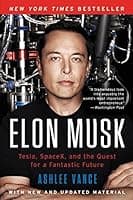
South African-born entrepreneur who built SpaceX, Tesla, and SolarCity into interconnected ventures aimed at making humanity multiplanetary and transitioning Earth to sustainable energy.
The Musk brothers initially offered 25% of their company for just $10,000 — learning that founders must value their own work aggressively or let others capture the upside.
““A friend of mine wrote to remind me that only 5 of the first 9 Pegasus launches succeeded; 3 of 5 for Ariane; 9 of 20 for Atlas; 9 of 21 for Soyuz; and 9 of 18 for Proton. Having experienced firsthand how hard it is to reach orbit, I have a lot of respect for those that persevered to produce the vehicles that are mainstays of space launch today.””
“Internet, renewable energy, and space as the three areas that would undergo significant change in the years to come and as the markets where he could make a big impact.”
“What Musk would not tolerate were excuses or the lack of a clear plan of attack.”
“The Musk brothers were not the most aggressive businessmen at this point. “I remember from their business plan that they were originally asking for a ten-thousand-dollar investment for twenty-five percent of their company,” said Steve Jurvetson, the venture capitalist. “That is a cheap deal! When I heard about the three-million-dollar investment, I wondered if Mohr Davidow had actually read the business plan. Someho…”
““He points out that one of the really tough things is figuring out what questions to ask,” Musk said. “Once you figure out the question, then the answer is relatively easy. I came to the conclusion that really we should aspire to increase the scope and scale of human consciousness in order to better understand what questions to ask.””
“‘The longer you wait to fire someone the longer it has been since you should have fired them,’””
““My mentality is that of a samurai. I would rather commit seppuku than fail.””
““We need to figure out how to launch multiple times a day,” Musk said. “The thing that’s important in the long run is establishing a self-sustaining base on Mars. In order for that to work—in order to have a self-sustaining city on Mars—there would need to be millions of tons of equipment and probably millions of people. So how many launches is that? Well, if you send up 100 people at a time, which is a lot to go on…”
“Musk came to see man’s fate in the universe as a personal obligation. If that meant pursuing cleaner energy technology or building spaceships to extend the human species’s reach, then so be it. Musk would find a way to make these things happen. “Maybe I read too many comics as a kid,” Musk said. “In the comics, it always seems like they are trying to save the world. It seemed like one should try to make the world a…”
“Each one of his businesses is interconnected in the short term and the long term. Tesla makes battery packs that SolarCity can then sell to end customers. SolarCity supplies Tesla’s charging stations with solar panels, helping Tesla to provide free recharging to its drivers. Newly minted Model S owners regularly opt to begin living the Musk Lifestyle and”
“‘Take it down to the physics,’””
“Hollman was one of many engineers who arrived at this realization after facing one of Musk’s trademark grillings. “The worst call was the first one,” Hollman said. “Something had gone wrong, and Elon asked me how long it would take to be operational again, and I didn’t have an immediate answer. He said, ‘You need to. This is important to the company. Everything is riding on this. Why don’t you have an answer?’ He ke…”
Tim Higgins
Shares Elon Musk, Tesla, and SpaceX.
Jimmy Soni
Shares Elon Musk, Tesla, and SpaceX.
Peter Thiel, Blake Masters
Shares Elon Musk, Tesla, and SpaceX.
John Malone
Shares Elon Musk, Tesla, and SpaceX.
Patrick McGee
Shares Elon Musk and Tesla.
Tommaso Ebhardt
Shares Elon Musk.
““He points out that one of the really tough things is figuring out what questions to ask,” Musk said. “Once you figure out the question, then the answer is relatively easy. I came to the conclusion that really we should aspire to increase the scope and scale of human consciousness in order to better understand what questions to ask.””
“Hollman was one of many engineers who arrived at this realization after facing one of Musk’s trademark grillings. “The worst call was the first one,” Hollman said. “Something had gone wrong, and Elon asked me how long it would take to be operational again, and I didn’t have an immediate answer. He said, ‘You need to. This is important to the company. Everything is riding on this. Why don’t you have an answer?’ He kept hitting me with pointed, direct questions. I thought it was more important to let him know quickly what happened, but I learned it was more important to have all the”
“‘The longer you wait to fire someone the longer it has been since you should have fired them,’””
“Rocket Propulsion Elements, Fundamentals of Astrodynamics, and Aerothermodynamics of Gas Turbine and Rocket Propulsion,”
“What Musk would not tolerate were excuses or the lack of a clear plan of attack.”
““A friend of mine wrote to remind me that only 5 of the first 9 Pegasus launches succeeded; 3 of 5 for Ariane; 9 of 20 for Atlas; 9 of 21 for Soyuz; and 9 of 18 for Proton. Having experienced firsthand how hard it is to reach orbit, I have a lot of respect for those that persevered to produce the vehicles that are mainstays of space launch today.””
“Internet, renewable energy, and space as the three areas that would undergo significant change in the years to come and as the markets where he could make a big impact.”
“outfit their homes with solar panels. Tesla and SpaceX help each other as well. They exchange knowledge around materials, manufacturing techniques, and the intricacies of operating factories that build so much stuff from the ground up.”
““The only thing that makes sense to do is strive for greater collective enlightenment,” he said.”
“information.””
““We need to figure out how to launch multiple times a day,” Musk said. “The thing that’s important in the long run is establishing a self-sustaining base on Mars. In order for that to work—in order to have a self-sustaining city on Mars—there would need to be millions of tons of equipment and probably millions of people. So how many launches is that? Well, if you send up 100 people at a time, which is a lot to go on such a long journey, you’d need to do 10,000 flights to get to a million people. So 10,000 flights over what period of time? Given that you can only really depart for Mars once every two years, that means you would need like forty or fifty years.”
“The Musk brothers were not the most aggressive businessmen at this point. “I remember from their business plan that they were originally asking for a ten-thousand-dollar investment for twenty-five percent of their company,” said Steve Jurvetson, the venture capitalist. “That is a cheap deal! When I heard about the three-million-dollar investment, I wondered if Mohr Davidow had actually read the business plan. Somehow, the brothers ended up raising a normal venture round.””
“What’s more, SolarCity is a key part of what can be thought of as the unified field theory of Musk.”
““The Importance of Being Solar.””
“Eberhard’s journey began with him building a technical model of the electric car on a spreadsheet. This let him tweak various components and see how they might affect the vehicle’s shape and performance. He could adjust the weight, number of batteries, resistance of the tires and body, and then get back answers on how many batteries it would take to power the various designs. The models made it clear that SUVs, which were very popular at the time, and things like delivery trucks were unlikely candidates.”
“Musk came to see man’s fate in the universe as a personal obligation. If that meant pursuing cleaner energy technology or building spaceships to extend the human species’s reach, then so be it. Musk would find a way to make these things happen. “Maybe I read too many comics as a kid,” Musk said. “In the comics, it always seems like they are trying to save the world. It seemed like one should try to make the world a better place because the inverse makes no sense.””
“quantum probability”
“Each one of his businesses is interconnected in the short term and the long term. Tesla makes battery packs that SolarCity can then sell to end customers. SolarCity supplies Tesla’s charging stations with solar panels, helping Tesla to provide free recharging to its drivers. Newly minted Model S owners regularly opt to begin living the Musk Lifestyle and”
““My mentality is that of a samurai. I would rather commit seppuku than fail.””
“Craig Venter,”
“Greg Kouri,”
“Franz von Holzhausen”
““From that point on, he and I discussed settling Mars. It really impressed me that this is a guy that thinks big.””
“‘Take it down to the physics,’””
“* The Musk brothers were not the most aggressive businessmen at this point. “I remember from their business plan that they were originally asking for a ten-thousand-dollar investment for twenty-five percent of their company,” said Steve Jurvetson, the venture capitalist. “That is a cheap deal! When I heard about the three-million-dollar investment, I wondered if Mohr Davidow had actually read the business plan. Somehow, the brothers ended up raising a normal venture round.””