Multiple Bad Decisions
Most leaders can only survive one major mistake, so careful decision-making becomes essential for longevity.
Gretchen Rubin
58 highlights · 12 themes · 2 cited people/companies
British Prime Minister and wartime leader who rallied Britain through World War II with his oratory and uncompromising resolve
Most leaders can only survive one major mistake, so careful decision-making becomes essential for longevity.
“On June 16, 1940, France collapsed. Britain stood alone, under constant air attack and threat of invasion, while Germany controlled all of Europe. “Let us therefore brace ourselves to our duties,” Churchill exhorted, “and so bear ourselves that if the British Empire and its Commonwealth last for a thousand years, men will still say, ‘This was their finest hour.’”
“We shall go on to the end. We shall fight in France, we shall fight on the seas and oceans, we shall fight with growing confidence and growing strength in the air, we shall defend our Island, whatever the cost may be. We shall fight on the beaches, we shall fight on the landing grounds, we shall fight in the fields and in the streets, we shall fight in the hills; we shall never surrender.”
““Winston has fifty ideas a day,” Roosevelt observed, “and three or four are good.””
“Biographies of great figures must tackle the essential question: what was the foundation of their genius? In Churchill’s case, it was his extraordinary gift of expression. Perhaps it is possible for a leader to conceive large ideas without the ability to express them, but a leader unable to articulate such thoughts cannot inspire others to share them. Churchill was able to describe his timeless, heroic Britain so cl…”
“On the problems of deploying a fleet during the First World War, Churchill observed, “Out of intense complexities intense simplicities emerge.””
“One of Churchill’s best targets for his humor was himself. In 1944, when asked not to repeat mistakes made after the First World War, he replied, “I am sure that the mistakes of that time will not be repeated; we shall probably make another set of mistakes.””
““No one pretends that democracy is perfect or all-wise. Indeed, it has been said that democracy is the worst form of Government except all those other forms that have been tried from time to time.””
““Nations which went down fighting rose again,” he declared, “but those who surrendered tamely were finished.””
“It isn’t enough that a biography explain what a person has done; it must explain how he or she was able to do it. During his life, and even after it, in the thickening haze of distance, Churchill kept his bulky figure fixed in people’s view. He had a genius for presenting himself so he could be understood and remembered by everyone. How did he do it?—through symbols. To drive himself into the public mind, Churchill…”
“Churchill was a gifted speaker when properly prepared, but he couldn’t think on his feet and rarely said anything in public he hadn’t memorized. His speeches were plotted right down to stage directions—“pause; grope for word”; “stammer; correct self”—meant to give the impression he was extemporizing. Although his speeches read well today, he often failed to persuade his actual audiences because he couldn’t adapt his…”
““Short words are best,” he said, “and the old words when short are best of all.””
“Churchill recognized the value of accountability and opposed efforts to add layers of advisers who lacked actual responsibility. “Lots of people can make good plans for winning the war if they have not got to carry them out,” Churchill pointedly noted when he addressed a Joint Session of Congress in 1943. “I dare say if I had not been in a responsible position I should have made a lot of excellent plans.””
Richard Koch
Shares Winston Churchill, Britain, and Germany.
Marie-France Pochna
Shares Winston Churchill, Great Britain, and United States.
asuycdg6.org
Shares British, Great Britain, and United States.
Alain Jemain
Shares Roosevelt, Gestapo, and Great Britain.
Chet Richards
Shares British, Congress, and United States.
Gregor Schöllgen
Shares British, Germany, and Hitler.
““We seem to be very near the bleak choice between War and Shame. My feeling is that we shall choose Shame, and then have War thrown in a little later on even more adverse terms than at present.””
““First, it is that kind of courage which enables men to stand up unflinchingly and do a foolish thing, although they know it is popular. Second it is that kind of courage which cannot only be maintained in the face of danger, but can even shine brightly in its total absence.””
““Nations which went down fighting rose again,” he declared, “but those who surrendered tamely were finished.””
““There is never a good time for a vacation, so take one anyway.””
““All I wanted,” he explained, only half joking, “was compliance with my wishes after reasonable discussion.””
“We shall go on to the end. We shall fight in France, we shall fight on the seas and oceans, we shall fight with growing confidence and growing strength in the air, we shall defend our Island, whatever the cost may be. We shall fight on the beaches, we shall fight on the landing grounds, we shall fight in the fields and in the streets, we shall fight in the hills; we shall never surrender.”
“Lady Astor snapped, “Winston, if I were your wife, I’d put poison in your coffee,” he’d retorted, “Nancy, if I were your husband, I’d drink it.””
“With his genius for expression, Churchill could convey his ideas in phrases that burned themselves into people’s minds. Eloquence matters: we cannot persuade others where we cannot voice our own thoughts. Decades after his death, Churchill remains one of the most frequently quoted figures in history.”
““Short words are best,” he said, “and the old words when short are best of all.””
““You ask, what is our aim? I can answer in one word: It is victory.””
““This is not the end. It is not even the beginning of the end. But it is, perhaps, the end of the beginning.””
““These facts are not like the facts of science—once they are discovered, always the same,” observed Virginia Woolf, of biography. “They are subject to changes of opinion; opinions change as the times change.””
““Never give in, never give in, never, never, never, never . . . never give in, except to convictions of honor or good sense.””
“Throughout his life, he showed the undisciplined intelligence typical of autodidacts; he was incapable of rigorous analysis, and after making his conclusions, clung to them too stubbornly.”
“Churchill criticized Stanley Baldwin: “Occasionally he stumbled over the truth, but hastily picked himself up and hurried on as if nothing had happened.””
“On May 8, 1945, as Churchill announced victory in Europe, an enormous crowd gathered to cheer him. “In all our long history,” he thundered, “we have never seen a greater day than this.””
“Churchill wrote: “Of all the talents bestowed upon men, none is so precious as the gift of oratory. . . . Abandoned by his party, betrayed by his friends, stripped of his offices, whoever can command this power is still formidable.””
““Nothing in life is so exhilarating as to be shot at without result.””
“One of Churchill’s best targets for his humor was himself. In 1944, when asked not to repeat mistakes made after the First World War, he replied, “I am sure that the mistakes of that time will not be repeated; we shall probably make another set of mistakes.””
““Success is going from failure to failure without loss of enthusiasm.””
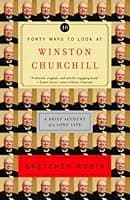
“It isn’t enough that a biography explain what a person has done; it must explain how he or she was able to do it. During his life, and even after it, in the thickening haze of distance, Churchill kept his bulky figure fixed in people’s view. He had a genius for presenting himself so he could be understood and remembered by everyone. How did he do it?—through symbols. To drive himself into the public mind, Churchill simplified himself. As his image multiplied, it became more recognizable, as not only his appearance but even his character was reduced to a few swift strokes.”
“Historically, forty meant “many”—just as we, after inflation, use the word million: “There are a million reasons to study Churchill.””
“Even though large tracts of Europe and many old and famous States have fallen or may fall into the grip of the Gestapo and all the odious apparatus of Nazi rule, we shall not flag or fail. We shall go on to the end. We shall fight in France, we shall fight on the seas and oceans, we shall fight with growing confidence and growing strength in the air, we shall defend our Island, whatever the cost may be. We shall fight on the beaches, we shall fight on the landing grounds, we shall fight in the fields and in the streets, we shall fight in the hills; we shall never surrender; and even if, which I do not for a moment believe, this Island or a large part of it were subjugated and starving, then our Empire beyond the seas, armed and guarded by the British Fleet, would carry on the struggle, until, in God’s good time, the New World, with all its power and might, steps forth to the rescue and liberation of the Old.”
“Macaulay, Gibbon, Darwin, Plato, and Aristotle,”
“Before the first night of Pygmalion, playwright George Bernard Shaw wired Churchill: “Am reserving two tickets for you for my premiere. Come and bring a friend—if you have one.” Churchill replied: “Impossible to be present for the first performance. Will attend the second—if there is one.””
““I have nothing to offer but blood, toil, tears and sweat.” “London can take it.” “Never was so much owed by so many to so few.” Often his most stirring lines were in simple language, as in his February 9, 1941, broadcast addressed to the United States: Put your confidence in us. Give us your faith and your blessing, and, under Providence, all will be well. We shall not fail or falter; we shall not weaken or tire. Neither the sudden shock of battle, nor the long-drawn trials of vigilance and exertion will wear us down. Give us the tools, and we will finish the job.”
“Churchill came under fire for his performance as First Lord of the Admiralty, he struck back by describing his critic as “one of those orators who before they get up, do not know what they are going to say; when they are speaking do not know what they are saying; and when they have sat down, do not know what they have said.””
““The soul of Poland is indestructible. . . . [S]he will rise again like a rock, which may for a spell be submerged by a tidal wave, but which remains a rock.””
“In 1943, to an American critic of the Raj, Churchill said, “Before we proceed any further, let us get one thing clear. Are we talking about the brown Indians in India, who have multiplied alarmingly under the benevolent British rule? Or are we speaking of the red Indians in America who, I understand, are almost extinct?””
““Perhaps it is better to be irresponsible and right than responsible and wrong.” “All newborn babies look like me.””
“To distill Churchill’s sprawling life into its essential elements, each chapter focuses on one question. What was Churchill’s supreme moment? How did he see the world? What was his dominant quality? What were his motives, his formative role, his weaknesses, the important dates of his life? How did he look? How did he die? What made him a hero? Did he cheat on his wife? Such questions sound naive when put bluntly, but they are, after all, what we want to learn when we study great lives.”
“The uniform, the cigar, and the V sign make Churchill an instantly recognizable figure. The uniform, the cigar, and the V sign”
““It is a good thing for an uneducated man to read books of quotation. . . . The quotations when engraved upon the memory give you good thoughts.””
““Be on your guard, because I am going to speak in French, a formidable undertaking and one which will put great demands on your friendship with Great Britain.” After the war, he addressed a French audience in English: “I have often made speeches in French, but that was wartime, and I do not wish to subject you to the ordeals of darker days.””
“Churchill also exploited the force of simile and metaphor. Of his opposition to socialism, he said, “We are for the ladder. Let all try their best to climb. They are for the queue.” He wrote of a meeting with Roosevelt and Stalin, “There I sat with the great Russian bear on one side of me, with paws outstretched, and, on the other side the great American buffalo, and between the two sat the poor little English donkey who was the only one of the three, who knew the right way home.””
“Biographies of great figures must tackle the essential question: what was the foundation of their genius? In Churchill’s case, it was his extraordinary gift of expression. Perhaps it is possible for a leader to conceive large ideas without the ability to express them, but a leader unable to articulate such thoughts cannot inspire others to share them. Churchill was able to describe his timeless, heroic Britain so clearly that the entire nation rose to the level of his vision.”
“Many people don’t know their own opinions until they hear them voiced by someone else. They’re at the mercy of leaders, who, by articulating half-formed beliefs and fears, give them force.”
““Events were soon to arise in the fiscal sphere which were to plunge me into new struggles and absorb my thoughts and energies at least until September 1908, when I married and lived happily ever afterwards.””
““Winston has fifty ideas a day,” Roosevelt observed, “and three or four are good.””
“On the problems of deploying a fleet during the First World War, Churchill observed, “Out of intense complexities intense simplicities emerge.””