Invisible Among Competitors on Own Street
Without a distinctive sign and brand identity, even excellent product gets confused with neighbors — the taxi driver incident revealed that obscurity was costing them customers they never knew they had.
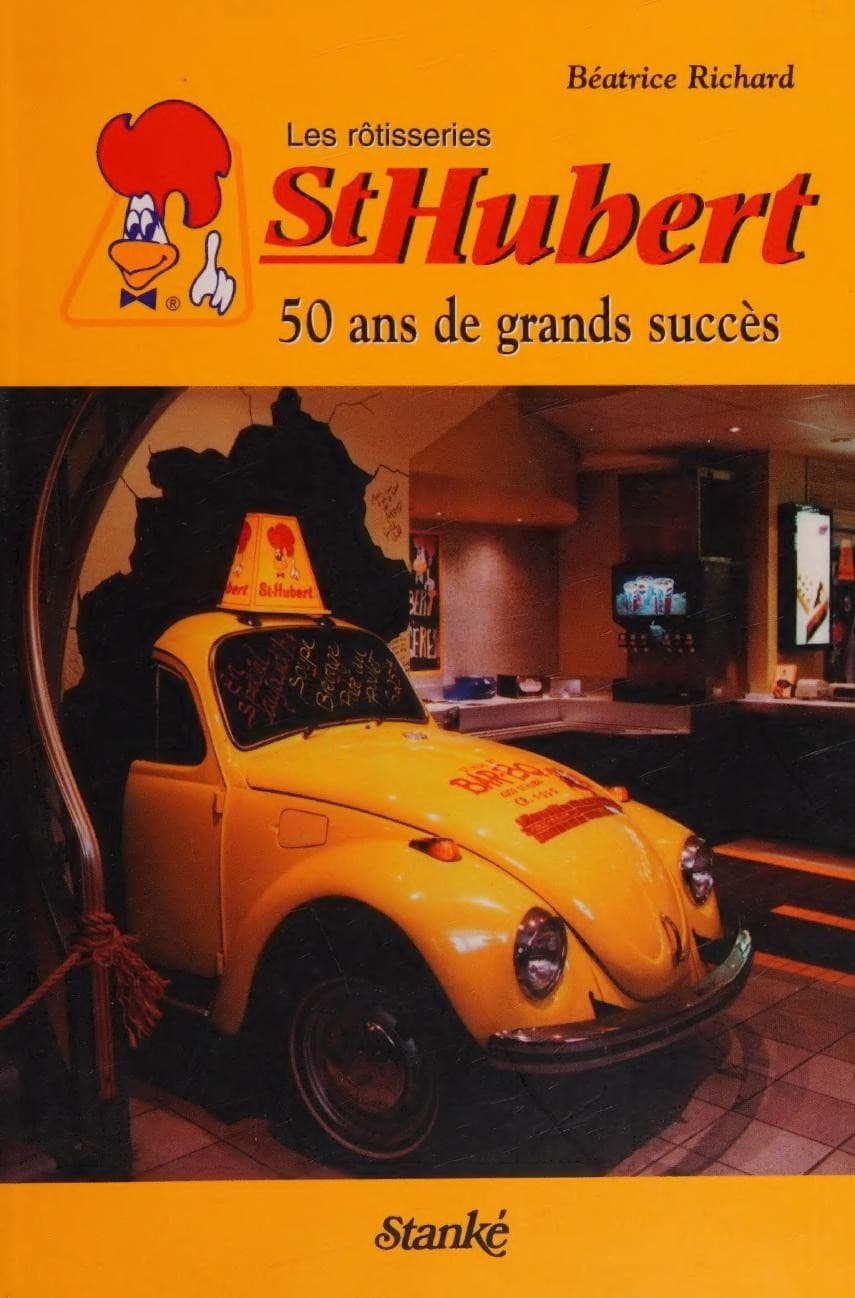
Beatrice Richard
70 highlights · 15 themes · 6 cited people/companies
Quebec rotisserie chicken chain that grew from a 78-seat restaurant on Saint-Hubert Street into a province-wide institution by inventing free home delivery, pioneering restaurant TV advertising in Canada, and turning a family recipe into a mass-catering and retail grocery empire — all while embodying the economic awakening of francophone Quebec.
Without a distinctive sign and brand identity, even excellent product gets confused with neighbors — the taxi driver incident revealed that obscurity was costing them customers they never knew they had.
Charging the same price across dining room, counter, and delivery masked wildly different cost structures; the oil crisis forced St-Hubert to finally sacrifice free delivery and price each channel according to its true cost.
A snack bar started selling rotisserie chicken right beside them without the Légers noticing — teaching that what happens around the business matters as much as what happens inside it.
“On April 28, 1967, Expo opens its doors: 300,000 Montrealers and impatient tourists storm the site, armed with their “passport” complete with photo and souvenir pages. Over the next 184 days, more than fifty million visitors will pass through the turnstiles of Terre des Hommes. The crowds are so large that the food services “crack” and quickly become saturated. In insufficient numbers, the restaurants and snack bars…”
“Like its competitors, St-Hubert Bar-B-Q provides delivery, but at the customer’s expense. In addition to the order, the customer must pay $2 or $3 for a taxi. However, at the time, this kind of extra charge is not within everyone’s budget. At this rate, the clientele risks plateauing quickly. René then has a flash of genius: why not deliver the chicken for free? Free delivery, the rotisserie owner believes, would en…”
“But the tables turn. While the competition mocks their unusual management, the Légers, who don’t care, take the experiment even further. A technological innovation is starting to invade homes: television. Every evening, more and more families gather around the small screen. René immediately grasps the significance of the phenomenon. If radio increases sales, what about the cathode-ray screen, which captures the publ…”
“A shadow on the picture, however: this new class of businesspeople lacks the financial foundations to really take off. In fact, this means that French Canadians account for barely 20% of the province’s growth, even though they represent 85% of its population. Starting in 1960, successive governments would adopt a policy of redirecting economic development in favor of Francophones. In this regard, the slogans of the…”
“It is also, for those who want it, the chance to quickly climb all the ranks. Pierre Paul is one of them. In a few months, the workings of the kitchen will hold no more secrets for him. After dishwashing, he will be assigned to bread, then to potatoes. Next, he will move to “the block” to prepare the plates, that is, to arrange the chicken, fries, coleslaw, and sauce. Then comes the job of “chicken breaker,” a delic…”
“But sometimes cunning was needed to circumvent a fussy administration. For instance, workers had to show credentials to access the site, meaning they needed passes. Yet with the pace of the construction, it was sometimes hard to predict how many workers would be needed. That night, the rotisseries had to be installed, which required an extra team of four workers. Of course, the extras didn’t have passes and there wa…”
“Nevertheless, he has the soul of a go-getter. At the time he meets Hélène, René is playing water polo with Roland. A powerful and aggressive player, he scores goals and quickly becomes the backbone of the team. In this respect, he went to the right school. Three times champion in Greco-Roman wrestling, the young man has been practicing this noble discipline since his early childhood. The experience left an indelible…”
“Putting his experience to good use, René reorganizes the kitchen from top to bottom and applies a simple principle, which will become a model for his future rotisseries: “A busy kitchen doesn’t move!” Everyone stays at their station and no one crosses paths. It is the dishes, the food, that move, not the staff. Also, each employee is assigned two or three specific tasks that do not require them to roam around. The b…”
“The new employee does not know it yet, but his hiring coincides with a strong growth spurt for the company. He will soon experience it very concretely. One fine morning, the staff is greeted by a dreadful crash: the Légers have just rented the neighboring building to expand their premises. The walls vibrate under the blows of sledgehammers, to the point that sometimes you have to hold the dishes so they don’t fall o…”
“René remains unshakable. Out of sheer exhaustion, they eventually discreetly advise him of two or three agencies. Not long after, a new “star” appears on the small screen: the St-Hubert rooster! Faced with René’s persistence, the broadcaster finally gave in, thus creating a precedent. And what a precedent! His client’s advertising campaign literally bursts onto the screen. “My God! Twelve at the table!” exclaims Jul…”
“A comforting element, the bosses work side by side with the staff, getting their hands dirty themselves, never shirking any task, even the humblest. Sharing the same work shifts inevitably creates strong bonds. Florent, for instance, quickly becomes fond of the Léger family and is inspired by their dedication. “If they can do it, I can do it too.” The esteem is mutual. His boss pushes him so much that after six mont…”
“Now, a short time after this unsuccessful attempt, a young man shows up at the company offices. He wants to meet with Mr. Léger. No problem. At St-Hubert, he is well known since he is Raymond Berthelet, one of the regular suppliers of the company. This entrepreneur, along with his brother Yves, manufactures a chicken soup base that he distributes throughout Quebec. He delivers his goods to the rotisseries every week…”
Guy Gendron
Shares Montreal, Quebec City, and Pizza Hut.
Dave Greber
Shares Montreal, Quebec, and Laval.
A. Alfred Taubman
Shares Burger King and McDonald’s.
Donald J. Savoie
Shares Kentucky Fried Chicken and Burger King.
Francisco Souza Homem de Mello
Shares Burger King.
Thomas Veszelits
Shares Burger King.
“For now, the young woman and her husband have only one concern: that everything be perfect to welcome the clientele, half tempted, half curious, who are already crowding at the restaurant doors. Inside, it’s all hands on deck. The excitement is so intense you could cut it with a knife. Fortunately, the family has pitched in. René shares the kitchen with his father, his aunt Exélire reigns at the cash register while Hélène and her mother-in-law bustle about the dining room. Before getting started, a thousand and one details must be checked. The owners are nervous. The tension rises, the aroma of roast chicken grows stronger. They open. As if by magic, the stage fright disappears. Customers settle in, the din swells. The kitchen kicks into gear and the procession of dishes begins. A legend is being born quietly, without fanfare, among the clatter of dishes and casual conversations.”
“Nevertheless, he has the soul of a go-getter. At the time he meets Hélène, René is playing water polo with Roland. A powerful and aggressive player, he scores goals and quickly becomes the backbone of the team. In this respect, he went to the right school. Three times champion in Greco-Roman wrestling, the young man has been practicing this noble discipline since his early childhood. The experience left an indelible mark on him: a winner’s temperament. When he starts something, he has only one thing in mind: to win. An ability that will prove very useful to him later.”
“The young man landed in the kitchen of a Murray’s Lunch chain restaurant as a dishwasher. It was thanks to this humble task that he discovered a vocation as a restaurateur. Obviously, the new employee did not stop there. In three years, he learned all the secrets of the trade: preparing breakfasts, making salads, cooking steaks. René held positions as a kitchen assistant and assistant chef, and even tried a stint in the dining room. But his favorite area remained the kitchen. Reactions have to be fast; you have to be everywhere at once, perform several tasks simultaneously, and use strategy. A bit like water polo.”
“Pushing the limits of his profession, René loves that, much to the dismay of his colleagues, whom he sometimes amuses himself by teasing, speeding up the pace of the dishes he prepares excessively. For him, work must be a game, an attitude he would later encourage among his employees. But that’s another story… For now, it’s time to leave Murray’s Lunch and give up his magnificent weekly salary of 11 K. The mischievous cook hands in his apron to embark on a more lucrative, more stable career, and one particularly suited to his superb physical condition: firefighter.”
“context was more favorable than ever. The war coming to an end opened up new prospects for enterprising people. For five years, French Canadians had saved as never before in their history. During the conflict, they had earned good salaries and their purchases had been rationed, as industrial production was entirely devoted to the war effort. As a result, there was a flood of money just waiting to be spent. Consumption picked up to unprecedented levels. Household appliances entered homes, construction resumed, suburbs expanded, and cars became more accessible to all.”
“In 1949, their lives took a turn. As he was about to take the tram to go to work, René was hit head-on by a reckless driver’s car. Violently thrown to the ground, he ended up with a broken arm and nose, as well as a triple fracture in his leg—injuries that would require no fewer than five surgeries. To make matters worse, his bones would not calcify. Confined to bed, in a cast for a year, the father had to say goodbye to his job. It would be another two years before he fully regained the use of his leg. And the severity of his injury would forever prohibit him from working as a firefighter. As for compensation… At the time, unfortunately, there was no group insurance plan to cover such misfortune. However, the city of Montreal agreed to grant the household a lifetime annual pension of $528—a meager $44 per month. A pittance. A true “change of status,” but not in the desired way. With a wife and two children to feed, their former carefree days were gone.”
“But far from crushing the Léger family, the ordeal energized them. To start, it revealed to René the unsuspected strengths of his wife. “It was above all an opportunity for me to discover my wife’s true personality, her courage,” he would later say. “She fully understood the situation I was in and all the troubles that might ensue for our little family. Yet, she never stopped encouraging me, constantly reminding me that it would all end one day…” As a result, the recovering man underwent a deep personal reevaluation.”
“With few resources, the couple sets up a small cigarette business, hand-rolled cigarettes made in their home, which they have turned into a workshop. The scene is romantic. Tobacco dries everywhere in the kitchen. The children play while René, seated in his bed, uses the rolling machine and Hélène cuts the ends and packs the cigarettes. Business goes well thanks to their hard work and the loyal clientele of firefighters eager to help their former colleague.”
“As soon as he is back on his feet, he puts this talent to use in a small lottery business, distributing punch cards by bicycle. Very quickly, he enlists five salesmen who canvas the restaurants. The formula is successful, but it’s only a makeshift, and the Légers are aware of it. Nevertheless, the business allows them to save enough money to consider more serious projects.”
“And then, one fine day, René meets, by chance in his wanderings, a certain Mr. Rivard. A salesman by trade, the man maintains multiple business relationships. Among these is a Belgian-born chemist who has just developed a line of beauty products under the brand Maria Robins. His formulas are excellent and are just waiting to be marketed. The prospect is all the more enticing because the female clientele for cosmetic products is booming in Quebec. The days are gone when makeup and beauty care were seen as the preserve of women of questionable virtue. Despite priests continuing to thunder against the immodesty of their parishioners, lipstick is now on every woman’s lips and the American pin-up girl has become the model to follow.”
“The realization of the project proves to be more arduous. A space must be leased and a complete set of kitchen equipment acquired, rotisseries purchased, utensils, tables, chairs. Quite the program! The Légers quickly come up against the limits. Their savings, the result of previous businesses, may seem substantial for the time—$7,500. However, this is a bit tight for investing in a restaurant. As for credit, the couple doesn’t even consider it! Back then, French Canadians had little capital and banks were hardly willing to lend to them. But this kind of concern does nothing to diminish the determination of the young entrepreneurs. After several days of searching, they finally find a space. The place is decent, no more, but a good coat of paint and a thorough cleaning should be enough to turn the pumpkin into a carriage. Hélène and René quickly call the owner, a certain Mr. Ménard.”
“In the days following the opening, Hélène is walking on air. The chickens are turning golden in the rotisserie. The kitchen is a buzzing hive. Drawn by the delicious smell, customers are flocking in. With its 78 seats, the small restaurant quickly becomes packed. The first weekend promises bright prospects: “Our first Saturday night is amazing,” the new owner notes in her journal. “It’s packed all night.” The young woman is overjoyed. She finally has her dream. The restaurant closes in the early hours of the morning. After all, you have to accommodate the hungry night owls pouring onto the pavement when the clubs close. In this early fifties era, Montreal is experiencing one of the liveliest nightlife scenes. Television has not yet been commercialized! So people go out more often. However, the Léger family is far from imagining just how providential the cathode-ray screen will one day be for them. Other more pressing concerns occupy their minds.”
“René learned this at Murray’s Lunch: in the restaurant business, every action, every second counts. You need precision and rhythm. The grand ballet of cooks allows for no improvisation, because ultimately there are customers to satisfy and a dining room to fill day after day. You can’t achieve this in chaos. A cold dish or one served late, a waitress panicking – and you risk losing a customer forever. Moreover, wasted energy is expensive. For an evening, the initial earnings max out at $500. That’s not enough considering the effort put in and the expenses to cover. A serious change of direction is needed; otherwise, at the rate things are going—in fits and starts—the business is heading for derailment.”
“Putting his experience to good use, René reorganizes the kitchen from top to bottom and applies a simple principle, which will become a model for his future rotisseries: “A busy kitchen doesn’t move!” Everyone stays at their station and no one crosses paths. It is the dishes, the food, that move, not the staff. Also, each employee is assigned two or three specific tasks that do not require them to roam around. The buzzing and anarchic hive is replaced by an orderly assembly line. Within a few days, everything falls into place. In the dining room, Hélène feels energized. This time, she’s sure, the rotisserie is here to stay.”
“The clientele. That’s where the problem lies: they need to find a solution to increase it, and quickly. Otherwise, what’s the point of serving the best chicken in the world with the brightest smile? And besides, the couple’s savings are melting away before their eyes. At this rate, the Légers will soon have to shut the doors. However, Hélène refuses to even consider such a possibility. Succumbing to discouragement is simply not like her. For her, hopeless causes do not exist. As for René, he doesn’t know the word “panic.” On the contrary, as a true athlete, it’s often when he’s backed into a corner that he performs at his best. A quality that will prove very useful in the coming months.”
“One evening, while Hélène is resting at home, the phone rings. It’s the rotisserie. They need her to help out. The young woman heads there at once. It’s worth making the most of the crowd to provide the best service to as many people as possible. Word of mouth, their only advertising, will do the rest. Since René took the car, Hélène hails a taxi. “Drive me to St-Hubert Bar-B-Q!” she tells the driver. He takes her straight to… Mr. Rheault’s former restaurant, almost next door to the rotisserie. Sitting in her taxi, Hélène is shocked.”
“The illuminated storefront of the snack bar advertises rotisserie chickens! The previous autumn, the business had been bought by a certain Mr. Defontel. The event had completely escaped the Léger family’s notice. There were several restaurants in the neighborhood. So, one more or one less, what difference did it make? Besides, it wasn’t a rotisserie, just a simple snack bar. So, no competition… until now. The Léger’s neighbor has been drawing part of the rotisserie’s clientele for several weeks, maybe even months. However, neither Hélène nor René, no doubt too absorbed in their own concerns, had noticed. What a lesson! What happens around the business matters as much as the business itself, the young woman realizes.”
“Unexplained incidents come back to her memory: several times, people told the Léger family that they had gone to their rotisserie without even seeing them. Intrigued, the couple couldn’t make sense of the story. Yet, they had been at the rotisserie on those evenings! Hélène finally understands the origin of the confusion: customers are confusing the two restaurants. Subsequently, the Léger family will notice that the other taxi drivers are making the same mistake. St-Hubert Bar-B-Q has only a modest neon sign in the window, nothing to distinguish it from its neighbor. That’s the rub: the Léger’s rotisserie lacks notoriety. Devoid of its own image, without real personality, it blends in with the mass of other restaurants.”
“The conclusion is obvious: for their business to grow, it needs a sign, a large, giant one, visible from afar, easily recognizable, and advertising, lots of advertising. Since October 9, 1951, the Légers have done a little on the radio, on CKVL at a cost of $25 for 30 seconds. But it is not enough. Hélène easily convinces her husband. Innovation and boldness have never frightened René. But, once again, all this is expensive, very expensive. And yet, funds are dwindling day by day. What to do? The couple hardly has the leisure to reflect further. Another trial strikes the family just a few weeks after the taxi incident.”
“The very next day, the Léger family puts up for sale the furniture in good condition that they have left and permanently leave the apartment on rue Chambord, which the disaster has rendered uninhabitable. Parents and children move in with the bare minimum of furniture to the tiny dwelling located above the rotisserie. Its cost is already included in the lease. So no more additional rent to pay for a roof! Of course, this is far from living like royalty. The family squeezes into two rooms. The parents sleep in the living room. As for the children’s bedroom, its furnishings are limited to a bunk bed. The rest of the space serves… as a storage room. In any case, Claire and Jean-Pierre hardly have the leisure to complain about it. To avoid another tragedy, Hélène and René decide to send their offspring to boarding school: Claire to the convent of Saint-Lambert, Jean-Pierre to Eulalie-Durocher College. It is the best solution for parents who are very busy trying to bail out their business.”
“For children, separation is hardly easy. The atmosphere of boarding schools seems quite strict compared to that of home. So they always look forward to Sundays, which are either visiting days or parlour days, depending on the case, with impatience. Certainly, the Légers are sometimes too busy to spend the day with their offspring. No matter, they are never far away. When they come to Saint-Hubert street, Claire and Jean-Pierre do puzzles and watch NFB films on television. Fortunately, in the summer, they spend wonderful holidays at their grandparents’ on Île Perrot. As they get older, they start attending cultural events: shows, exhibitions, museums. The Légers never refuse them any opportunity to enrich themselves intellectually. There are also ski weekends at Mount Sutton. Nothing lavish about these getaways. Claire makes sandwiches and takes her little brother down the slopes. Hotelier friends offer discounted lodging to the two teenagers. Never any pocket money or reckless spending. Even when their business prospers, the Légers prefer to let their children fend for themselves. Just because our parents own a rotisserie doesn’t mean we should have everything handed to us!”
“Second step: install a lighted sign to distinguish the rotisserie from its competitors. It’s a big investment. But the Léger family won’t have to spend any money to do so. In fact, the craftsman who makes them, a certain Mr. Green, believes enough in the future of the small business to offer the Legers credit. “If it doesn’t work out, I’ll lose the sign, that’s all. If it works, you’ll pay me what it’s worth.” Deal concluded. Mr. Green will have no reason to regret his generous agreement. Not only will his clients pay the bill down to the last cent, but they will also later order from him a giant tuxedo-wearing rooster that will tower over the rotisserie’s roof for a long time.”
“First step: enhance the chicken dish to make it even more appealing. On March 22, 1952, the St-Hubert rotisserie serves its coleslaw for the first time, to the great delight of its customers.”
“Third step: give the only true rotisserie on Saint-Hubert Street the notoriety it deserves. Confident, René convinces Hélène to risk it all, that is, all the money the household has left, by organizing a big advertising campaign. Something never seen before for a restaurant. All his life, the co-founder of St-Hubert Bar-B-Q would maintain his belief in large-scale advertising. For him, it is one of the pillars of business success. Commonplace today, the strategy was bold and decidedly ahead of its time, especially for such modest merchants! But owning a tiny rotisserie doesn’t prevent the owners from thinking big.”
“Starting in April, advertisements praising the merits of St-Hubert Bar-B-Q flood the airwaves during prime time. The Léger family simultaneously uses the services of three radio stations. This is a first in Quebec for restaurant owners. The name St-Hubert Bar-B-Q enters every Montreal household. The impact is immediate: one week after the start of the campaign, the company is no longer losing a single cent. Two weeks later, sales have jumped. Finally, the Léger family has the wind in their sails. After months of struggle, the ship is sailing smoothly. With sales of nearly $2,000 a week, the company’s break-even point is quickly surpassed. The Léger family too…”
“Happiness never comes alone. Now that the dining room of the rotisserie is operating at a furious pace, a new clientele is appearing on the horizon. Some time before the launch of the advertising campaign, René had observed a curious phenomenon. People were calling to have chicken delivered to their homes. “We don’t do delivery,” he would reply, “but if you want some, we’ll bring it to you.” At the time, with the rotisserie in dire straits, it was hard to refuse customers. But the rotisserie owners had no intention of making this service standard, due to insufficient resources. In the meantime, the radio advertisement changed everything. The phone, which had been silent for far too long, is now constantly busy. In the evenings and especially on weekends, a growing number of customers, enticed by the ads, are asking to be served at home.”
“Getting ahead of the wave. René remembers the lessons from previous months. If he does not meet the demands of his customers, the competition will be happy to do so. All the human resources of St-Hubert Bar-B-Q—in other words, the entire Léger family!—were thus put to use. René hires his brother as a deliveryman and his father takes over order dispatch. During the week, Hélène or René handle the deliveries. Soon enough, though, the family workforce is not enough for the job. Demand continues to grow. Clearly, there is an opportunity here that deserves to be exploited on a larger scale. The idea is beginning to take shape in René’s mind. Of course, this requires an entire organization… and a significant investment—yet another one! Still, the business remains risky.”
“Like its competitors, St-Hubert Bar-B-Q provides delivery, but at the customer’s expense. In addition to the order, the customer must pay $2 or $3 for a taxi. However, at the time, this kind of extra charge is not within everyone’s budget. At this rate, the clientele risks plateauing quickly. René then has a flash of genius: why not deliver the chicken for free? Free delivery, the rotisserie owner believes, would encourage more people to place orders. In return, a sufficient flow of deliveries would allow the transportation costs to be spread among a larger number of people, in short, leading to substantial economies of scale. Even better, beyond a certain threshold, it is possible to make a profit. To make this service profitable, René calculates, they would need to deliver at least $1,000 in meals per week. The concept is revolutionary. Perhaps too much so. Hélène hesitates. If no one has ventured down this path yet, it’s probably because it leads nowhere. And what will they do if the orders are insufficient? Their business is only just starting to recover. Is it really the right time to get involved in another experimental project? In the end, the young woman agrees to “give it a shot.” You might as well strike while the iron is hot.”
“The rotisserie is experiencing another upheaval. It’s not the first, and it won’t be the last. The kitchen is being expanded and the basement is being renovated. In no time at all, the Léger family sets up a state-of-the-art delivery system, unique of its kind. Three telephones are installed to take orders, and the rotisserie acquires three cars to ensure deliveries. Of course, radio advertisements announce the good news. The move gets people talking. René becomes the laughingstock of the other shopkeepers. Free delivery? The small rotisserie on Saint-Hubert Street has really lost its mind. At the cost, they’d have to sell a lot of chicken… Impossible, it won’t last a month.”
“But the tables turn. While the competition mocks their unusual management, the Légers, who don’t care, take the experiment even further. A technological innovation is starting to invade homes: television. Every evening, more and more families gather around the small screen. René immediately grasps the significance of the phenomenon. If radio increases sales, what about the cathode-ray screen, which captures the public’s attention at the strategic supper hour? Making his service known through this channel… now that promises some busy evenings! Firm in these convictions, René goes to the prestigious channel 2 of Radio-Canada to buy some airtime. The head of advertising, wide-eyed, politely but somewhat bored, explains to him: • - Restaurants don’t advertise on television, sir. It’s too small. The effect won’t last, maybe two or three months at most. René insists. He wants a televised commercial. His interlocutor grows impatient. • - In any case, Radio-Canada does not create advertising messages, you need to contact specialized firms. • - Give me the name of one of them, I’ll manage just fine. • - But that would be against the regulations…”
“René remains unshakable. Out of sheer exhaustion, they eventually discreetly advise him of two or three agencies. Not long after, a new “star” appears on the small screen: the St-Hubert rooster! Faced with René’s persistence, the broadcaster finally gave in, thus creating a precedent. And what a precedent! His client’s advertising campaign literally bursts onto the screen. “My God! Twelve at the table!” exclaims Juliette Béliveau, who quickly calls St-Hubert Bar-B-Q for help. This good Quebec mother who worries about feeding her brood well instantly becomes a legend. The image hits home. And for good reason. The Légers target the mother of the family, the one who holds the purse strings… and would love to untie those of her apron from time to time. St-Hubert chicken asserts itself not only as the ally of the overwhelmed housewife, but also as the symbol of conviviality, a very strong value in French-Canadian society.”
“Soon, another advertisement will capture the popular imagination. Created by Jean Lesiège, owner of the Lesiège advertising agency, the jingle will become famous: “Dring! Dring! Dring! What do you want? Put! Put! Put! St-Hubert Bar-B-Q… In less than an hour that’s not much, our deliveryman will be at your house. Ring, ring, ring… A chicken at your door, put, put, put, St-Hubert Bar-B-Q!” It is so successful that people greet the drivers by humming it. Some even ask them to sing it! The Léger family has pulled off quite a feat: they created a bond with their customers in just a few months. In short, they find themselves in the big leagues. And that’s not just a turn of phrase.”
“In fact, Coq St-Hubert benefits in its own way from the popularity of “Rocket” Maurice Richard. On Saturdays, the advertisement airs immediately after the Canadiens’ games, precisely at 10:28 p.m. At the rotisserie, as soon as the announcement of the final score appears on screen, the phone rings off the hook. That night, the three deliverymen are not enough for the job. Extra deliverymen are then hired. A little before the end of the game, they line up in their cars behind the rotisserie. Sometimes more than fifty, they fill the alley up to the next street corner. At 50 cents per order, each driver delivers three to five orders per trip and may complete up to five runs in an evening. This type of pay quickly earns these drivers the nickname “fifty cents” in everyday language.”
“No longer anonymous, St-Hubert Bar-B-Q has become an institution. The mockers are confounded. Could they have guessed it? René has marketing in his blood. “It was advertising that made me known, that put me on the map,” he says, “it’s advertising that will continue to bring me success.” The Légers observe, analyze, innovate. Are they not the pioneers of free delivery in Canada? And then, they sell more than just chicken. They are also spreading a certain idea of Quebec: warmth, friendliness, simplicity. Others will imitate them later on. Meanwhile, the rotisserie owners take a nearly insurmountable lead over the competition. “From that moment on,” René Léger would say later, “the business more or less pushed me from behind, and I would really have had to make an effort not to succeed.””
“Less than an hour later, still on air, Jacques Normand heartily enjoys his chicken and thanks St-Hubert. Sensing the oncoming tidal wave, René had not waited for this dazzling success to skewer and roast a slew of chickens in advance. Subsequent events proved him right. Little by little, a crowd gathers at the restaurant’s doors. On the sidewalk, the line grows longer and the wait increases. Braving the weather, people hardly take notice. The wafting smell of grilled chicken teasing their nostrils seems stronger than the hardships of the cold. All night long, the kitchen runs at a frantic pace. The phone does not stop ringing. The delivery service is quickly saturated, with the delivery people unable to keep up with demand. It becomes necessary to disconnect the phone lines. The Légers go to bed at six in the morning, exhausted but satisfied. There is $800 in the register: at 75 cents per leg and 85 cents per breast, that’s a total of 1,000 legs and breasts sold in one night. An achievement! It won’t be the last…”
“Hélène can be proud of how far she has come. St-Hubert Bar-B-Q has made its mark not only with the public but also among restaurant professionals. Driven by René, the rotisserie kitchen is constantly improving. This is also the result of teamwork. Indeed, René does not hesitate to consider suggestions from his employees… and to implement them when they prove effective. Thus, one day, one of his assistant cooks, Mr. Marcotte, draws his attention to something seemingly trivial. He is tired of buttering his rolls one by one with a brush. The task is tedious and takes too much time. While he is busy with this, he cannot do anything else. As a result, during the rush, he doesn’t know where to turn. To solve the problem, he proposes a curious solution. “What if we cut in half the small table where I butter my bread?” he asks his boss. “In the center, I would install a wringer roller and roll it over the butter. I would then just have to slide the rolls across it.” A week later, Mr. Marcotte’s table is installed. The invention makes everyone happy. Besides making the work easier and speeding up service, this device also allows the bread to be buttered more evenly. Such creativity benefits the customers, the restaurateur couple’s number one priority.”
“The Légers feel too close to people to act otherwise. Are they not from the same background as most of their regular customers? From that small, emerging middle class of the post-war period? Tightly knit, this class then makes up the majority of a francophone Quebec society eager to take off. The Légers share the same values and aspirations: to work hard to improve their condition. This creates invisible but tenacious bonds. Success therefore begins with self-respect and respect for others. From the opening of the rotisserie, its founders adopted the QSP policy (quality, service, cleanliness). Their philosophy is to offer the best at the best possible price. They will never deviate from this. Also, whether in the kitchen or the dining room, protocol is no laughing matter. Nothing that comes back from the dining room, not even an untouched loaf of bread, must be returned to the kitchen, on pain of dismissal. Beware of those who forget, even for a moment.”
“Spring 1957. A restaurant adjoining the St-Hubert Bar-B-Q closes. What’s more, the building that housed it is put up for sale. For the Léger family, it’s now or never to expand their dining room. However, they don’t have the means to acquire the building. At least for now. Once again, Mr. Ménard comes to their rescue. Hélène and René convince their landlord to buy the building on their behalf. In exchange, the rotisserie owners will rent the premises from him for 10 years with a purchase option of $90,000. The agreement is signed in May. Once again, sleeves are rolled up at 6355 Saint-Hubert Street. Mr. Ménard’s building is turned upside down: a basement is dug, the framework is redone. The shared wall is knocked down to expand the rotisserie dining room. Ninety thousand dollars! The commitment is colossal; it requires constantly rising revenues. But the Léger family believes in their star more than ever. The events that follow will soon prove them right.”
“The new employee does not know it yet, but his hiring coincides with a strong growth spurt for the company. He will soon experience it very concretely. One fine morning, the staff is greeted by a dreadful crash: the Légers have just rented the neighboring building to expand their premises. The walls vibrate under the blows of sledgehammers, to the point that sometimes you have to hold the dishes so they don’t fall off the shelves. This cataclysmic atmosphere hardly bothers the older employees. They are used to it. It’s already the second time in five years that the rotisserie has been renovated and reorganized. The St-Hubert spirit is also a bit like that: a kind of state of permanent revolution.”
“It is also, for those who want it, the chance to quickly climb all the ranks. Pierre Paul is one of them. In a few months, the workings of the kitchen will hold no more secrets for him. After dishwashing, he will be assigned to bread, then to potatoes. Next, he will move to “the block” to prepare the plates, that is, to arrange the chicken, fries, coleslaw, and sauce. Then comes the job of “chicken breaker,” a delicate task that involves separating the breast from the thigh without wasting the meat. Finally, before becoming a manager, he will be a rotisseur, the highest achievement. By definition, it’s the master position at St-Hubert Bar-B-Q. For a long time, Mr. Léger took care of it personally. He also worked hard, from the very first day, to find the exquisite formula that now ensures St-Hubert’s reputation: meat that is well cooked but tender and juicy under a crispy skin. Now, the rotisseurs he has trained are taking over. Still, the boss keeps an eye on the poultry browning on the spit.”