PRIME MOVERS
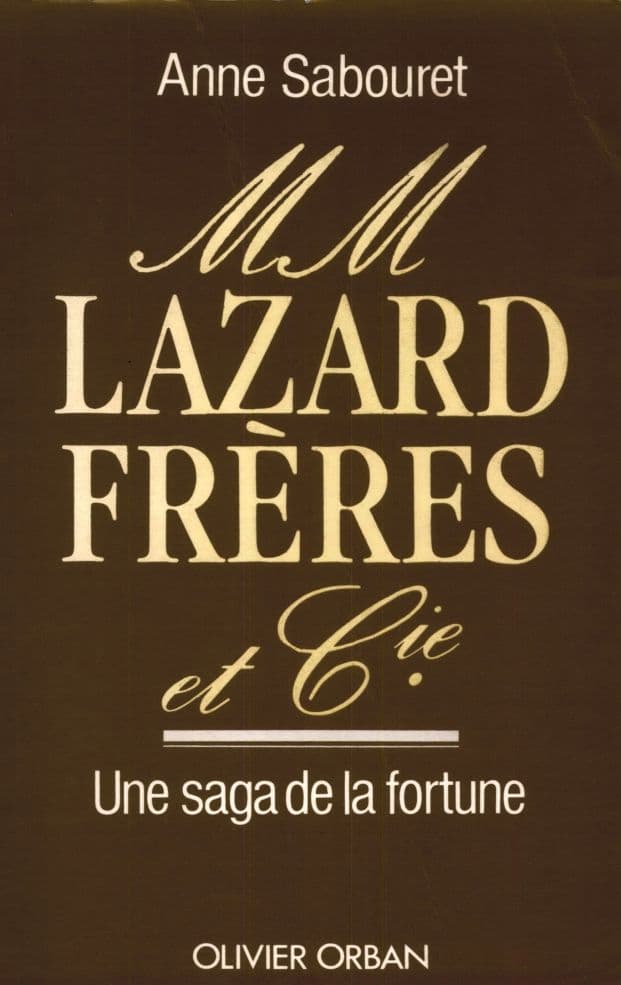
Mm. Lazard Freres et Cie: A Saga of Fortune (translated)

Mm. Lazard Freres et Cie: A Saga of Fortune (translated)

Anne Sabouret

27 highlights · 11 concepts · 55 entities · 3 cornerstones · 4 signatures

Context & Bio

A dry goods shop opened by Jewish immigrants in Gold Rush San Francisco that reinvented itself as a secretive tri-continental partnership bank — Paris, New York, London — surviving wars, seizures, and nationalizations by keeping personal liability, refusing retail deposits, and rebuilding its fortune at least three times across five generations.

Era1849–1990s: from California Gold Rush frontier commerce through two world wars, Nazi asset seizures, French nationalizations, and the rise of New York as the global financial capital.ScaleThree-city partnership (Paris, New York, London) that outlasted every major French fortune of its era — Renault, Citroën, Coty — earned more than both Rothschild houses combined, and became the most secretive investment bank in France while advising governments on both sides of the Atlantic.
Ask This Book
27 highlights
Cornerstone MovesHow they build businesses
Cornerstone Move
Magical Triangle From War's Wreckage
situational

Their American base, their intact international network, as well as their two major specializations - foreign exchange and the financing of gold transfers - suddenly became major assets. While bonds collapsed and the franc quickly lost two-thirds of its pre-war value, London and New York fully benefited from the paralysis of the old European financial centers. Over the post-war years, these gentlemen from Lazard thus set up a magical New York-London-Paris triangle, governed by a top-tier team that made the firm a true hidden power. Governments would often call on them. The talent and genius of the partners during this delicate period was to always think big and international.

2 evidence highlights — click to expand
Cornerstone Move
Personal Liability as Nationalization Shield
situational

a particularity made a difference between Lazard and the others. It is what, in any case, spared it the guillotine of nationalizations in 1981.

3 evidence highlights — click to expand
Cornerstone Move
Gold Bags to Gold Points — Liquidate at Peak
situational

The year 1876 was a decisive turning point in the history of the Lazards: the partners of the firm realized that the golden age of fabric and hardware trade was over. Their energy and expertise, they believed, would be better utilized in a strictly banking business. A firm that could skillfully manage this triple domicile in Paris, San Francisco, and London. Their decision was quickly made. They liquidated their assets by auctioning them off. "They ended their careers as merchants with the biggest annual profit they had ever made," notes Charles Altschul. "The firm had accumulated more capital than it could advantageously use in its business."

2 evidence highlights — click to expand
Signature MovesHow they operate & think
Signature Move
Business Lunches Not Society Dinners
situational
The David-Weills mainly hosted lunches, especially 'business' lunches. Some receptions, but far removed from the lavish high society dinners of the time.
2 evidence highlights
Signature Move
Bank Without Tellers or Savers
situational
chose to keep its legal structure, while its competitors became very standard public companies: the Lazards and the Weills continue to share profits, but they are also liable with their personal assets in case of bankruptcy. Similarly, although the accumulated accounts of small savers confer a huge financial clout to major deposit banks, the Lazards refrain from playing any role in draining national savings. This does not mean that they refrain from participating in the country’s economy. Their interventions in the field of gold transfers, brokerage, and foreign exchange operations gradually build the power of this bank without tellers.
2 evidence highlights
Signature Move
Primogeniture to Prevent Capital Dilution
situational
But already the nearly dynastic principle wanted by the founders to avoid the dilution of capital was at work: a kind of primogeniture now existed in the family, allowing the transfer of the limited partnership shares to only one of the sons, to the detriment of all the others.
2 evidence highlights
Signature Move
Secrecy as the Operating System
situational
Behind this mysterious sign, "Lazard Frères et Cie" hides the most secretive investment bank in France and the story of a family now at the top of the French fortunes chart.
2 evidence highlights
More Insights
Capital Strategy
Dynastic Primogeniture Against Dilution
situational
But already the nearly dynastic principle wanted by the founders to avoid the dilution of capital was at work: a kind of primogeniture now existed in the family, allowing the transfer of the limited partnership shares to only one of the sons, to the detriment of all the others.
2 evidence highlights
Competitive Advantage
Sleeping on Gold Bags Earns Trust
situational
It is reported that their reputation for honesty is so great that all of San Francisco knows that one can come without fear to store their bags of gold with the Lazards. Many pioneers also got into the habit of entrusting them to transfer their treasure to New York, or even to Europe. Simon reportedly slept on the precious bags he was transporting across the United States, rifle in hand...
2 evidence highlights
Risk Doctrine
Three-Legged Stool Across Sovereigns
situational
Lazard Partners is indeed an unusual bank, which has always operated on three legs - Lazard Frères in New York, Lazard Brothers in London, and Lazard Frères in Paris - and is endowed with a very rare legal status: that of a partnership. Its members are therefore liable with their personal assets.
2 evidence highlights
Identity & Culture
Fortune-Rebuilding as Core Competence
situational
"Just over the last ten years, I can say that I have made a fortune again. But my father himself had made a fortune again, after the war. And my great-grandfather had the merit of creating the first wealth."
3 evidence highlights
In Their Own Words

I know it will take a very long time for my success to be recognized. I have always known it would take forever. That there is no point, absolutely no point, in trying to force one's destiny. But I know - and it's my grandfather's example that allows me to say this - that when I am very old, I will be entitled to this recognition. So, I wait to be very old with great impatience.

Michel David-Weill on patience, generational wealth-building, and the slow recognition of Lazard's approach.

The historical mistake of the Rothschilds was that they never had an American base; a base that we at Lazard have consolidated for more than forty years. Not that Lazard-Paris isn't doing well, far from it. But New York is the 'sports center.' If you want to be a champion, or even a semi-champion, New York is the ultimate arena. The rest of the world is just provincial in comparison.

Michel David-Weill explaining why Lazard's tri-city structure, anchored in New York, gave them a permanent edge over the Rothschilds.

Just over the last ten years, I can say that I have made a fortune again. But my father himself had made a fortune again, after the war. And my great-grandfather had the merit of creating the first wealth.

Michel David-Weill on the David-Weill family's pattern of rebuilding fortunes across three generations.

So it is at least the third time, in my family, that we build a fortune. It is ultimately the only way to really get rich, given a tax system as little 'stimulating'. Also facing the international monetary disorders that mean that money could very well be worth nothing at the end of every month.

Michel David-Weill on why serial fortune-building, not fortune-preserving, is the family's real competitive advantage.

I am first and foremost the man, the scarcely visible link, who unites and underpins the efforts of the Lazard houses.

Michel David-Weill defining his role as the invisible connective tissue across Lazard's three autonomous offices.

Mistakes & Lessons
Nazi Seizure of Everything

Even total asset confiscation and looting of the David-Weill art collections couldn't kill the firm because the American base and international network survived independently — geographic redundancy was the ultimate insurance.

Rothschilds' Missing American Leg

Lazard learned from watching the Rothschilds that lacking an American base was a fatal structural error — New York was 'the ultimate arena' and everything else was provincial.

Continue Reading
Related Books
l'Ange Exterminateur
Airy Routier

Why linked: Counterparty overlap: Antoine Bernheim + luxury-control narrative.

Michelin: A Century of Secrets
Alain Jemain

Why linked: Shares Louis Renault, André Citroën, and France.

Leonardo Del Vecchio
Tommaso Ebhardt

Why linked: Shares New York, France, and United States.

The Taste of Luxury - Bernard Arnault and the Moët-Hennessy Louis Vuitton Story
Nadège Forestier & Nazanine Ravaï

Why linked: Counterparty overlap: Antoine Bernheim + luxury-control narrative.

The Robin Hood Trap
Thomas Veszelits

Why linked: Shares New York, United States, and Paris.

Key People
Antoine Bernheim
Banker / power broker

Primary figure in this dossier arc (1 mentions).

Michel David-Weill
Person

Recurring actor in this dossier network (3 mentions).

Bruno Roger
Person

Recurring actor in this dossier network (1 mentions).

Hitler
Person

Recurring actor in this dossier network (1 mentions).

Louis Renault
Person

Recurring actor in this dossier network (1 mentions).

Key Entities
Raw Highlights
Dynastic Primogeniture Against Dilution (1 highlight)

But already the nearly dynastic principle wanted by the founders to avoid the dilution of capital was at work: a kind of primogeniture now existed in the family, allowing the transfer of the limited partnership shares to only one of the sons, to the detriment of all the others.

Business Lunches Not Society Dinners (1 highlight)

The David-Weills mainly hosted lunches, especially 'business' lunches. Some receptions, but far removed from the lavish high society dinners of the time.

Sleeping on Gold Bags Earns Trust (1 highlight)

It is reported that their reputation for honesty is so great that all of San Francisco knows that one can come without fear to store their bags of gold with the Lazards. Many pioneers also got into the habit of entrusting them to transfer their treasure to New York, or even to Europe. Simon reportedly slept on the precious bags he was transporting across the United States, rifle in hand...

Bank Without Tellers or Savers (1 highlight)

chose to keep its legal structure, while its competitors became very standard public companies: the Lazards and the Weills continue to share profits, but they are also liable with their personal assets in case of bankruptcy. Similarly, although the accumulated accounts of small savers confer a huge financial clout to major deposit banks, the Lazards refrain from playing any role in draining national savings. This does not mean that they refrain from participating in the country’s economy. Their interventions in the field of gold transfers, brokerage, and foreign exchange operations gradually build the power of this bank without tellers.

Three-Legged Stool Across Sovereigns (1 highlight)

Lazard Partners is indeed an unusual bank, which has always operated on three legs - Lazard Frères in New York, Lazard Brothers in London, and Lazard Frères in Paris - and is endowed with a very rare legal status: that of a partnership. Its members are therefore liable with their personal assets.

Magical Triangle From War's Wreckage (1 highlight)

Their American base, their intact international network, as well as their two major specializations - foreign exchange and the financing of gold transfers - suddenly became major assets. While bonds collapsed and the franc quickly lost two-thirds of its pre-war value, London and New York fully benefited from the paralysis of the old European financial centers. Over the post-war years, these gentlemen from Lazard thus set up a magical New York-London-Paris triangle, governed by a top-tier team that made the firm a true hidden power. Governments would often call on them. The talent and genius of the partners during this delicate period was to always think big and international.

Fortune-Rebuilding as Core Competence (1 highlight)

"Just over the last ten years, I can say that I have made a fortune again. But my father himself had made a fortune again, after the war. And my great-grandfather had the merit of creating the first wealth."

Personal Liability as Nationalization Shield (1 highlight)

a particularity made a difference between Lazard and the others. It is what, in any case, spared it the guillotine of nationalizations in 1981.

Gold Bags to Gold Points — Liquidate at Peak (1 highlight)

The year 1876 was a decisive turning point in the history of the Lazards: the partners of the firm realized that the golden age of fabric and hardware trade was over. Their energy and expertise, they believed, would be better utilized in a strictly banking business. A firm that could skillfully manage this triple domicile in Paris, San Francisco, and London. Their decision was quickly made. They liquidated their assets by auctioning them off. "They ended their careers as merchants with the biggest annual profit they had ever made," notes Charles Altschul. "The firm had accumulated more capital than it could advantageously use in its business."

Secrecy as the Operating System (1 highlight)

Behind this mysterious sign, "Lazard Frères et Cie" hides the most secretive investment bank in France and the story of a family now at the top of the French fortunes chart.

Other highlights (17)

"I know it will take a very long time for my success to be recognized. I have always known it would take forever. That there is no point, absolutely no point, in trying to force one's destiny. But I know - and it’s my grandfather’s example that allows me to say this - that when I am very old, I will be entitled to this recognition. So, I wait to be very old with great impatience."

In Paris, Michel David-Weill lives in a very beautiful private hotel. For his vacations and weekends, he has a choice between a house in Jamaica, another near New York, a house on the French Riviera inherited from his father where sumptuous lunches are held, a 400-hectare family property, near Paris.

"So it is at least the third time, in my family, that we build a fortune. It is ultimately the only way to really get rich, given a tax system as little 'stimulating'. Also facing the international monetary disorders that mean that money could very well be worth nothing at the end of every month."

A house as lesser-known as its "boss", Michel David-Weill, and its partners. But one that makes much more money than both Rothschild houses combined, the one in Paris and the one in London.

"The historical mistake of the Rothschilds was that they never had an American base; a base that we at Lazard have consolidated for more than forty years. Not that Lazard-Paris isn't doing well, far from it. But New York is the "sports center." If you want to be a champion, or even a semi-champion, New York is the ultimate arena. The rest of the world is just provincial in comparison," sums up Michel David-Weill.

The history of Lazard was, however, chaotic. Several times, the saga nearly ended abruptly. In the dark days of 1940, when all "Jewish assets" were seized, when the fabulous collections of the David-Weills were being added to the artistic loot of Hitler or Goering, who could have imagined that everything would restart less than five years later?

During the some one hundred and forty years over which the Lazard saga unfolds, many fortunes have been built in France. Brilliant industry captains emerged. None survived the test of time. Forgotten, Louis Renault. Squandered, the considerable fortunes of André Citroën or the perfumer François Coty.

He defines himself initially as: "I am first and foremost the man, the scarcely visible link, who unites and underpins the efforts of the Lazard houses. I believe that for some, Lazard-Paris is Jean Guyot; for others, Antoine Bernheim or Bruno Roger. That Lazard-New York is Félix Rohatyn or Zarb. That Lazard-London is, depending on who you ask, John Nott or Wemer Wylie... But in fact, it is true that through them, it is still me; in other words, the house is always "ours", and its story continues..."

In many small German states, sovereign protection is granted to these encumbering travelers only for one or two nights. Barely arrived, one must depart again. And everywhere one must pay, still pay. To have the right to enter the state, to exit it, to use a road, a bridge, to transport one's meager riches without trouble. The laws that apply to Jews are always partial, often harsh.

Lazard Frères became a general partnership "for the operation of manufacturers and trading houses, banks, commission, and consignment in Paris and San Francisco, and in all other locations." The House of Banking was born! A historic date for this future investment bank was this January 1er, 1864.

His biographer, Charles Altschul, describes him as "the real driving force of the house", emphasizing his character traits: "He was very ambitious, indefatigable, always in control. With his combative spirit, he led the policy of the house as soon as he was firmly in the saddle. Those who had met him in business often found him too demanding, too authoritarian. But those who had the privilege of knowing him more closely, soon came to appreciate the charm of his personality."

Three types of checks circulated at the time: yellow checks for settlements in Californian gold-dollars, green checks for payments in paper dollars, and even blue checks for bills settled in silver dollars.

Three types of checks circulated at the time: yellow checks for settlements in Californian gold-dollars, green checks for payments in paper dollars, and even blue checks for bills settled in silver dollars.

the Kahns, the Loebs, the Guggenheims, the Goldmans, the Sachses, the Warburgs, the Schiffs, the Seligmans, the Simon Rothschilds, the Belmonts, the Frederick Strauses or Lazarus Strause

"The purchasing power has varied little, despite the incessant increase in military spending, the finances of the State are properly managed and this policy ensures that the State enjoys excellent credit both domestically and internationally," summarizes the historian Jacques Chastenet.

Until World War I, the Bank primarily engaged in discounting trade drafts between France and the United States. It also profited from what would be called today foreign exchange and what was then known as the "gold points," a system that prevailed until the establishment of the Gold Exchange Standard, in other words, the universal acceptance of the gold standard. Another source of profits for Lazard house: managing a few private portfolios, few in number but well-chosen. Finally, it is probable that it was in these years 1900-1910 that it took its first stakes in industrial companie

Lazard Frères continues to thrive cheerfully, with its San Francisco branch. During the war, President Wilson prohibited American public agencies from lending funds to belligerents. However, this policy of financial neutrality does not apply - liberalism obliges - to private banking establishments. As a result, almost all American banks have joined one of the two sides, most often that of the Franco-British allies. Lazard is obviously among them.