Radio Hauraki Investment
Only invest in businesses you understand and have empathy for - he never listened to radio and couldn't contribute meaningfully to the endless drama of managing radio personalities.
New Zealand entrepreneur and corporate finance dealmaker who built multiple businesses and orchestrated major privatizations during economic liberalization
Only invest in businesses you understand and have empathy for - he never listened to radio and couldn't contribute meaningfully to the endless drama of managing radio personalities.
Sold courier businesses for much less than they were worth - buyers leveraged and refloated them at huge profit, doing 'a Gibbs on Gibbs.'
“*My whole business experience has driven me to free markets … Over the years in running businesses in a highly regulated New Zealand society we found the great majority of one’s energy was spent either running up and down to Wellington to get permits or licences, or alternatively it was spent with one’s lawyers trying to find ways and means around the regulations. The net effect of that was probably over half of the…”
“Gibbs was happy now. As September 1993 drew near, when Freightways and Midavia Holdings had to buy their 224 million Telecom shares from the Americans at the privatisation price of $1.81, the share price was floating upwards towards the $4.00 range. Gibbs’ and Farmer’s pay day arrived when they outlaid around $200 million for their 112 million shares and immediately sold 67.5 million on the open market for $256 mill…”
“Their advantage has usually been analytical, more than temperamental. They’ve found a structural hole in a particular market, where true value hasn’t been recognised by everyone else, and have exploited that little niche effectively and rationally. Then they’ve often repeated the formula many times. As such, they’ve been predators, and in real life predators seek to incur the least risk possible while hunting.”
“Alongside Gibbs and Richwhite, two Fay, Richwhite men, Rob Cameron, a former senior Treasury official, and Steve Walker (‘Wakka’), a young thruster, rounded off the core of the team. For a while they called themselves the ‘Steam Team’, after a local brew in San Francisco (Anchor Steam) which they’d drunk in large quantities on American visits. In May 1989, a few months into their quest for Telecom, Gibbs was stunned…”
“The beauty is that whatever is left is mine to spend as I like. That has freed me up to do the crazy things I do. And spending millions on sculptures on some paddocks in the Kaipara is aberrant behaviour from an economic point of view, the money is written off and gone, like buying an ice-cream, there’s no way I could recoup it by selling The Farm. That seems to upset some of my contemporaries, but to me it is the e…”
“Gibbs had learnt, by accident, that walking away was sometimes the best approach. Castle Hill was his biggest deal, but there were several others: a service station site, another supermarket with a wider group, and a large hardware store not far from Mosman.”
“‘Unless I’ve got superior information,’ he says, ‘and I know it’s superior because I’ve developed it, investing in particular stocks and bonds is just punting.’ Gibbs continued to put most of his money in the bank. When people asked for advice on shares, he told them to invest in funds that followed the market index. Picking winners, he argued, was futile for most people.”
“*If a deal’s any good, you should be able to do it with no money.*”
“After the initial burst of activity from mid-1980 to early 1981, Atlas barely occupied three or four days a month of Gibbs’ time. Bidwill was the executive director while, even before his formal appointment as chairman, Gibbs’ style was to latch on to the topic periodically, testing and challenging Bidwill’s ideas, then letting him get on with it, while he kept his mind free for other opportunities.”
“The nature of Gibbs’ involvement in Forestry Corp was similar to that of his role at Atlas, Freightways and Bendon. His style was markedly different to John Fernyhough’s, for example, who as chairman of Electricorp spent most of his working week in Wellington and operated as an executive chairman. Gibbs gave Kirkland clear direction and then limited his role to challenging, provoking and guiding — and then stepping…”
“Gibbs lived by a rule that if he couldn’t demonstrate the deal was successful on an A4 sheet of paper, it wasn’t any good.”
“He is the greatest entrepreneurial businessman I’ve come across, head and shoulders above everyone else, with a very clear vision of what needs to be done. And though it may have looked from the outside as if he took great risks, he was actually very risk-averse; in fact he basically eliminated risk. He did his homework carefully, so that even though Tappendens was the biggest transaction that any of us had been inv…”
Joanne Black
Shares New Zealand, Freightways, and Telecom.
Grant Baker
Shares New Zealand, Telecom, and Auckland.
Ebbe Dommisse
Shares New Zealand, Margaret Thatcher, and Russia.
John Malone
Shares TCI and Tom.
Thor Bjorgolfsson
Shares Russia.
Andrew Rule
Shares Australia and Woolworths.
“‘What’s it made of?’ I heard an art dealer ask a businessman standing beside him, as they gazed at the extraordinary new sculpture by Anish Kapoor at Gibbs Farm. The businessman laughed. ‘Money,’ he said.”
“The idea that Gibbs could create one of the world’s great sculpture parks on a farm overlooking the Kaipara Harbour, a neglected and unvisited backwater north of Auckland, is outrageous. But no more outrageous than many of Alan Gibbs’ big ideas over the years: that in his mid-twenties he could build the first genuine New Zealand car, the Anziel Nova; that normal business disciplines and practices could be applied to the nation’s public health system; that the best way to make money in business is to persuade other people to give it to you; that he could double the utility of a car, extend human freedom and transform transport patterns around the world by creating the world’s first high-speed amphibious vehicles.”
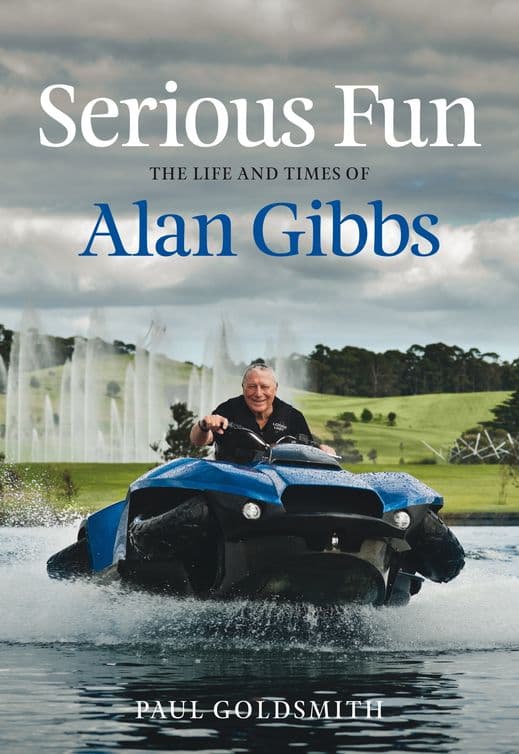
“At the time of writing, Gibbs is going to market with the world’s first high-speed amphibious vehicles. He’s starting with three versions: the Phibian, a large amphi-truck designed, amongst other uses, for all-terrain search and rescue activities; the Gibbs Humdinga, a four-wheel-drive beast that can also skim across rivers and harbours; and the Gibbs Quadski, a cross between a high-speed quad bike and a jet ski, targeted at the recreational market, particularly in the United States. These are the first offerings from a series of amphibians that he plans to roll out over the next few years.”
“It has extended into a 17-year quest that so far owes him US$200 million and has thrown up a seemingly inexhaustible supply of complex problems to solve. In the process his business, Gibbs Amphibians, has made stunning technological advances, registered dozens of patents and produced something in the Aquada that captured the public’s imagination internationally when it appeared in 2003.”
“Gibbs has had a long and highly productive business career. By adopting a low-risk style of deal making, keeping his affairs simple and choosing good partners, he amassed one of New Zealand’s largest personal fortunes during the 1980s and 1990s. His early career was an exemplar of capitalism’s creative destruction as he carried out the necessary restructuring of many inefficient companies and organisations so that either they could survive and add value in a world of open competition, or the resources invested in them could be put to better use elsewhere.”
“His thinking, naturally, was shaped first by his parents, but subsequently it has been greatly influenced by Austrian economist Friedrich Hayek, especially Hayek’s last book, *The Fatal Conceit: The errors of socialism.* One of Hayek’s essential insights was to see the wisdom borne out of the millions of voluntary decisions made every day by people operating in free markets and the folly of socialists who supposed they could plan for better outcomes and use the modern state’s powers of coercion to bring those plans to fruition. In their conceit, the socialists and planners show no awareness that there are huge limits to our knowledge and reason.”
“He carries himself in a way that’s hard to define, but which makes it clear that he is a leader of men. You never find him with nothing on his mind. He’ll want to tell you how the world could be so much better if only people could be persuaded to demand their freedoms, face reality and shrug off the dead weight of government intervention. An evening with Gibbs involves plenty of inspiration, some fear (if the laser beam momentarily alights on you), a good supply of his favourite Kistler chardonnay and much laughter.”
“G Hunt, *The Rich List: Wealth and enterprise in New Zealand, 1820–2000*”
“TN Gibbs exemplified the Protestant work ethic. One of his favourite aphorisms was ‘Pray as if everything depended on God and act, or work, as if everything depended on you’.”
“If Elsie was a warm and loving saint in her youngest son’s eyes, Theo remained remote and inscrutable. By the age of 12, Alan had worked out a mutually beneficial way to extract money from Theo. Since 1944 Gibbs had owned JA Hazelwood, a reasonably substantial general store in Upper Hutt. On weekends he’d visit the business, taking Alan along for the ride. Theo was an observant man and would point things out to his son to teach him about the world, but Alan soon figured out that, at bottom, his father had better things to do than answer an endless stream of questions from a 12-year-old. He proposed that Theo pay him a sixpence fee (around $1.50 in today’s terms) if he could remain silent all the way from Wellington to Upper Hutt. The deal was readily accepted. Theo Gibbs did have a lot on his mind in the early 1950s. Having come to Wellington largely to concentrate on Macduffs Ltd, he’d found that despite his efforts, the company was struggling by 1949 in the intense post-war competition. In 1950 he arranged to merge it with Woolworths. This deal unlocked good value for shareholders and enabled him to extract himself from day-to-day management. Thereafter he operated as a company director and adviser to several businesses, including Hurley Bendon Ltd, a new lingerie company set up by brothers Ray and Des Hurley.”
“Gibbs’ warm and easy relationship with Holyoake, who went on to become prime minister briefly in 1957 and again for more than a decade from 1960, boosted his boyhood confidence. Ian’s ambition and his success at Kinloch, meanwhile, provided Alan with a benchmark that in time he might measure himself against. His eldest brother also drove around in great sports cars. As a schoolboy, however, Alan could only daydream of future deeds and entrepreneurial schemes as he stomped the streets on his paper rounds or delivered parcels of groceries during holiday jobs at Hazelwoods. He took any opportunities that presented themselves to trade, however, such as with bubble gum at school or when mushrooms could be gathered on the hills and sold on the roadside.”
“The New Testament Parable of the Talents provided a leitmotif: a master left each of his servants with the same sum of money and expected them to trade with the money until he returned. Those who had turned the money to a profit were rewarded further, but the one who had ‘put it away safely wrapped up in a cloth’ was condemned for having done nothing with it, for having wasted opportunities.”
“For a young man with a good intellect and a mechanical bent, it offered many opportunities, particularly given the gathering awareness that while New Zealand sat comfortably amongst the handful of richest countries in the world, thanks to high prices for the wool, meat and dairy products it produced so efficiently, those conditions wouldn’t always prevail and it might be a good idea for the country to broaden its industrial base. In”
“As an engineer, Gibbs put in a strong early performance. Maths wasn’t his favourite subject and he did no more than pass, but he gained high marks in his other first year engineering papers. The course required students to take holiday internships for practical experience, so Gibbs spent the summer of 1958/59 at Precision Engineering, a metal pressing firm near Wellington’s Basin Reserve. The experience taught him the danger in forcing intellectually stimulated people to perform boring tasks. Gibbs was drafted to spend several days feeding metal into a press while pushing a pedal each time it went in.”
“A little unsettled, Gibbs spent some of the following summer in Adelaide on an internship at the ICI plant converting salt into soda ash. He was assigned to work on a methods study, which considered the operation’s industrial processes to see how they might be improved. Working alongside a very bright arts graduate, he was surprised and interested to discover that although he wasn’t an engineer, this man was very good at assessing industrial processes. He learnt that ICI consciously employed non-engineers for this work, the rationale being that because they didn’t know anything about the processes, they asked the most basic, and often the most productive, questions. Engineers, by contrast, frequently took some aspects for granted and missed opportunities to do things differently.”
“The Taoist philosophy, as it filtered through to me, was about power; how the emperor can best control his country. One of the principles was that if the people know the law, the people are strong; if they don’t know the law, the emperor is strong. I later understood that this idea formed the basis of the communist system; if the law was whatever the leaders said it was on the day, the people lived in terror. The Chinese, meantime, had a great civilisation yet it never crossed their minds to give people a vote or to worry about the opinions of the peasants; it was all about power and running empires. Coming from a normal Western environment, where democracy was everything and giving voters what they wanted seemed to be our only purpose on earth, this was a fantastic awakening; it opened my mind. I loved political science.”
“When I look at crazy 18-year-old terrorists ready to blow themselves up, it doesn’t surprise me. Young boys aged 17 to 21 are mad. If that guy John Pocock, who I admired, had been a radical communist and said the way to get our ideals out there is to walk down the main street of Christchurch and rough a few people up, I probably would have done it. It’s fascinating to realise that. Nature has made young boys highly impressionable and easily led as cannon fodder to fight for their tribe, I suppose. Fortunately Pocock wasn’t radical enough, and Khrushchev wasn’t reading Jenny’s letters.”
“Looking back on the period now, Gibbs finds it bizarre: ‘You couldn’t subscribe to an overseas magazine without government permission, couldn’t import anything without a licence, couldn’t even compete domestically with another trucking firm, for example, without going to court to get a licence and proving that you had a customer who couldn’t be served by someone else. It was an incredibly controlled country.’ The Gibbs family, like any business family in the country, had been sucked into the system. Hazelwoods, the general store in Upper Hutt, had the state-sanctioned monopoly on bread in the area. The region was neatly carved up by bureaucrats, but the price was controlled to four pence a loaf.”
“He carried out his first market intelligence in Singapore, irritating the local traders by haggling extensively but not buying. The city was very poor and scruffy.”
“Their next stop, Colombo in Sri Lanka (then Ceylon), was also an assault on the senses, but on a train excursion through the lush tropical countryside to Negombo they gained a sense of the glory of the former British Empire. As they sailed to Aden, Alan spent much of his time talking to fellow passengers about their electronics purchases, finding out what they’d paid. By the time they reached Aden, then a free-trade port and still part of the Empire, he’d worked out the lowest price anyone had achieved in Singapore for the radio he wanted:”
“A couple of weeks staying in King’s Cross in a one-room flat with a coin-operated gas fire was sufficient for them to organise their European excursion. Theo had lent the young couple £400 to buy a car; the money went a long way since they were able to buy a car tax-free as they were taking it out of Britain. Alan picked up a Morris 1100 for £408 and was delighted with the result. ‘It was a fantastic little car; probably the favourite of all my cars. Designed by Sir Alec Issigonis, the same guy who designed the Mini, and with hydrolastic suspension and a front-wheel-drive transverse engine, which has since become the standard worldwide, it handled brilliantly.’”
“At the High Commission in Haymarket, a recently completed modernist tower with great views across the city, Alan was on a good wicket. He was paid £1800 a year (nearly $70,000 in today’s terms), twice what he could have earned in the civil service at home, on top of free accommodation and plenty of privileges, such as duty-free alcohol and membership of the RAC Club, a posh private men’s club near the High Commission. He was much taken with the sports area in the RAC Club’s basement, which had a 33-yard heated swimming pool, a restaurant, massage tables, a Turkish bath and squash courts:”
“Strange things came across his desk at the High Commission. In November 1963 Congo rebels attacked several church mission stations. Gibbs had to pass on a cable sent by one New Zealand missionary to her parents. It stated simply: ‘All well, Cyril with Jesus.’ In reality, Cyril had been mown down by machine-gun fire at Stanleyville; his wife, who sent the cable, had an arm hacked off and both their daughters had legs amputated.[2](private://read/01jrsfvkjy84rkprtbz9amfvj8/#rw-num-note-477210-626309542-2) The travails and stoicism of several missionary families that he encountered during his work profoundly affected Gibbs.”
“Everything was so dug in that import licences had become property rights. Because the incumbents had a guaranteed place in the market, there was no genuine competition. The New Zealand economy had become feudal; you were born with licences or you were a serf. The lucky families with lucrative licences made millions; the rest of us paid crazy prices for their products. It was a corrupting system in the sense that importers naturally spent an awful lot of time being nice to civil servants and politicians, giving them holidays, tickets to the theatre and lunches, although I never saw any evidence of corruption involving wads of cash.”
“The import licences were extremely political. Some import licences were worth millions to these guys who owned them. There were such huge vested interests involved that the system became rigid. In theory, our eight-man committee was supposed to work out whether, given the state of our foreign exchange reserves, we could allow more imports, and if so whether we should grant more licences, say, for children’s shoes or for tins of sardines. It was impossible to make such judgments, and because the politicians had the hell beaten out of them if they took anything away from an existing importer, the tendency was for everyone on the schedule to get the same as the year before, plus or minus a set percentage to reflect balance of payments pressures.”
“The reality is, however, that TN Gibbs had sent mixed messages over a longer period. Alan didn’t receive any financial assets from his father, but he had gained something more valuable. As he puts it, ‘I gained the benefit of seeing Dad being successful in business. He didn’t talk about it much, but watching him gave me the feel for it, it gave me the confidence that business wasn’t a great mystery, but rather something I could master.’”
“It was a blow, but Gibbs didn’t despair yet. They’d also written to Holyoake, who’d been overseas early in September. He’d discussed the project with Marshall and asked his deputy to be ‘kept in touch with developments’.[9](private://read/01jrsfvkjy84rkprtbz9amfvj8/#rw-num-note-477268-974936905-9) Eventually Marshall relented and the brothers secured a meeting with him, but their charm and enthusiasm weren’t sufficient. Writing a month later, Marshall offered only a flicker of hope that he and Customs Minister Norm Shelton might consider some licences for the Anziel project further down the line if the balance of payments situation improved, allowing for a general relaxation of import controls. But there was no assurance.[10](private://read/01jrsfvkjy84rkprtbz9amfvj8/#rw-num-note-477268-974936905-10)”
“Not taking the hint, the Gibbs kept pushing. Ian explained he was going to the UK to visit the Reliant plant and they really needed their prototype to make progress. Marshall finally yielded at the end of November, allowing them to spend £750 on their prototype, but stressing that this munificence did not imply that approval had been given for the broader project.[11](private://read/01jrsfvkjy84rkprtbz9amfvj8/#rw-num-note-477268-974936905-11) Such was the extent of the state’s powers in New Zealand that the young entrepreneur had had to crawl on hand and knee to get this far.”
“Knowing that the car project would take months, possibly years, to come to fruition, Gibbs kept busy on other things to pay the bills. By the time Alan joined Anziel, Ian was employing six or seven people. Leaving the car project to one side, Alan’s job at Anziel was to look for a manufacturing business to buy, in order to grow the business. There was an expectation down the line that he would buy into this new business.”
“Within a few months Alan found a small metal-pressing business in South Auckland, Holmes Manufacturing Ltd. It was a family affair owned by a tool maker who was keen to devote more time to his magnificent train set. The company employed around 12 people: two tool makers, the most highly skilled men of the trade, who made the dies from which the metal would be stamped, and 10 press operators. They made components for Dominion Electric, a company that assembled electronic goods under protection from international competition by import licences. Holmes Manufacturing produced metal chassis for radios and television sets. They also made stainless steel conveyor chains for freezing works and film reels and cans for the government film department. One of their highest volume products was a peach pitting spoon; basically a bent knife. ‘It was an elementary little business,’ Gibbs recalls, but he was intent on turning it into something bigger.”
“TN Gibbs had taken a piece of wisdom from the biblical King Solomon as one of his guiding principles in business: ‘Take shares in several ventures; you never know what will go wrong in this world.’[12](private://read/01jrsfvkjy84rkprtbz9amfvj8/#rw-num-note-477268-974936905-12) Alan Gibbs took it to heart. While the car project ground its way through the system and while he set about expanding Holmes Manufacturing’s business, he cast about for other entrepreneurial schemes. He spied an opportunity to import advanced breeding stock for chicken meat. Stiff controls over importing birds were in place and the best birds in New Zealand were bred to produce eggs rather than meat.”
“Alan arranged to bring Sir Lawrence Hartnett, the father of the Australian car industry, to New Zealand to lend weight to their press conferences and ministerial visits. Hartnett had overseen the birth and development of the Holden since the 1930s and was a respected figure internationally. With Hartnett flying in on Sunday, 17 September for the announcement, they planned maximum publicity. ‘Top secret plans for New Zealand’s own car’ were leaked to the *Sunday News* to build up excitement, then coverage of the Sunday afternoon press conference generated front-page or page-three news all around the country the following day. Initially, they talked simply of a ‘90 mph family car’. Ian Gibbs fronted, while Lawrence Hartnett said he was at a loss to explain the proposal’s cool reception from Norm Shelton, the Customs Minister.[15](private://read/01jrsfvkjy84rkprtbz9amfvj8/#rw-num-note-477268-974936905-15)”
“Basically I could see it was only ever going to be extremely frustrating. There was no way to get into scale manufacturing because of the controlled system. Because of the inefficiency of it, we never made cash; the cash was all tied up in stock. We could make a year’s requirements in six weeks but had to hold stock to supply the market for a year. There was no real free cash coming out of the business. And there was no real satisfaction since our customers were paying too much for our products because of the monopolistic system.”
“*Dad used to swear that the primary object was water safety training. He’d capsize periodically so I’d get used to righting the boat and get out from under it. But I learnt quickly that if you were winning a race or doing well, he wouldn’t try the water safety exercise. It was simple, if you were winning you didn’t get dumped; though Dad claims that wasn’t the lesson he was trying to teach me*.[2](private://read/01jrsfvkjy84rkprtbz9amfvj8/#rw-num-note-477196-607209396-2)”
“As far as resource booms go, this one was a whopper. New companies were being floated continually and there’d be specialist reports from so-called independent mining surveyors. It was all based around rumours and there were large sums involved. We had a small trading desk downstairs with phones and ticker tape giving the latest prices. I remember being amazed going into the room and seeing guys yelling ‘buy 5 million’, ‘sell, sell’; they were hysterical. I’d never seen anything like it. It introduced me to the lunacy shown by the guys trading in a boom, and the lessons that came from the massive crash that followed have served me well. I became allergic to bubbles, which helped me survive several later ones.”
“the subtlety of the Japanese attitude; that it wasn’t about breaking contracts whenever they became inconvenient. It reflected a different mind-set. ‘We’re used to an absolutist Roman law view of contracts,’ Gibbs says, ‘and in the West we’ve developed languages capable of the precision needed for such contracts, whereas Japan’s language, by design, is imprecise; each word has several meanings, so as to avoid offence.’ The Japanese were relying on relationships, with a certain amount of give and take expected at difficult times.”
“As well as sub-underwriting, IPC organised takeovers. Gibbs was taught to scour though stocks to find companies that were cheap and likely to benefit from restructuring. Then they would find someone who would benefit from buying it, while arranging a hefty fee for IPC.”
“Ron Scott had been one of Gibbs’ mates at Canterbury University. The son of a Scottish tea planter in India, Scott had inherited some money and was working for a leading real estate firm in Sydney. The pair ran into each other and soon devised a scheme to make money in their spare time. Supermarkets were a relatively new idea in Australia and there was money to be made by consolidating a two-and-a-half-acre site suitable for a new supermarket. City councils around Sydney were keen to facilitate these developments and had rezoned a number of potential sites. The typical site had 12 private houses on it, the value of which might double overnight. The task was to buy the 12 properties, then flick the combination on to a corporate developer, such as Lend Lease. Naturally, plenty of other speculators were trying to do the same thing and it was a race to line up all the property owners at one site. The exercise was akin to herding cats.”
“*They were all interested; they all wanted top dollar. But there was always a real estate agent amongst the 12, or a lawyer, or a suspicious old person with grasping children in the background warning them not to get ripped off. It was an exercise in the art of negotiation; the art of getting the confidence of* *these people. They’d ask who we were representing and we’d say, ‘Of course, we can’t tell you that.’ They’d all nod and we got away with the fact we were nobodies. But because everyone was different and most involved their lawyers, the process took weeks. By the time you’d got the tenth to sign on the line, the three-month option had expired for the first and second; so then you’d have to go back to the first and offer them more. Even though we weren’t risking our money, it was a hairy business and a stressful one, because we’d be dreaming of all the money we’d make if we could pull it off. The closer we got, the more tantalising it became as we worried that we’d miss out.*”
“*When they made the offer, we said, ‘How do we know that you’ll document this deal and sign it off by Friday?’ The Lend Lease guy said, ‘You have the word of a director of Lend Lease that we’ll complete this transaction. The word of a Lend Lease director is not given lightly.’ ‘OK,’ I said. Well, we got the documents in on Thursday and they started to have all sorts of little problems with the details, then trouble getting the directors available for signing. Eventually they agreed to meet at 3pm on Friday to square it away. We met and they were still fluffing around. Finally, the penny dropped. They were stalling us, calling our bluff that we had another offer and trying to lower the price at the last moment.* *Being a simple Kiwi guy, I was enraged. I didn’t give a damn if we lost the deal. I stood up and said, ‘You bloody bastards are trying to renegotiate; you gave us*”