Ignoring Intuition About Looming Crashes
I should have exited Iceland before the 2008 crash when my intuition signaled danger, but ego and busyness blinded me.
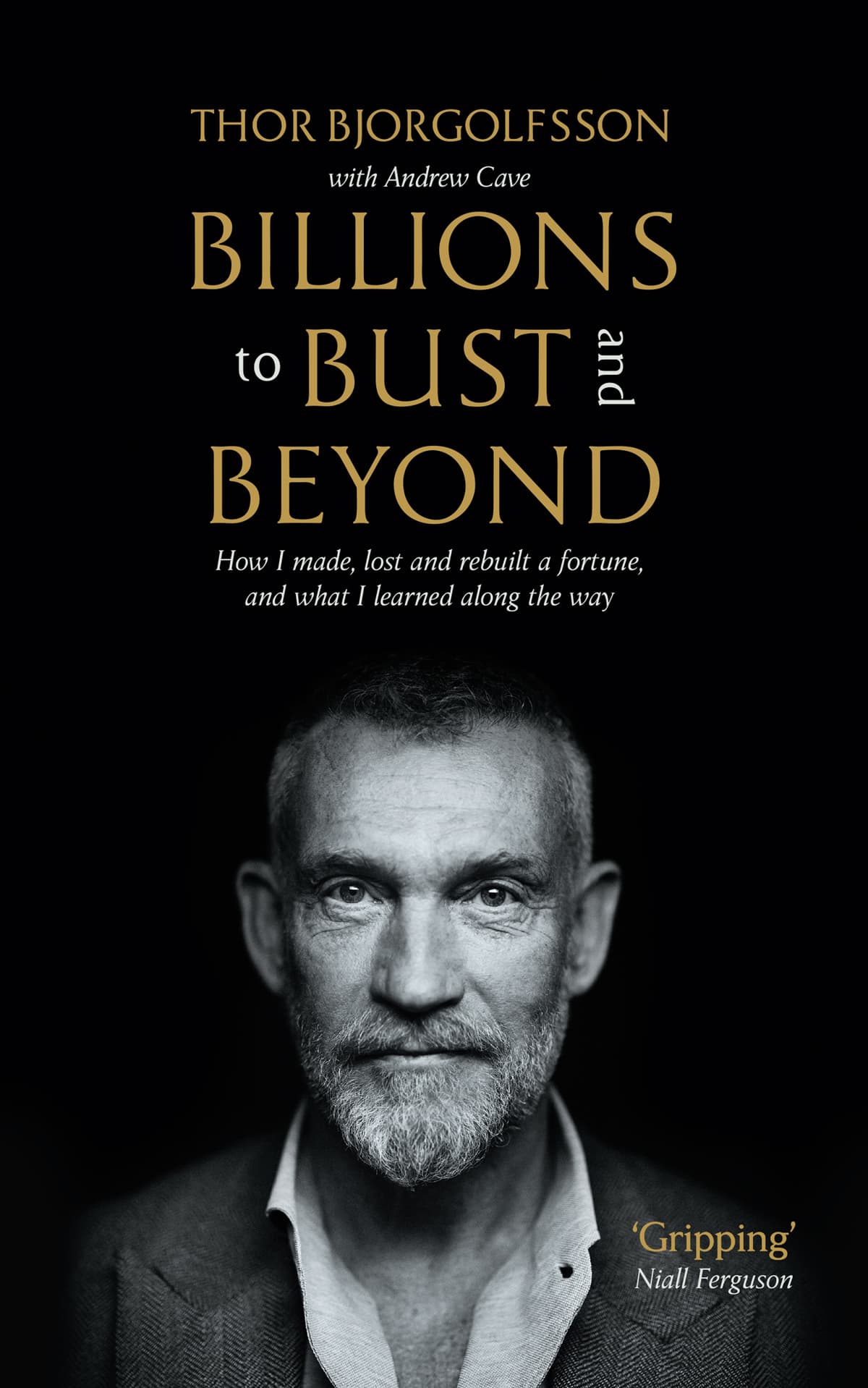
Thor Bjorgolfsson
204 highlights · 17 themes · 38 cited people/companies
Thor Bjorgolfsson is an Icelandic entrepreneur and investor who built multibillion-dollar businesses across emerging markets, notably in Russia (Bravo brewery), Bulgaria (Balkanpharma, BTC), Iceland (Actavis, Landsbanki), and Poland (Play), becoming one of Iceland’s wealthiest and most influential business figures.
I should have exited Iceland before the 2008 crash when my intuition signaled danger, but ego and busyness blinded me.
Being involved in too many deals dulled my oversight, leading to lack of control and missed danger signs.
Relying on unprecedented levels of leverage can amplify gains but also destroy a fortune overnight when cycles turn.
“What in fact happened was a typical macroeconomic event in the form of Covid-19. The financial and economic effects for business were artificially prolonged by the zero per cent interest ‘rescue policies’ of the US and European central banks. I learned from my experience in Iceland, when I had waited too long for the tide to turn, to cut my losses and not leave any loose ends. So in Latin America I decided to make a…”
“In the boom years, along with countless others, I worshipped the god of leverage. In my best year, I made $1.3 billion from merging, floating and spinning off businesses. Then I looked to do it all again. I was always happiest when deals, ideally more than one at a time, were in view. I liked to call what I did visionary and similar in some ways to chess, in that I was always planning the game several moves ahead. I…”
“One of my major mistakes was that I was in too much of a hurry to try other ventures and didn’t pay enough attention to Iceland’s problems. I was trying to lay as many bets as I could while the plentiful supply of surplus capital lasted. But I had lost focus and was involved in too many things. I sold Bulgarian telecoms group BTC but then, before I had finished a project with Finnish telecoms firm Elisa, I was engro…”
“I took my chances and lost. I am not ashamed of that. I am also far from alone in the fallout of 2008. In private equity deals, what often happens is that managers are offered a share of the profits but are required to plough some of their savings into the deal as well. If people are willing to do that, they are genuinely aligned. That works well in the private equity model but somehow it is absent in the way the ba…”
“Branding is a personal passion of mine, dating back all the way to the Bravo venture in St Petersburg, and it felt exciting and invigorating to be essentially building a start-up again. But what should we call our new baby? After discarding an initial notion to use the Play brand, we looked for a similarly dynamic name behind which to build a challenger, customer-centric culture and asked half a dozen marketing agen…”
“People have said to me that the deal could have sunk Deutsche Bank. It was my deal – and I put my hand up clearly for it – but the multiples that it was pitched at now look nothing short of staggering. We put in 12 times leverage and 5 times equity, with the result that Europe’s second-largest generic drugmaker was valued at 17 times its underlying EBITDA. Why did we value Actavis so highly? Well, it was the height…”
“I should have walked away once I had figured out what was going on. I should have said: ‘I smell a rat and this is dangerous.’ That was what my intuition was telling me, but I ignored it because I thought I would be portrayed as a failure or a bad loser if I claimed that the deal was rigged. Instead, I wrote letters to the prime minister, the economics minister and the privatisation committee and did media interview…”
“In Russia, I was able to get out in time. This time, I was too deeply entrenched. As an investor, I was being chased by banks every day. ‘What do you want to do next?’ they would ask. ‘Want to deal in real estate? We’d love to help you. Can we lend you some money?’ The banks were hugely overbor-rowed themselves and yet chasing new opportunities to lend. We should have spotted the dangers of the situation a mile off.”
“When communism crumbled in eastern Europe, the fear was palpable. Entire economies were coming apart, familiar structures were vanishing overnight. But beneath that surface, something new was taking shape. I didn’t run from that chaos – I ran towards it. In Russia, I found opportunities where others saw only risk, and I managed to create a start-up business in the rubble of the old system there. The same was true du…”
“We had just started on the first module when we realised that we would have to go immediately to stage two, so we started building that. All at once we were producing, marketing and selling a new beer, while constructing a new brewery and doubling and tripling production. We reinvested old capital into the business again and again. When we launched in St Petersburg in 1999, we were still a secret. Nobody knew what w…”
“the question I always kept in mind in the debt bubble was: how much am I personally guaranteeing? That was a checkpoint for me. The answer, when the markets crashed, was that I had personal guarantees of €400 million. One of my advisers, a restructuring specialist, told me that this was the largest personal guarantee he had ever seen in a restructuring. After my father went bankrupt and his €250 million share of our…”
“It seems to me that my biggest and best deals over the last three decades have all happened inside a failed process of some kind or other. The successes have come not in times of stability, but in the aftermath of collapse. If there’s a philosophy that runs through my career – and my life, really – it’s this: systems fail, but resilience creates opportunity. Time after time, I’ve seen it play out in the world around…”
Thomas Veszelits
Shares Deutsche Bank, Forbes, and Colombia.
Ebbe Dommisse
Shares Deutsche Bank, Russia, and Heineken.
Peter Venison
Shares US, UK, and London.
Peter Andersson och Tommy Larsson Segerlind
Shares Russia, EU, and Switzerland.
Odd Harald Hauge
Shares London, Switzerland, and Central Bank.
Tadashi Yanai
Shares UK, London, and father.
“Born into one of Iceland’s most famous capitalist families, I remember negotiating my earliest deal at the age of 10 when I persuaded my father to lend me $80 to buy a stack of vintage *Marvel* and *X-Men* comic books. I went into a 50–50 partnership with him. It was my idea and his money, which seemed to be a good notion at the time. I never paid him back, but the comics became a great investment. They have never been sold and are stored in a warehouse, accumulating value that will hopefully be passed on to my children.”
“A decade and a half later, I made my first fortune amid the Khrushchev-era concrete apartment blocks of Russia’s hinterland following the collapse of the Soviet Union and fall of communism. I made my money from alcopops and beer, funding growth through my credit card, bank and private equity borrowings and working all the hours I could. Calculating that there were large profits to be made for the first outsider to successfully launch a premium beer brand in newly capitalist Russia, I set up shop in the Wild East and built the nation’s biggest foreign-owned brewery start-up, selling out for hundreds of millions of dollars ten years later.”
“I thrived on coping with the esoteric, the dangerous and the exotic in pursuit of a deal. From pharmaceuticals investments in Bulgaria at the time NATO was bombing Serbia to dismantling a top-heavy former nationalised telecoms giant in the Czech Republic, I discovered that a little capital and a lot of debt could multiply my initial wealth many times over. It peaked when I bought a Bulgarian telecoms group, BTC. My leverage on that deal was 95 per cent, meaning I only had to put up 5 per cent of the funds myself. I was hooked.”
“I had more money than I could have spent in a thousand years. *Forbes* estimated my wealth at $3.4 billion and put me on its cover. Steady increases in asset value kept adding to my fortune. It might just as well have been on autopilot. Doubts crept up on the periphery, but everything was moving too fast for me to process it clearly and objectively.”
“What does a deal-aholic think about when he wakes up in the morning with a dull thud in his head? I am not interested in financial architecture or in predicting the regulatory weather, nor do I rely on structural change. Economies and their markets, their regulators and their rules are constantly changing. A proficient surfer knows how to read the waves but cannot dictate what kinds of waves come in. The market is often wrong and it is those sorts of imbalances I make money from. I have made profits by accepting more risk than some other investors could stomach and then quickly de-risking through financial engineering before selling out to people with different risk appetites. Do I want a level playing field? No – no more than a surfer would like the sea to turn flat. In both instances, that course of events would just turn everything into a commodity.”
“I have always been interested in what I call special situations. I like to parachute into hairy situations, save them from getting worse, turn them around and make an exit. You could call it storm-riding financial markets. Such situations develop only when people are scared and do not understand the risks. I act like one of the advance guards who seeks to establish an entrenched advantage. I am not a mercenary. I am accountable. My personal reputation and wealth are at stake and my next deal depends on how I have entered and exited my last one. Publicly quoted corporations are normally not nimble or brave enough to put their balance sheets at risk in the same way that risk-taking individuals do. I can put myself on the line for what I am doing. People know who I am and what they see is what they get.”
“So what do they see? A deal junkie who constantly has his eye on the next stage of the plan? A financial manoeuvre that will turn the situation and open up the potential for profit? And what do I think of when I’m in the midst of such a plan? How I can tweak the shape of the business. What can be spun off, demerged or sold? What potential is there for mergers to create larger focused businesses, maybe specific to geographies or sectors? How much leverage can be put on the deal? What is the potential for stock or bond offerings? Which larger investors can be brought in for slices of the action? My eye is always on how I exit. I don’t normally just buy something, hold it for a long time without changing the business and then just sell. What interests me is the evolution, the de-risking, and the stage-by-stage metamorphosis of a business into something that is simply inherently more profitable.”
“In the boom years, along with countless others, I worshipped the god of leverage. In my best year, I made $1.3 billion from merging, floating and spinning off businesses. Then I looked to do it all again. I was always happiest when deals, ideally more than one at a time, were in view. I liked to call what I did visionary and similar in some ways to chess, in that I was always planning the game several moves ahead. I like to think I am good at spotting opportunities and having a sense of how things could turn. If asked about my strengths I’m intuitive – my best results have come when I have followed my intuition, whereas the times I have managed to suppress it have usually ended in disaster. I’m always looking at my portfolio and seeing how I can develop and enhance it, and my time horizon is generally where I want to be in two to five years.”
“What was it like to add $2 billion to my personal wealth in the space of just two years? It certainly wasn’t ‘easy come, easy go’, although that is how it might look now, but it was definitely rapid. I made my first $100 million in 2002, from the Bravo brewery sale to Heineken. In those years Pharmaco, later Actavis, a generic pharmaceutical business where I was the largest shareholder, had become a public company with a stock market capitalisation of about $50 million – so small that London investment bankers would barely give me the time of day. But Actavis grew phenomenally both organically and through mergers and acquisitions, and by 2008 it was valued at €5.3 billion ($7.3 billion dollars at the exchange rate of the time) and was Iceland’s biggest industrial company, second in size only to the banks on the nation’s stock exchange. Actavis, in all its guises, was my biggest, most profitable and most complicated investment. It sums up the way I like to do business. In its early days, it involved putting together an equity consortium in a privatisation in eastern Europe. Then there was a reverse takeover of a listed company, the spin-off of its core business, a hostile cross-border takeover of another listed company, a public-to-private leveraged buy-out, financial restructuring and finally a sale to a listed company.”
“It is like managing a Formula One racing team: you are constantly making adjustments to the car to improve performance and also adapting your race strategy to get ahead of the competition.”
“What happened is that money got diverted out of the economy into the capital markets. It is like when people stop buying houses and cars and instead mortgage their apartments and start speculating in the equity and government bond markets. Companies can do that too. Directors say to each other: ‘Let’s not focus so much on fishing or making more food here. Let’s just buy this debt.’ This is one similarity between what happened in Russia and Iceland before their respective crashes. In Iceland, the situation was stoked up by an unrealistically strong krona and the state issuing paper. Of course, the banks had their problems too, but the biggest problem was the unsustainable strength of the currency. That is what caused the most collateral damage when the bubble was finally pricked.”
“Another similarity is the oligarchies that had emerged in pre-crash Russia and in Iceland. I would estimate that in 2008 about 30 people controlled Iceland’s economy, out of a total population of 300,000. That is one in 10,000: not an excessive concentration of power compared with, say, the US or the UK, but the extent of what Iceland’s political and financial oligarchs controlled was, as with their counterparts in Russia, disproportionate, which in such a small country created a huge imbalance.”
“In Russia I was just a marginal character outside the system, whereas at the time of the crash in Iceland I was close to the centre. I had the biggest balance sheet and the biggest exposure to the economy, but I did not realise how weak the state was. I was also fooled by the ratings. An Icelandic economist has pointed out, and rightfully so, that the Icelandic banks are the only financial institutions in the world that have gone bankrupt with an A rating. With Russia, I was always aware of the fragile state of the economy. My assumption was that it could blow up tomorrow and everything would be gone.”
“In 2008, people in Iceland believed they were destined for something, that it was time for ‘God’s frozen people’, as a former Icelandic prime minister, David Oddsson, had once referred to them, to take their place. But Iceland was trying to punch way above its weight without regard to the fundamentals. It was like when Iceland’s national handball team won silver in the Beijing Olympics in 2008. ‘Iceland is not a small country. It’s the “biggestest” country in the world,’ exclaimed the president’s wife at that time. I shared in that moment, having arranged at the last minute to go to Beijing for the game with my wife Kristin. We were on holiday in St Tropez when we heard that Iceland had got into the final. I rang my secretary and asked her to get us to China. I wanted to be there at the moment when Iceland had a chance of winning gold in something. Within 24 hours, we were in Beijing. It was a symbol of how at that time almost anything seemed possible for Iceland.”
“Let’s do the math, as Americans say. In 2005, *Forbes* calculated I was worth $1.4 billion, making me Iceland’s first billionaire. By the peak of the boom, midway through 2007, this had increased to $4 billion, with roughly one third of my wealth in Actavis, another third in Landsbanki, Iceland’s second-biggest bank which was privatised in 2002, and the remainder in other ventures. But by the end of 2009, following the government’s seizure of Landsbanki and the fall in Actavis’s valuation, this had fallen to about $40 million. So if people asked how I was doing, I replied that I still had 1 per cent of my net worth.”
“the question I always kept in mind in the debt bubble was: how much am I personally guaranteeing? That was a checkpoint for me. The answer, when the markets crashed, was that I had personal guarantees of €400 million. One of my advisers, a restructuring specialist, told me that this was the largest personal guarantee he had ever seen in a restructuring. After my father went bankrupt and his €250 million share of our joint guarantees was added to mine, the total rose to €650 million and the proportion of the balance sheet I was guaranteeing rose from 12 per cent to 20 per cent.”
“I do not mean to paint me white and them black; I am just looking at it from a different perspective. My actions were not dictated by any great altruism; I simply thought Iceland would weather the financial storm and we would get to the other side. Most of the other guys just said: ‘There’s not a chance in hell.’ But they were pessimists, something I can never be accused of being. Innate optimism is at the heart of everything I have ever done. I believe that to succeed you have to be an optimist and then you build everything from that. In the years after the 2008 crash, the biggest danger was that I would lose my optimism. I came close to doing so but thank God it didn’t happen.”
“A family is like a forest: when you are outside, it is dense; when you are inside, you see that each tree has its place. African proverb”
“On a fateful day in 1978, a knock came at the door. Dad was in his study and a few men went in to sit with him. One of them was in the kitchen speaking to my mother. The atmosphere was sombre, but I found it hard to understand just how serious things were because I knew all the men from happy social occasions in our home. They were cool guys, with long sideburns. One of them came into my room and removed his glasses. The rims were so thick and heavy that they left a wide red line across the bridge of his nose. He looked me in the eye and asked if my Dad had ever been bad to me. ‘No,’ I replied. When Dad was drunk, he fell asleep. The man asked me if I was sad when Dad went drinking. I hesitated and said ‘yes’. He took me into the living room to sit down with my father and mother and the other men and explained that they were discussing whether Dad should go to a nice hospital for a few weeks to stop him drinking again. He then asked me: ‘What do you think Thor? Would you like Daddy to stop drinking?’ All eyes fell on me and I was surprised that they were asking me and that everyone was listening carefully for my answer. I said: ‘Yes, I would,’ and the room went quiet as my words sank in.”
“Of course, an 11-year-old does not see his home country on such terms. Put an 11-year-old in Moscow under Brezhnev or in Tehran today and he will sculpt a world that suits his interests and enthusiasms. But this particular 11-year-old who was taken from Reykjavik to San Francisco in 1978 made a discovery and a long-term decision.”
“The magnitude of this realisation was extraordinary. As I walked down the big wooden staircase from the TV room, I just thought to myself: ‘He’s gone. I have to try to take control of this situation.’”
“The newsreader spoke of major embezzlement and fraud, and by the end it seemed as though he had recited half of the penal law. The report said they had been arrested and would be kept in isolation for six weeks. Six weeks in solitary confinement? That day was a slap in the face, just as shocking to me as the one my mother had given my father 13 years before. Again it signalled a breach of trust, this time between the Icelandic establishment, me and my family. I knew I didn’t want to be part of the system in this country. But another thing struck me as I sat there in front of the TV. I felt I was now responsible for the family and realised I had to grow up overnight.”
“My great-grandfather became the most influential leader of this new society over the following decades. Many were more prominent in politics, but none had the impact that he did in Iceland. Like me, his great-grandson, more than a century later, he built a fortune and lost it. He was also able to build subsequent fortunes, so he will continue to be my guiding light. And his story illustrates much about my family and Iceland and my role in both.”
“After his stay in Bordeyri, Thor was hired by a merchant in Borgarnes on a decent wage. But he still kept his sheep and expanded further, buying land in Borgarfjordur and hiring a keeper. Within a short time, he became the town’s leading sheep farmer, again making his money from the export trade. After a dispute with the merchant who employed him, Thor borrowed money from Scottish traders he had got to know in Borgarnes and opened his own store in nearby Akranes, and at the same time continued to expand his sheep business. By not only investing his own funds but also taking loans to expand even further, he was as it turned out buying into a bubble.”
“Perhaps ‘bubble’ is an exaggeration, but within a very short period in the 19th century the number of sheep in Iceland doubled from 400,000 to 800,000. Everyone in Iceland was affected. It changed the nature of farming, making ever-increasing production its goal. It brought substantial amounts of money into the country and changed the nature of finance. By paying farmers to keep his sheep, Thor was in a sense like the derivatives traders of today, as he was really betting on the selling price come autumn. If high, he turned a profit. If low, he was protecting the farmers from losses.”
“After getting his fingers burnt so badly, Thor came to the conclusion that the only way for Icelanders to create any real wealth was in the fishing industry. In pursuance of that belief, he went on to become the leading figure in building up the fishing trade in Iceland after centuries in which the focus had been on farming. It took him and his associates only two decades to transform both Iceland’s economy and its society. Living standards rose significantly and a more accomplished and robust culture was established.”
“As I have always been able to do, I made it up as I went along”
“Life’s not fair. Accept it and move on.”
“out. I often think that the best lessons I learned in business were outside business school, which cannot teach you how to pitch or close a deal – these are things you have to learn in the field.”
“The advertising law in Iceland was very strict and you could not advertise alcohol. We needed something innovative, so I created a travelling beer festival. We did a lot of camouflaged advertising, obtained a lot of media coverage and sold a lot of beer. Then my father told me he was thinking of doing something really off the wall. He had sold the Pepsi franchise and was left with just the brewery, an old soft drinks factory and a non-compete clause that prohibited it from making soft drinks for sale in Iceland. He had met up with an old friend, Ingimar Haukur Ingimarsson, and they decided to set up a joint venture in Russia, which was just opening up to external capital. They would ship to Russia bottling equipment formerly owned by Pharmaco, a listed Icelandic pharmaceutical company, and make soft drinks for sale locally. The two old friends would eventually fall out spectacularly over this venture.”
“The Russian joint venture went ahead in 1993 under the name Baltic Bottling Plant. Magnus was in charge of setting up the factory and I was in charge of marketing. We made two reconnaissance trips. We took a look, came back and said: ‘It’s a bizarre place but let’s see what we can do.’ We had heard that Russians wanted something colourful so we produced a batch of pink lemonade and shipped a couple of containers to Russia. I toured the shops, carrying out market research and trying to gauge the demand for soft drinks. But Russia was pretty chaotic at that time. I came across empty supermarket shelves and long lines of people queuing for food; the shops smelled and the service was dreadful. But I realised that we could make something there. Even though we had old products, they could still work. That is what Russia became in those years: a dumping ground for old stock.”
“Coming from the US, where everyone greeted me sweetly and asked how I was, it was a shock to arrive in Russia. If you asked a Russian how he was, you were likely to get the answer: ‘Better today than tomorrow.’ The Russians were a pessimistic bunch, used to hearing about grand three- or five-year plans without ever seeing anything getting better. So maybe it’s harsh to say that they were pessimists; perhaps they were just well-informed optimists.”
“A lot of corners were cut and the chaotic nature of the joint venture meant that it was effectively stillborn. The Russians, who owned 35 per cent of the venture, contributed the land and buildings, and Ingimar and Bernard (who had a 65 per cent stake) were supposed to contribute the old Icelandic bottling machinery and some start-up funds. Magnus, my father and I were supposed to be running the venture for the stakeholders who had contributed the machinery and the factory. We had no stake in the venture, but the hope – and promise – of earning equity if the business prospered. However, after the equipment arrived and was commissioned, we discovered that the BVI guys had tricked our Russian partners and Russian customs. Instead of contributing the machinery in return for share capital and thereby avoiding customs duties and taxes as start-ups could legally do, the manifest listed just some items of furniture and supplies. The BVI guys set up another offshore company that ‘owned’ the machinery to take leasing payments from the Russian factory’s monthly cash flow. They had tried to get UK investors for the joint venture and failed. They did put in a small amount of money but then tried to extract funds, as they did not believe the venture would ever become profitable – obviously influenced by their failure to get any investors, which was probably because they had no track record as principals in any deals, let alone risky emerging-market deals.”
“It has been amazing to watch how this man has shaped Russia over the last quarter of a century. When he first appeared in the Kremlin with real power as prime minister in 1999, while I was living in Russia, he was just what the country needed. A disciplined leader with ambitions to turn Russia around from the downward economic and social spiral that his weak predecessor Boris Yeltsin had presided over while he was in power. Yeltsin was simply a raging alcoholic with a kleptocratic circle of oligarch advisers who were not working in either his or Russia’s best interests by any measure.”
“In Putin’s first eight years, he stabilised the economy, curbed the oligarchs’ influence and their looting and strengthened the state immensely. He was an absolute hero to the vast majority of Russians who craved a strong leader to ensure a strong Russia that would project its power internationally. People in the West forget this today and don’t really appreciate the horrible state of Russia for its inhabitants when Putin took over, or the Herculean task of turning it around when he took the reins of state control.”
“In those chaotic days I became familiar with the Russian term *krysha*, meaning roof, which was important to understand. This was summed up well by David Hoffman in an article published in the *Washington Post* in May 1997: > Almost every business in Russia – from kerbside vendors to huge oil and gas companies, American and foreign firms, even mayors and regional bosses – pays for the protection service of some kind of *krysha*, according to security experts here.”
“Alcohol had long been a major cause of early deaths in Russia, so the government knew there was a lot to gain by trying to change people’s drinking habits. There was also a lot of fake vodka for sale, made from petrochemicals and very often deadly. One manager at the plant was hospitalised for five weeks after drinking such store-bought fake vodka. This was the situation when Bravo was started and it was probably one of the reasons that the World Bank gave a $100 million loan facility to the brewery. It was there to support the government, and this was one way of doing so.”
“This venture transformed the business but was not without its problems. Although the Baltic Bottling Plant had nothing to do with the new company, the fact that it was doing well and had the right formula for success enraged the BVI guys, Ingimar and Bernard, who started challenging us in court and asking for settlements. We therefore had both mobsters and ex-partners looking for a cut in the business in exchange for doing nothing, but having a nuisance value to be bought off. I have since come up against this kind of thing on many occasions.”
“The Russian beer market was really taking off. For every can of ‘long’ drinks sold in Russia, 40 times as much beer was being consumed, and the market was growing at 20 per cent a year. If we could win just a 5 per cent share, that business would be much larger than anything we were doing in alcopops. Beer was a complementary product, distributed by the same dealers and sold in the same bars. We had the connections. We just needed the capital and the sheer nerve to do it. We focused on long drinks from 1996 to 1998 and started our brewery project the following year. Free cash flow from the long drinks business went into securing the land and some of the equipment, but we needed another $25 million. Russia was booming, so we decided to tap external investment for the first time, going to the London capital markets. We thought we would have to syndicate the $25 million, but a Californian funds group, Capital Research, attracted by the idea of private equity in an emerging market, said that it wanted to fund the entire project. We spent some time negotiating the valuation, estimating future earnings and coming up with a formula that gave Capital 33 per cent of the company. The shareholders all agreed, and we set up a tax-efficient Cyprus-based company to own all the Russian assets.”
“I was seven months into the construction of the new Bravo brewery in St Petersburg when the currency crisis hit, having ploughed everything that I owned into this hole in the ground of a brewery. ‘What’s our position without this investment?’ I asked Bravo’s finance director. He explained: ‘We owe millions to our suppliers, and our customers, particularly the 3,000 shops in St Petersburg and 4,000 in Moscow that we distribute to directly, owe us millions too. The problem is that we owe in dollars and they owe in roubles and this is where we are screwed.’ All of a sudden, instead of those assets and liabilities matching, they were massively apart. It was a hugely volatile time: South Korea was also in crisis, the Long-Term Capital Management (LTCM) hedge fund had imploded and there was a lot of talk about financial meltdown. South Korea and Russia, to an extent, were both rescued by the International Monetary Fund; Wall Street was forced by the US Federal Reserve to bail out LTCM.”