“The volume of sales of men's suits largely depends on the salesman's skills and attitude towards the customer. The same piece of clothing, if recommended properly, might just be sold. If not properly recommended, business that should have been done may be lost. Therefore, selling suits, whether it's marketing or sizing, requires very high skills and experience. However, selling casual clothes is different: you do no…”
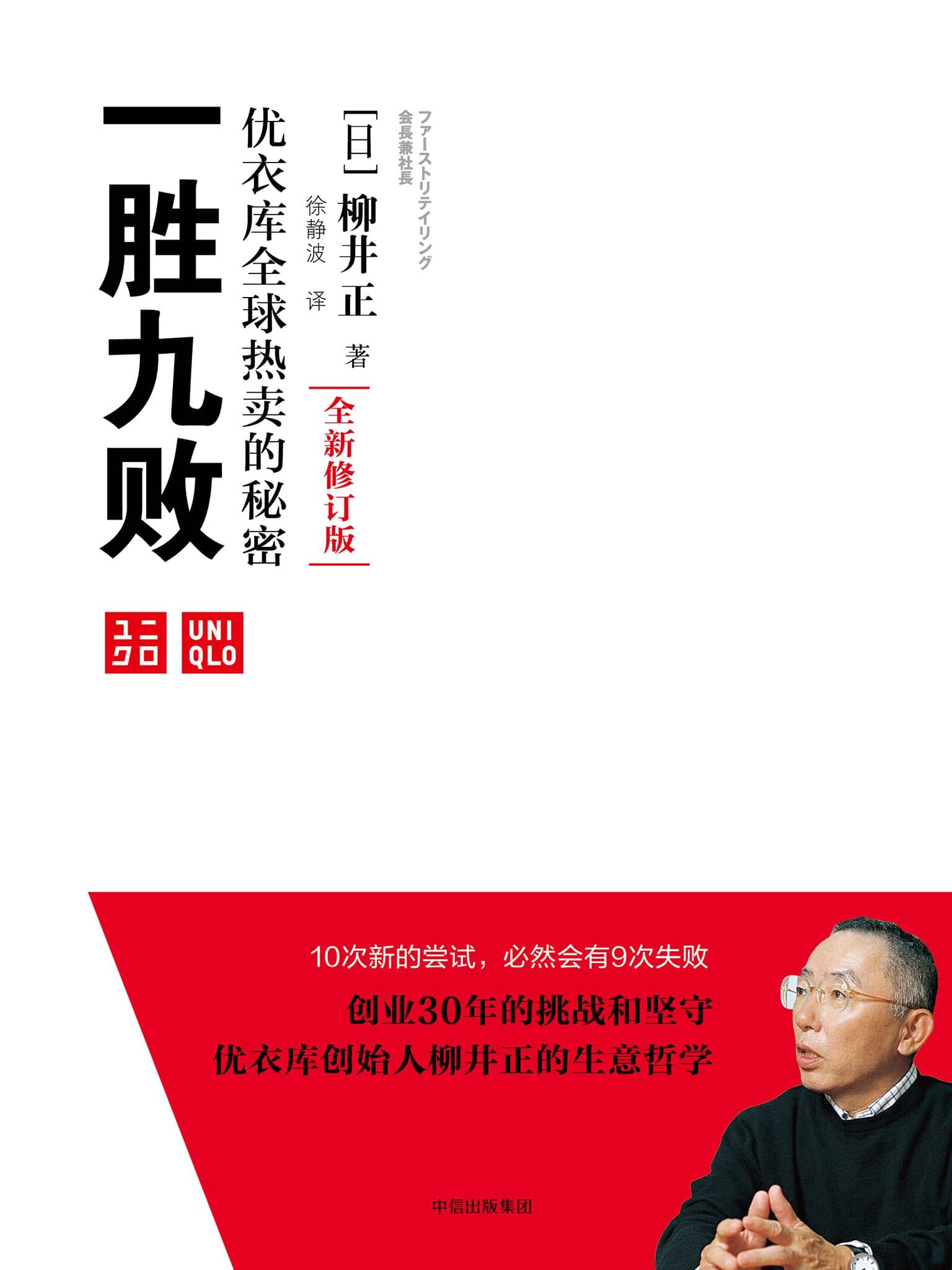
One win and nine losses: The entrepreneurial life and business philosophy of Japan's new richest man, Tadashi Yanai (translated)
Tadashi Yanai
29 highlights · 11 themes · 32 people/companies
Tadashi Yanai, founder and president of Fast Retailing/Uniqlo, who transformed his father's small-town men's suit shop into Japan's largest casual wear retailer and became the country's richest man.
Era
1970s-2000s Japan: post-war economic boom, bubble economy, bubble collapse and prolonged recession — plus retail industry shift from downtown specialty shops to suburban chain stores.
Scale
Built Uniqlo from a single 330-sqm casual wear store in 1984 to a publicly listed company on the Tokyo Stock Exchange (1999) with stores across Japan, the UK, and China under Fast Retailing Co., Ltd.
Ask this book
29 highlights
Suggested questions
Notes
“The reason why Uniqlo was able to grow rapidly is because everyone wanted to realize the company's business philosophy as soon as possible, and it is the result of the whole company working together. The attention Uniqlo received from society is not something we can control, nor do we desire it. But we know that customers who come to buy Uniqlo's products will naturally comment on the price and quality of the produc…”
“My father was an old-fashioned businessman. He was honest and valued friendship, trading only for the livelihood of the family, and could not be called an entrepreneur or operator. "Business is done in practice," are words of wisdom my father lovingly instilled in me. However, sometimes I couldn't quite agree with some of his practices. Therefore, my father was both my teacher and an example of what not to do. Never…”
“After the bubble economy collapsed, the Japanese economy has been in a slump. Imagine, if a person has been working for more than 30 years, then his 30 years can be defined as "20 years of great success + more than ten years of great failure". I didn't initially have a clear realization that there would be a big failure after the big success. But now I know that this factor of failure has long been lurking in the su…”
“This is how the first "UNICLO CLOTHING WAREHOUSE" casual wear store introduced in the preface of this book was born. The store's business philosophy is to "let customers buy casual clothes like they buy weekly magazines." The shops are located in densely populated urban areas, but they are located in alleys and the rent is cheap. We rented the first and second floors of an apartment building, which totaled about 330…”
“The moment I took over the company seal from my father, I knew that I have no way back. Since the company's baton has been handed over to me, I must do my best to run the company desperately. At this moment, I had a passion for business and wanted to take the risk.”
“At that time, the Uniqlo logo was "UNICLO". Four years later (March 1988), when the company formed a joint venture with local people in Hong Kong and was preparing to set up a commodity purchasing company (the company name was set as "UNICLO TRADING"), the person who went through the company registration procedures mistakenly changed the "UNICLO" to "UNICLO". C" is written as "Q". Later, we looked at the font and fo…”
“In a small city like Ube, information is quite isolated. To get the latest fashion information, I often buy and read fashion and jewelry magazines. I travel overseas once a year, especially to see stores in Western countries such as the United States and the United Kingdom. I was particularly inspired by the advanced retail businesses at the time, such as ESPRIT, BENETTON, GAP, LIMITED, NEXT, and other chain store b…”
“• A corporation is a living entity with a lifespan. If it cannot generate good economic returns, it can dissolve and disappear at any time.”
“That year, I was 35 years old and served as the Executive Director of Shougun Commercial Stock Co., Ltd. (now Fast Retailing Co., Ltd.), which my father managed. After graduating from university, I worked in a supermarket for 10 months. After resigning, I led a loose life for a while, then took over my father's men's suit store. When the first Uniqlo store opened, it was exactly the 12th year of my joining the compa…”
“In the following years, I challenged various markets with clothing sales as the core, experienced several failures, and made some business friends. In the end, I established "Fast Retailing Co., Ltd.". Currently, the company not only carries out Uniqlo's retail business throughout Japan, but also opens Uniqlo specialty stores in countries and regions such as the UK and China. In the process, we learned a lot of valu…”
“I don't have the idea of leisurely writing a memoir, because the market is changing constantly, and all the time, I am thinking about what I have to do and want to do, so I don't have the spare time to quietly recall the past. But, what is business management? Why do we work in a company? For these basic concepts, I want to confirm and summarize, and share with directors and employees who have fought together and wi…”
Themes
Turnover Speed Over Margin SizeShared Mission Over Solo GeniusFather as Teacher and Counter-ExampleFailure Germs Hide Inside SuccessSuburban Location ArbitrageCasual Clothes Like Weekly MagazinesBurn the Boats When You Take the SealAccidents as Brand ArchitectureCustomer Need First, Company Desire NeverSteal From Foreign Retail Then LocalizeCompanies Die Without Self-Reinvention
People
Companies
Highlights
“That year, I was 35 years old and served as the Executive Director of Shougun Commercial Stock Co., Ltd. (now Fast Retailing Co., Ltd.), which my father managed. After graduating from university, I worked in a supermarket for 10 months. After resigning, I led a loose life for a while, then took over my father's men's suit store. When the first Uniqlo store opened, it was exactly the 12th year of my joining the company. Although at that time I couldn't distinguish the difference between "doing business" and "working", I had already begun to feel the joy and fear of doing business.”
“In the following years, I challenged various markets with clothing sales as the core, experienced several failures, and made some business friends. In the end, I established "Fast Retailing Co., Ltd.". Currently, the company not only carries out Uniqlo's retail business throughout Japan, but also opens Uniqlo specialty stores in countries and regions such as the UK and China. In the process, we learned a lot of valuable things from our customers and our partners. What makes me proud is that the company also has a large number of hard-working excellent employees. On this occasion, I would like to express my heartfelt thanks to the directors and employees of the company for their great support and encouragement to me who is not very good in the past years.”
“I don't have the idea of leisurely writing a memoir, because the market is changing constantly, and all the time, I am thinking about what I have to do and want to do, so I don't have the spare time to quietly recall the past. But, what is business management? Why do we work in a company? For these basic concepts, I want to confirm and summarize, and share with directors and employees who have fought together and will continue to fight together. This is my motive and rationale for writing this book.”
“• At the funeral, I told my relatives and friends, "My father was my greatest competitor in my life." That was the first time I wept openly in public.”
“• A corporation is a living entity with a lifespan. If it cannot generate good economic returns, it can dissolve and disappear at any time.”
“Essentially, a company is not an eternal entity. It has a high degree of fluidity and a very low chance of permanence.”
“After the bubble economy collapsed, the Japanese economy has been in a slump. Imagine, if a person has been working for more than 30 years, then his 30 years can be defined as "20 years of great success + more than ten years of great failure". I didn't initially have a clear realization that there would be a big failure after the big success. But now I know that this factor of failure has long been lurking in the success. In other words, the germ of failure lies in success, and this germ of failure grows quietly during the period of success, leading to the current disastrous results.”
“An organization like this has the flexibility to adjust its structure and asset scale according to sales. A company without this flexibility will not work, and a rigid organizational structure will sooner or later cause problems. As I just said, companies have a lifespan, and if they can't change themselves according to changes in the environment, it's impossible for the company to survive well. As an operator, no matter how the business environment changes, it is their most basic responsibility to continuously improve business performance.”
“The reason why Uniqlo was able to grow rapidly is because everyone wanted to realize the company's business philosophy as soon as possible, and it is the result of the whole company working together. The attention Uniqlo received from society is not something we can control, nor do we desire it. But we know that customers who come to buy Uniqlo's products will naturally comment on the price and quality of the products. Public praise will naturally promote the growth of the company and the improvement of its efficiency. As a company, what we need to do is to strive to explore the needs of customers and produce better products according to the needs of customers. Whether such an act will lead to a new "Uniqlo craze" is something no one can predict or control.”
“My father was an old-fashioned businessman. He was honest and valued friendship, trading only for the livelihood of the family, and could not be called an entrepreneur or operator. "Business is done in practice," are words of wisdom my father lovingly instilled in me. However, sometimes I couldn't quite agree with some of his practices. Therefore, my father was both my teacher and an example of what not to do. Nevertheless, there's no doubt my father had a great impact on me.”
“From a very young age, I was instilled with the idea that "whatever you do, you should do it the best". Perhaps because of this, I developed a conception in my mind that this was how fathers should discipline their sons. In my childhood, I rarely received any praise from my father, except for the occasional compliment when I was accepted to high school and university.”
“Seeing my father betting everything he had in life, conducting his business as if it was a battlefield, I always felt that I was not suitable for this kind of life. Yet, I ended up inheriting my father's suit store and developed it into the Uniqlo we have today. Looking back, I am continually amazed at the incredible connection between my life's trajectory and my father's.”
“My father opened his suit store in 1949, the year I was born. In April 1984, he had a stroke. In June, the first Uniqlo store opened. In September of the same year, my father retired from his position as President and became Chairman, and I, who had been the Executive Director, took over as President.”
“On February 1, 1999, our company was listed on the main board of the Tokyo Stock Exchange. Five nights after I told my father the good news, he passed away. The next day, February 7, was my 50th birthday, while my father's 79-year-old life came to an end. At his funeral, I told my relatives and friends, "My father was the biggest competitor in my life." It was the first time I had cried so openly in front of everyone.”
“After the small suit store was on track, my father also ran a coffee shop and a movie theater, in addition to the construction company, and he became a standout character amongst the local operators. The construction business was thriving during the period of high economic growth. During this time, my father opened a VAN store because he liked the brand's merchandise very much. I often wore VAN branded T-shirts with athletic collars and touring shoes during my high school years. This was probably one reason why I became fond of casual wear.”
“During my time at university, I also traveled to the United States, and often went to tea at the high-volume jazz dance halls in Waseda and Takadanobaba. But to tell the truth, I visited mahjong parlors more than anywhere else. I didn't go to class often, and by the time I reached my third and fourth year, I didn't worry about job prospects. All I was thinking was: it would be best if I didn't have to work.”
“At that time, the head of Human Resources at Jusco was the sister of Takuya Okuda, the founder and honorary chairman of AEON Group. I remember my strong impression when I first joined the company was that the dormitory was well-equipped, and the care for people was very thoughtful. After joining the company, I was sent to the main store in Yokkaichi for training.”
“When I decided to go home to take over the family business, my father, who was perhaps busy with his own construction company, didn't give me anything to do, just handed me the men's clothing store. Not knowing what to do, I went into the store as usual, busy serving customers and doing miscellaneous things. At that time, "Ogura Shoji" had developed from an individual store into "Ogura Shoji Co., Ltd." with a capital of 6 million yen, with a men's clothing store with an annual sales of about 100 million yen and a VAN store selling casual wear.”
“Although I consider myself a unfilial son, I am, after all, someone with practical experience of Jusco's workflow and management structure, so after working for a while, I found many problems in the store's workflow from procurement to sales. The entire store was inefficient and turned money too slowly, even when selling high-end suits in the commercial street's suit stores. Although the company was not in the red, it did not make much money.”
“When I gradually understood the principles of doing business, I felt that I could not let this state continue, so I told the six clerks in the store how to do the right thing. But what happened next surprised me: these clerks began to resign. Two years later, only Mr. Ura was left. I never intended to have a fallout with these old clerks, maybe they thought I was wrong, maybe they were shaken by the future development of the store, which led to this regrettable result. But even when old employees like the store manager submitted their resignations, my father never blamed me. On the contrary, one day, he handed me the company's important account books and seals. If I were in his shoes, seeing these old employees leaving one after another, I would definitely say something. Now thinking back, I feel that my father is really great, truly a respected businessman. I guess my father might have thought this way: if you really have the determination to do something, go ahead and do it, even if you ruin the company in the end, as long as I am still alive, I can help you recover.”
“The moment I took over the company seal from my father, I knew that I have no way back. Since the company's baton has been handed over to me, I must do my best to run the company desperately. At this moment, I had a passion for business and wanted to take the risk.”
“Mr. Pu's VAN store, which is on the same commercial street, is a place where I often go to check the sales of casual clothes. If I were to say what kind of clothes suit me to sell, I think selling casual clothes that do not require to be measured for customers seems to be a better fit. Suits are only sold to men over the age of 20, while casual wear customers have no age restrictions, making it a very public market. Is casual wear a market with a promising future? At that time, I began to feel the potential of the casual wear market.”
“The volume of sales of men's suits largely depends on the salesman's skills and attitude towards the customer. The same piece of clothing, if recommended properly, might just be sold. If not properly recommended, business that should have been done may be lost. Therefore, selling suits, whether it's marketing or sizing, requires very high skills and experience. However, selling casual clothes is different: you do not have to measure and tailor the customer. Nevertheless, popular items often sell out and the less popular ones might not sell at all, creating a significant gap. Men's clothing, especially suits, is expensive and has a high margin but just like Japanese kimono, the turnover period is very long, usually only twice a year and at best three times. If the sales are good, it can make money, but if not, inventory could pile up. Sometimes, I feel like a taxi driver who only wants to pick up long-haul passengers, waiting for the opportunity takes a long time.”
“Originally, our company — like Aoyama Western Clothing, XEBIO (a Japanese sporting goods retail brand), and other companies — belonged to the "Japanese Western Clothing Top Chain Association". At that time, the retail industry in Japan was in a period of vigorous development of suburban shops. Amidst my peers striving to go public, I felt the limitations of my company only dealing in men's suits. Therefore, an idea started to form in my mind: opening a large casual wear store in the suburbs might be interesting.”
“In a small city like Ube, information is quite isolated. To get the latest fashion information, I often buy and read fashion and jewelry magazines. I travel overseas once a year, especially to see stores in Western countries such as the United States and the United Kingdom. I was particularly inspired by the advanced retail businesses at the time, such as ESPRIT, BENETTON, GAP, LIMITED, NEXT, and other chain store brands. Initially, I participated in business study groups organized by the industry associations and went overseas with my peers. Later, I would go alone to the United States to purchase items like t-shirts and jeans; I also went to London, England to purchase t-shirts, jewelry, and antique watches.”
“There, students had everything they needed for life, and it was easy to take. They didn't need any assistance from the sales staff, it's completely self-service. There wasn't that commercial flavor of trying to sell things, and the store layout was completely designed from the customer's perspective. Students walked in the store as casually as they would browse a bookstore or a record store. If they like something, they buy it, if not, they just look around and go out. I suddenly realized that selling our casual clothes in this way would be very interesting. However, this simple "self-service" form could easily be misunderstood as us trying to save on labor costs, a misunderstanding we would not want. Therefore, we believe the best way of service is "self-service that customers want", which later became UNIQLO's operating principle of "HELP YOURSELF".”
“This is how the first "UNICLO CLOTHING WAREHOUSE" casual wear store introduced in the preface of this book was born. The store's business philosophy is to "let customers buy casual clothes like they buy weekly magazines." The shops are located in densely populated urban areas, but they are located in alleys and the rent is cheap. We rented the first and second floors of an apartment building, which totaled about 330 square meters. The price of the product is set at 1,000 yen and 1,900 yen. The first day the store opened was an unprecedented event. From the time it opened at 6 a.m. to the next two days, there were so many people coming to the store that we had to limit the number of people entering the store.”
“At that time, the Uniqlo logo was "UNICLO". Four years later (March 1988), when the company formed a joint venture with local people in Hong Kong and was preparing to set up a commodity purchasing company (the company name was set as "UNICLO TRADING"), the person who went through the company registration procedures mistakenly changed the "UNICLO" to "UNICLO". C" is written as "Q". Later, we looked at the font and found that the visual effect was better after changing to "Q". Therefore, it was decided to change the names of all the company's stores, including those in Japan, to "UNIQLO". Real life is often like this. An accidental mistake is the beginning of a beautiful story.”
“At that time, the Uniqlo logo was "UNICLO". Four years later (in March 1988), when the company went into a joint venture with a local person in Hong Kong to establish a goods procurement company named "UNICLO TRADING", the person who was registering the company mistook the "C" in "UNICLO" for a “Q". Later, we realized that the visual effect was even better with the “Q”, so we decided to change all the names of the stores to "UNIQLO", including those in Japan. Indeed, sometimes real life is like this; a beautiful story often begins with a chance mistake.”