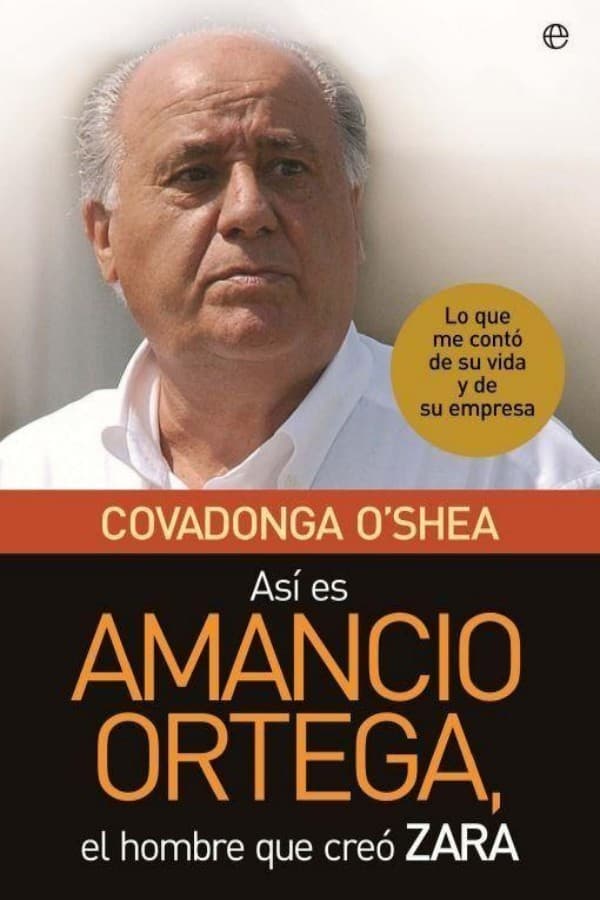
“What accounted for the success of a fashion that combined an attractive quality-price relationship with some design features that reminded, without a doubt, of the greats of the time? "Armani designs for you," a professional in the sector, an expert in luxury brands, told me, convinced of what he was saying when he saw me with a perfectly made Zara jacket, with an impeccable cut and a very characteristic fabric of this great designer. This jacket was one of my first purchases at Zara, which would become, as in the case of so many other women, one of my favorite stores.”
“"What was the secret of their success?", many wondered at the time, and continue to do so around the world. One of the company's executives gave the answer in four main lines: "From prices, the whole process is done in-house without intermediaries or brokers"; in addition to buying the material at a good price and having cheap labor —he said—, "the business formula is that the profit margin is very small. We prefer to make little on each garment but sell many."”
“Another key topic: offering up-to-date clothing. A stylist on the team explained that the brand's greatest success was being able to quickly detect and interpret fashion trends and customer tastes.”
“"Inditex has a department of 40 people—how many are there today?, I wonder—dispersed in New York nightclubs, shopping areas of Paris, trendy bars and hotspots in Spain... This trend tracking is known as market testing to target audiences".
In the search for more reasons for their overwhelming success, I add one that I think is fundamental: the constant renewal of stock, which changes by 40 percent every week and every three days new batches of clothes arrive at the stores. This means that, while other firms make their collection at once for the whole season, Zara continuously modifies its products according to what people are asking for.”
“In that report published in Telva, Olazábal concluded by explaining that "data, figures and surprises aside, the most interesting thing is that Zara is becoming a social phenomenon. Zaramania is starting to be detected already in many people as a shopping habit: buying the latest clothes to use and discard without guilt the following year".”
“However, another revolutionary, Paul Poiret, stated in 1890 that "clothing is an industry whose raison d'être is novelty". This is the determining nuance that a brilliant visionary, Amancio Ortega, spotted a century later, boarding with his entire team the dizzying train of fashion to make novelty distributed at the speed of sound, of that formula called just in time, a business identity mark and a new business model.”
“I still remember Valentino, in his Rome atelier, explaining to me what it meant for him that one of his multimillionaire clients would comment that a suit of his remained immaculate for three or four years and that she kept it in the back of her closet, like something of great value, even for her daughters. And who doesn't take care with a tenderness verging on veneration for that Pertegaz suit, and let's not even mention if it's a Balenciaga, that belonged to a grandmother or mother-in-law and which is perfect and timeless?”
“"Well, darlings—I've heard this word from him many times over these years, in which I have been fortunate to deal with him—, here I am. I am Ortega".”
“assure you it was not planned. I spend my days moving from one part of the factory to another to see how everything is going. If I'm not in the warehouse, I'm in design. I'm interested in the whole process but… how I enjoy seeing what our artists produce! It's what I love most about this whole complex".”
“Not wanting to waste a minute of the opportunity to speak with him, I asked him, "And you, Mr. Ortega, do you give your opinion when you talk to the designers?" As quick as a flash he replied, "Before we go on, don't let me forget a detail: not 'Mr. Ortega'. Here I am Ortega for everyone."”
“"What am I going to do? Work. If you want everything to run smoothly you have to be ready for whatever happens in the course of life".”
“Ortega's dream, shared by a group of executives he worked with, was to achieve precisely the best logistical system on the market; a novel formula that would allow the product to be placed in store, regardless of its location, in less than 15 days.”
“was a reality that was set to grow with a vocation for greatness. In other words, a before and after in the world of retail and distribution.”
“We entered another warehouse, where a team of Danish engineers were mounting highly advanced computer systems for the time. We stopped to listen and observe what they were doing; even though we didn't understand their language, we saw how they were handling those shiny devices, looking to revolutionize the market with their breakthrough and also mysterious programs for those who were not aware of cutting-edge technology.”
“We continued the tour. In a large room, with huge drafting tables, a group of designers worked surrounded by a thousand international magazines, mostly fashion, but also decoration or more generalist, of what began to be called "lifestyle".”
“One of the walls was flanked by a row of hangers full of clothes. I approached to observe them and saw some tags with known names. Ortega and I had an instant exchange of glances. He, very quickly, sharp and clear, without any hesitation gave me an explanation that I had not asked for at all: "It is logical that we get inspired by what people accept and search for in the global market! Here we study, disassemble, design, reassemble, adapt to our own style, sew, and launch into the market".”
“Trends, colors, successes of each season arrived at the design tables of Arteixo from all over Europe and beyond the seas. This was always this man's obsession: reworked, reinvented clothes, in direct connection with what consumers expected. Clothes that appeared very shortly after hanging in Madrid, Barcelona, and other cities in Spain; in Porto, Paris, or Mexico.”
“take that photo with you for that argument you give me, I would also like to have it as a memory. And then I'll think: why not with that other person, and with the other and with the other? And there goes my privacy. I want only my family, my friends and the people who work with me to recognize me on the street. I aim to live quietly, to be one among many, to be able to go anywhere, to have a coffee on the terrace of the Plaza de María Pita or to take a walk with my wife on the promenade without anyone knowing who I am."”
“In general, Amancio eats little but is a good host. "My favorite food—he has told me more than once—are fried eggs with French fries and sausage." This down-to-earth man, incapable of giving himself importance no matter how many times he appears cited in international economic magazines as one of the richest in Spain, and on the lists of the world's richest compiled by Forbes, in a more prominent position as the years go by, told me in great detail the starting point of his business story; a story so unusual and endearing, so deeply human, that it is key as a testimony of his life.”
“In relation to this, I remembered a comment that Luis Miguel Dominguín made to me years ago, when he was at the peak of his glory and his son, still a child, played in the garden of his house in Somosaguas: "This child will never be a bullfighter. To face a bull you have to go hungry." Could this be the catapult that launches geniuses, heroes, and saints into space?”
“"One afternoon, after school, I went with my mother to a store to buy food. I was the youngest of my siblings and she liked to come and pick me up to take me home, and many times I accompanied her for a walk while she did her errands. The store we walked into was one of those old-time grocery stores, with a high counter, so high that I couldn't see who my mother was talking to, but I heard something that, despite the time that has passed, I have never forgotten: “Mrs. Josefa, I'm very sorry, but I can't lend you any more money”. That left me shattered. I was only twelve”.
Amancio made clear to us that he was very sensitive, with a very strong sense of pride inside, and that after reacting with shock to the words he had just heard, he made an irrevocable decision: “This will never happen to my mother again. I saw it very clearly: from that day onwards, I would start working to earn money and help at home. I quit school, left my books and got a job as an assistant in a shirt store”. This business is still in La Coruña, on the corner of Juan Flórez Street.”
“It is true that from the moment he started his career as the last clerk of a shirt shop to today, at the foot of that great empire that is Inditex, he has set aside many opportunities that life offers to those who have made a fortune that is counted in billions; Amancio Ortega has preferred to dedicate himself body and soul to the business he was slowly discovering and in which he remains deeply involved. "We are all born for something," he often repeats with the absolute conviction that he has a mission to fulfill.”
“He is moved by an idea that explains a very important nuance of his biography: "There is something deeper that drives me to work, that moved me since that day as a child. It is not money, which is undoubtedly necessary for living; there are other different reasons that I discovered, all of them justified, that led me to do things tirelessly. It doesn't matter that I started working at 13, as I spent almost a year without being registered because I was not old enough. I treasure the first contract they made me at Gala".”
“"I didn't have time to study, because I worked twenty-four hours a day. I saw more and more clearly what I wanted to do and I didn't stop until I got it started, along with many other people. What I regret most after all these years is not speaking English, because I see how necessary it is. I make up for the rest by listening a lot and learning from those around me".”
“I can assure that fundamentally I have not changed. I think the same now as then. The important thing is to set goals in life and put all your soul into fulfilling them.”
“"Since I started working, I had an idea that obsessed me: why can't I invent something different from everything else on the market? I clearly saw that I wanted to fill a gap that existed in the textile business world.”
“Speaking of that intuition that led him to start a different way of working, I asked him how he had planned Inditex, the company that has become the most important textile group in the world. His philosophy and solid foundations appear in each of the phrases he is unfolding. He speaks unhurriedly, thinking carefully about what he is going to say. He is clear about the motives of his life.
"Since I started, my focus has been a full dedication to work, along with the highest level of demand. I was never satisfied with what I did and I have always tried to instill this attitude in everyone around me. Self-complacency is the worst if you want to achieve something significant. In this company we have never been complacent, not in those years when we were taking our first steps, nor now that we have stores all over the world. Blind optimism is negative. There should always be a desire for improvement and a consistent capacity for criticism. I always thought that to succeed we had to turn the organization upside down every day. But I also tell you that this company is less complicated than it seems. It's very easy to manage."”
“job: "Naturally, I was the errand boy: I cleaned the store, ran errands, or attended to the counter when there was a lot of urgency. Apparently someone recommended me to the owner, because he was intrigued that, ever since I set foot in the establishment, I took my work seriously and with a sense of responsibility. And I've always loved what I did and was keen to learn."”
“the world, the owner of Inditex told me that he always clearly saw that customers should never be lost sight of. He had stood out in that shirt shop for his way of attending to those who came in. That serious and hardworking boy, always ready to lend a hand to whoever needed him, is the same character who today, at seventy-two years old, knows how to pay attention to those who require his opinion to solve a problem or address an important issue in the dizzying pace of international expansion that the company is moving at.”
“"But Amancio, what are you doing at Inditex today instead of quietly celebrating at home?", I received the same answer I've heard on other occasions: "Why should I stop coming? Today I do what I always do: work. Only this morning I arrived a bit later. You know that my breakfast is important: first I have something at home with my family and then I go to have breakfast with my friends. I don't need much else to feel happy". "And have you asked for anything special on your day?". "I only ask God for health to keep moving forward," he reiterated to me once again convincingly.”
“The owners of La Maja paid close attention to the suggestions of the youngest of the Ortega's, who proposed to take charge of the clothing manufacture using fabrics from the store and manual labor provided by Primitiva, the wife of his brother Antonio, who was a seamstress. The results were positive and at that precise moment Amancio, who was not willing to give away the added value of his initiatives, quit his job as a clerk to dedicate himself to product manufacturing. In ten years of experience, he had made contacts with Catalan fabric manufacturers, which gave him access to wholesale prices, and had accumulated an interesting portfolio of his own clients.”
“To get started, they set up in a modest workshop and started manufacturing the famous quilted robes for women, which sold much better than expected. Reinvesting most of the profits, Amancio Ortega gave a major boost to his workshop and dedicated himself to manufacturing clothes that he sold to third parties, and even managed to export part of the production. Ten years later, his company had more than five hundred workers, had absorbed the supply and distribution operations, and had hired a team of designers. It was ready to make a foray into the only link in the chain that remained to be covered: retail distribution.”
“In 1975, with the opening of the first Zara store in La Coruña, a vertical integration was completed that represented a phenomenon hitherto unknown in the European fashion industry.”
“later. "You see it's true that I don't have an office—he told me Amancio in one of our conversations—. I've never had one. My work is not among papers, but in the whole factory." Indeed, that is how I met him, as I have told before, among hanging clothes circulating on the carousel of his distribution centre.”
“Amancio is a man of habits. This is how he describes one of his preferences every day, for years: "My favourite route is to take a walk through the design area. I have always liked sitting among the most creative ones and listening to what they propose, most of them very young, who spend time travelling the world and seeing all trends in the media, not only in clothing but also in lifestyle. I learn a lot from listening to them and, if they ask for my opinion, I give it, but they are good professionals and know very well what they are doing."”
“an article published in El País on June 16, 2008, it was commented that "Inditex's rise has been spectacular. Just four years ago, GAP, the leading American company at that time, doubled the Spanish group's sales, which was third behind the Swedish H&M. In 2005, it acquired European dominance and in recent years it has continued to grow strongly while GAP's business stagnated.”
“We have never been complacent, nor have we accepted easy success. Optimism can be very negative. You have to take risks! It was something I repeated tirelessly to all those who joined the company. And that meant following with determination what we had proposed.”
“Growth is a mechanism of survival; if there is no growth, a company dies. A company has to be alive for the people who are committed to doing so.”
“We did it from the beginning, the few of us who started this adventure. Every day, new ideas emerged; we didn't have preconceived plans.”
“A commitment that he has lived with passion, relying on his visionary intelligence, his intuition, his vision of the future and his hours of intense work. He devoted two years, 1986 and 1987, to ensuring that all the manufacturing companies in the group directed all their production to the Zara chain, and during this time, the basis for a logistical system suitable to the strong growth rate was laid out. A production system that has permeated the minds of 21st century entrepreneurs to the point of applying it to other areas of the luxury and fashion world: accessories, jewelry, cosmetics...”