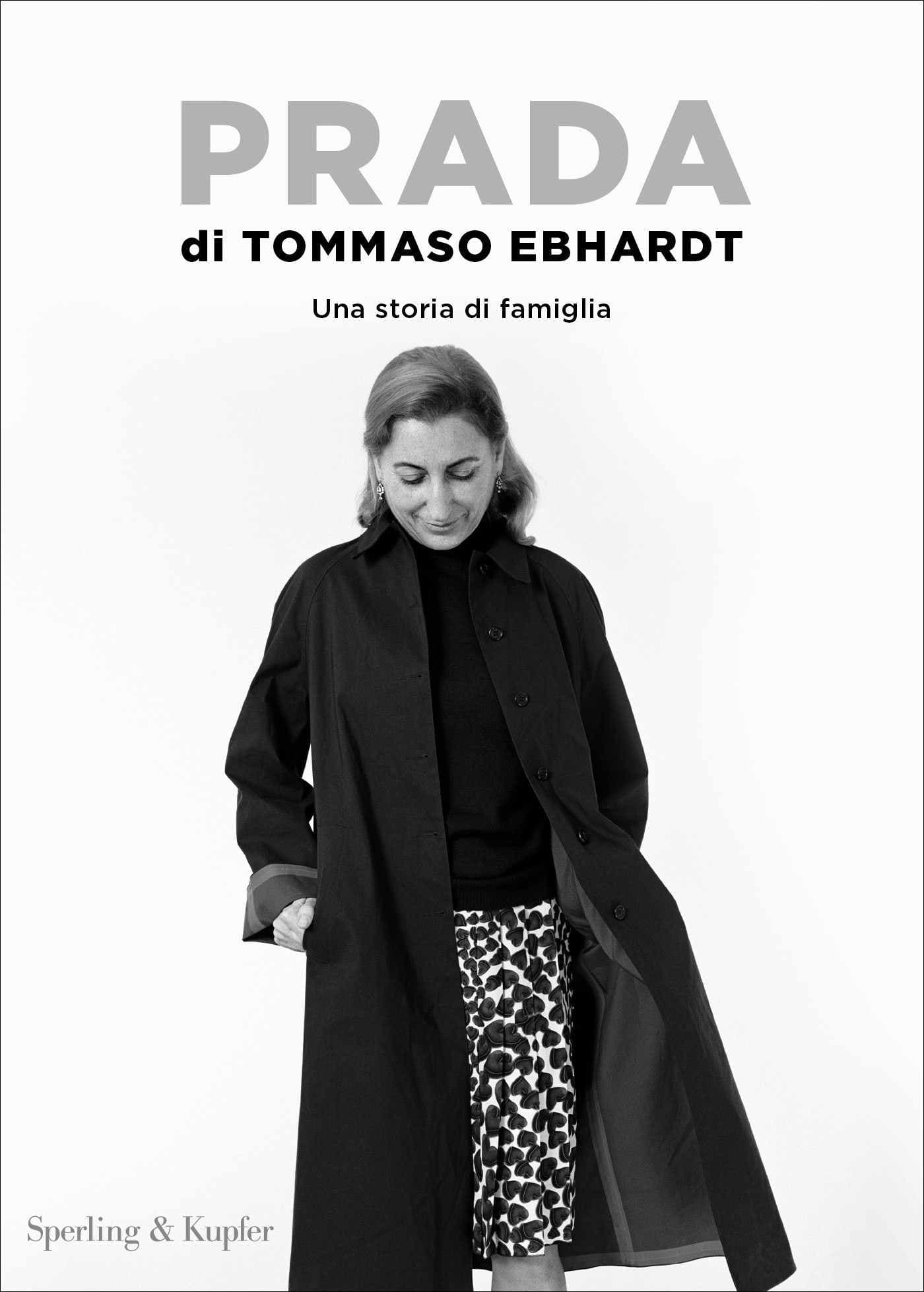
“? What role did the meeting with the energetic Tuscan entrepreneur Patrizio Bertelli play, who became her partner in business and life, and who made vertical integration his mantra and complete control over the manufacturing, distribution, and commercial processes his trademar”
“How did Miuccia Prada transform her grandfather's shop in downtown Milan into one of the most successful luxury brands in the world, controlling some of the most coveted brands, such as Miu Miu, capable of attracting relentless attentio”
“"Trying to know what it means to be someone else is perhaps the most interesting thing in the world. It is one of the reasons that drives me to write books, in addition to the desire to discover what it means to be oneself. I mainly deal with what it means to be me. Perhaps excessively."
EMMANUEL CARRÈRE, Yoga”
“She has dismantled the prevailing aesthetic standards in the world of fashion, introduced disturbing concepts, uprooted clichés, created a new stylistic language for emancipated, free women, transformed an industrial material into a cult object, captured the spirit of the times and put it on the catwalk.”
“He has taken the concept of vertical integration to the extreme, raised the excellence of industrial quality production, and transformed his passion into a team capable of competing for the oldest trophy in the world of sports.”
“Two visionaries find themselves, inevitably, dealing with the most difficult of transitions: taking a company that exploded thanks to the elective affinity of two never-banal minds to compete independently in an increasingly polarized sector around the global luxury giants, while at the same time maintaining their own diversity and originality. Miuccia Prada, the heir to the family brand, and Patrizio Bertelli, her husband.”
“For Christian Dior, the French designer who marked the golden age of haute couture, fashion is an intangible, uncategorizable concept, to define it exactly would be reductive. "It's a ballet, it's the spray of water in the park, the most sublime orchestra of intuitive elegance," Dior said, the great star of the fashion business post World War II, the first designer to be featured on the cover of Time magazine.”
“Patrizio Bertelli from Arezzo is clearly one of them, "a serial entrepreneur," is how one who has worked closely with him charitably describes him. He is one of those who are not afraid to take risks, with a volcanic character far from the politically correct, ready for gut decisions and instant choices, much to the peace of mind of collaborators, accustomed to outbursts and strokes of genius.
Even today, every single bag or shoe from Prada goes through his hands at the bright Tuscan headquarters in Valvigna: he designs it, touches it, smells it, checks every detail and, after going over it with the Lady, if he is convinced, he approves it. From that moment, in no time, it goes into production, as I will discover by visiting the labs where craftsmen in ice-white lab coats with the Prada logo invent new products.”
“Milan was establishing itself as the fashion capital, a cultural phenomenon and industry that generated wealth, liberated the country from the gloomy 1970s and catapulted it into a decade to be lived and enjoyed without thinking too much about tomorrow. Just as Dior's New Look fashion shows in Paris had helped French women emerge from the nightmare of the Nazi invasion with a return to displayed femininity, so on the Milanese catwalks, Italy showed the world its desire to live, consume, and enchant.”
“The fashion industry helps define a collective imagination made of luxury and glamour that crosses the Alps and provides an international stage for the birth of made in Italy, which finds in Milan its nerve center.
It is the Milan where "everything could happen," as the title of the book by Paolo Pillitteri, mayor during the indulgent eighties, says, which would be swept away by Tangentopoli, and re-evaluated in the Berlusconi era.”
“Two years later, she debuted with her first collection, presented in an elegant building behind the Arch of Peace: an unconventional, original, independent designer, completely foreign to the prevailing aesthetics of those years, a avant-garde woman who had already destabilized the luxury world with a black nylon backpack.
Her name is Miuccia Prada, a maternal surname that formally became hers when in the 1980s she was adopted by her aunt Nanda.
About a decade earlier, she had found herself, attracted by the love for beauty, taking over the store in the Galleria opened by her grandfather Mario and then passed on to her mother Luisa and aunt.”
“For the young and rebellious Miu Miu, as they call her at home, entering the family business meant interrupting a youth of political and artistic commitment, among feminist marches and mime courses at the Paolo Grassi school of the Piccolo Teatro.”
“Miuccia's production diversifies thanks to the use of original materials and unexpected combinations. By elevating a nylon backpack to a cult object, she makes her first indelible mark.
And then she goes further: from bags to shoes and clothes, the step is short, especially if you have beside you a fiery and brilliant entrepreneurial partner, with whom she discusses everything, continuously.”
“"It struck me from the first moment: it was so exciting because it brought something completely new to the runway, really strong but at the same time simple," designer Marc Jacobs tells me. "The materials were perfect, the proportions were perfect, the shapes simple but very seductive," he adds, after confessing his boundless admiration for Miuccia.”
“The truth is that Miuccia is different, light years ahead of many other fashionable designers, say her closest collaborators, who have built an almost symbiotic relationship with the Lady, jealously guarding her privacy and sharing her ideas.”
“Prada enters the fashion world as a true outsider.”
“Although the family brand was known and recognized for its traditional and austere elegance, Miu Miu enhances its transgressive aspect, which can be glimpsed in some of the early Prada brothers' bags from the 1920s, shown to me in the archives of the Group hidden in the basement of the Milan headquarters.”
“Suddenly, it becomes essential to have a branded sweatshirt to fit into the right circle. I beg my parents to buy me one, at least one, sweatshirt from Best Company, my only chance to get noticed by the prettier sisters at school. Exhausted by my continuous requests, Mrs. Svensson gives me a beautiful blue sweatshirt with blue lettering, thanks to which I win the heart of the youngest Crema sister, who still puts up with me.”
“The future becomes the present and it promises to be very, very different from what I would have expected in the eighties.
It's hard to dream too much these days. Easier to have nightmares.
Yet these are our times, I have no intention of not fully living them.”
“"I don't like the idea of escaping from the world. Lightening the gloom of the times, yes, but I want to live in the present," explains Miuccia surrounded by a jungle of journalists, curious people, fashionistas, and clients in the hangar of her Foundation.”
“I feel bewildered as if I were at Prada Marfa, a reconstructed store in the middle of the Texas desert, the pop-architectural installation by Elmgreen & Dragset on Route 90 near Valentine, in the deepest States.”
“Prada and, especially, Miu Miu – born in 1993 to satisfy Miuccia's rebellious soul – are the most sought after in the first quarter of 2024 by consumers all over the world, the "hottest brands" of the Lyst index, a global fashion search engine. These are two brands that will withstand during the first months of the luxury crisis induced by the collapse of purchases in China.
What's so special about them?
Is there a substantial difference from other luxury brands?
Is there any truth to it, or am I facing yet another marketing hoax?”
“One is mistaken: I do not care what others watch, it matters to me what to wear.”
“Every morning, when you choose what to wear, you decide what face to show the world, what role you want to play that day, which mask to wear.”
“"It's about freedom, about representing oneself," Miuccia Prada argues in an interview with Vogue Italia. "We should be able to be who we choose to be, always."”
“I search for my view of the world among the boxes; I don't find much except the usual black turtleneck sweater designed in Japan, the black velvet ankle-length trousers, which are the only ones I buy without having to shorten them, and a black jacket to give me a tone.”
“The Lady is right: fashion appeals because we all dream of being beautiful, but we do not want to talk about it as it touches our private life.”
“Miuccia is one of the three richest women in Italy.
According to the Bloomberg Billionaires Index, the Lady and Bertelli have a personal fortune of about 7 billion dollars each, built in less than fifty years, with an exponential acceleration after the listing on the Hong Kong Stock Exchange in 2011.”
“Yet up close, she is a shy lady, petite, with a contagious laugh, surrounded by friends with whom she questions the meaning of things, the future of society, and the role of art. She is super chic without ever being flashy, uses her work to send signals and provocations, and her Foundation to produce food for the mind, especially for the younger ones.”
“For a moment she crosses paths with her son Lorenzo, the designated heir from a stock perspective as well. Between them, there is real complicity and affection; they exchange a few comments about the show that just ended, she quickly caresses his face, and then they are lost in the wave of people following Miuccia to get a moment of her attention.
The Lady is extremely devoted to her children, she is proud of them, listens to them carefully, wonders what is right for their future, how to act as a grandmother: she recently has a granddaughter by Lorenzo, as she mentioned in her latest interviews. Finally, a woman in the family.”
“The new billionaires feel the need to be "reassured" about their status and they do it by flaunting the luxury goods of the most iconic brands, as explained by Bernstein financial analyst Luca Solca.”
“"Luxury is really meant to fill the deep-rooted insecurity of the new rich," said Solca, quoted in an article by Bloomberg Business Week dedicated to the emperor of the sector, "the cashmere wolf", Mister LVMH Bernard Arnault.”
“The coming years will be decisive in shaping the entrepreneurial future of our country; the patriarchs of family capitalism are inevitably forced to hand over control due to age reasons, and the activities they have created are often a direct expression of their personalities: drawing their future, once the founders are no longer there, risks becoming a matter of life or death.
Not to mention the scale. Size does matter, indeed. The "small is beautiful" no longer exists, and in our country, in many sectors - luxury and fashion being among the main ones - we do not have companies capable of competing in size with the world leaders.”
“The possibility that Italy, where about 80% of the world's luxury products are made, could become a French province is real. Just take a tour of the industrial districts of the sector, from Tuscany to Puglia, to find subcontractors who produce exclusively for the French cousins.”
“Listing the number of brands that have ended up in French hands becomes a painful count for those who care about the entrepreneurial future of our country: Gucci, Brioni, Pomellato, and Bottega Veneta are owned by Kering di François Pinault, the archrival of Arnault, who recently also targeted Valentino, acquiring 30% with the option to buy the rest of the shares in the coming years. Bulgari, Loro Piana, Fendi, Acqua di Parma, Emilio Pucci are the Italian brands in the LVMH portfolio, which recently also bought a stake in the holding company of Remo Ruffini that controls Moncler.”
“Prada wants to believe in its own future and is working to transform a company shaped around Miuccia and Bertelli into a group capable of remaining independent with its brands, Church’s and Car Shoe, in addition to Prada and Miu Miu, as well as the Marchesi patisserie.
The time I met him, to my question whether he wanted to sell, Bertelli, interviewed for Bloomberg, replied indignantly: "I have never sold anything! I still have the bicycle that my uncle left me."
That day, in 2021, demonstrating how much he thought about succession, Bertelli candidly admitted that his eldest son Lorenzo would take over the reins of the Group.”
“Miuccia and Bertelli have always been portrayed as the yin and yang: the brilliant creative, a refined intellectual lent to the creation of luxury and fashion, who meets the gruff industrialist with an exceptional intuition akin to the true animal spirit of capitalism.
I will discover that this is an oversimplification of the complexity of a couple where creativity and business blend, roles change and subvert depending on the moment.
That Bertelli has an irascible character is beyond question, capable also of temper tantrums and acts befitting a patriarchal leader of the last century, such as when he smashed the headlights of an employee's car who had parked in the wrong spot with a hammer.
But he is also a creative who sketches designs, and Miuccia has a knack for business: among the two there is an elective affinity – I am told by some of their closest collaborators – which also thrives on lively discussions, going beyond the tensions of a couple's relationship marked by inevitable separations and embraces, always present in the decisions that matter.”
“"The dialogue," as Miuccia says in Pradasphere, the volume derived from the exhibition which represented the timeline of the Prada world, "creates authenticity."
The lady believes in confrontation, whether it's about fashion, business, or art and their Foundation.”
“No comfort zone is allowed, as in the tradition of all those who have the courage, and perseverance, to change things.
Nothing is ever given up.”
“It affects me similarly to what Raf Simons must have felt in October 1989 when he attended Martin Margiela's Spring-Summer 1990 collection show, an event that had a fundamental influence on his life.”